Roblox turned its built-in AI assistant into an agent that plans, assembles, and tests games itself
Roblox enhanced its built-in AI assistant: it can now analyze game code, propose step-by-step plans, generate 3D objects, and self-verify results. Roblox…
AI-processed from TNW; edited by Hamidun News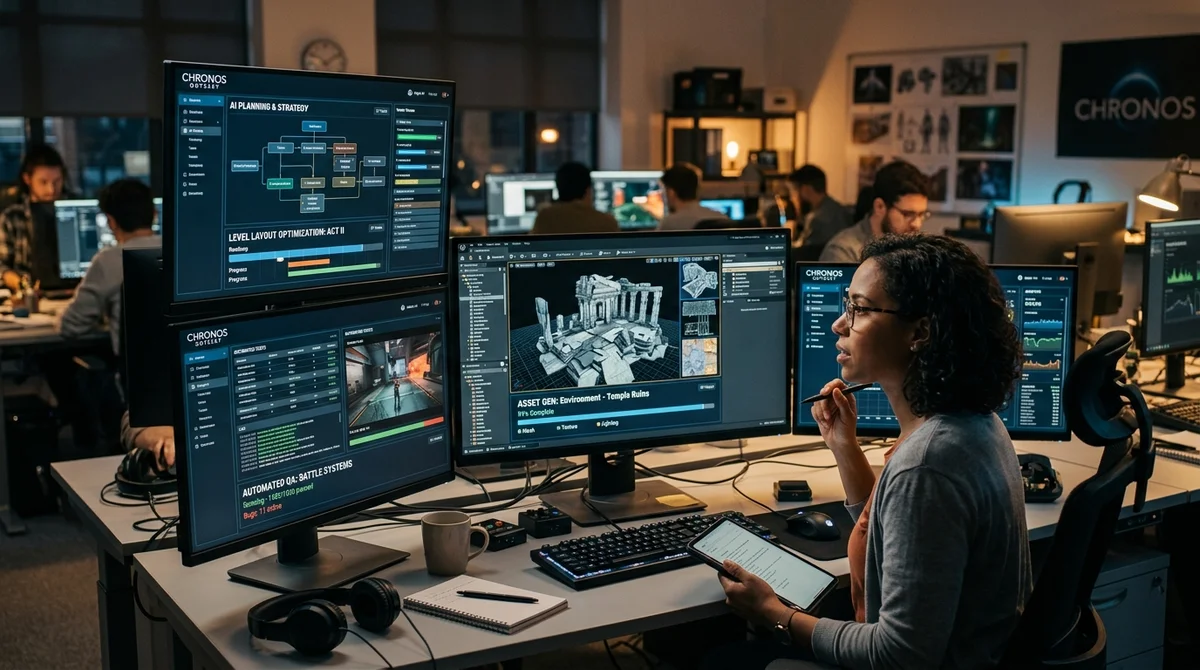
Roblox has expanded its built-in AI assistant to the level of a working agent: it no longer just suggests code, but can analyze a project, propose a plan of action, generate objects, check results, and refine them based on test feedback. For a platform where a huge portion of creators come without deep engineering background, this represents a notable shift from autocomplete mode to an almost full-fledged development co-author. The main innovation is called Planning Mode.
Instead of responding to a single request with a single code snippet, the assistant first analyzes the existing codebase and the game's data model, then asks clarifying questions and transforms the discussion into an editable action plan. The developer can review this plan, refine it, and only then run the implementation. Essentially, Roblox is attempting to turn the helper from a code fragment generator into a system that knows how to think about the approach to a task first.
This is an important distinction: it's one thing to ask AI to write a function, and quite another to entrust it with designing a solution within an already live project with dependencies, constraints, and accumulated logic. The second line of updates concerns content. The Procedural Models tool will allow creating 3D objects described not by a static mesh, but by parameters in code.
If a developer needs, say, a bookshelf, they can specify the number of shelves, height, materials, and other properties through a text query, and then change them without manual remodeling. Roblox is betting not just on image generation or decorative assets, but on parametric design, where an object retains internal logic of form. A staircase understands the relationship between height and steps, a table—between tabletop and supports.
For indie developers and small studios, this can significantly reduce the time spent creating variations of the same object. Separately, the company is adding Mesh Generation—generation of fully textured 3D objects directly into the game world from text description. This feature is built on top of the basic Cube model.
In February 2026, Roblox already demonstrated 4D-generation based on Cube: objects gained not just form, but interactivity, so they behave correctly within the game rather than remaining static props. According to the company, at the early access stage, developers generated over 160 thousand objects, and projects using 4D-generation showed a 64 percent increase in average playtime. This is one of the few examples where Roblox ties AI tools not only to developer convenience but also to a measurable effect on player engagement.
The most important part of the update is the so-called self-correcting loop. The assistant can now test individual aspects of the game, find problems, propose fixes, and return the check results back to the next planning cycle. Roblox calls this agentic loops: recurring cycles of planning, execution, testing, and refinement with gradually decreasing human involvement.
Next, the company wants to give multiple AI agents the ability to work in parallel in the cloud, not just within a local Studio session. In parallel, Roblox Studio has gained a built-in MCP client through which the assistant can connect to external services and tools like Claude, Cursor, and Codex. The long-term goal, which Roblox has been discussing since opening the Cube model in March 2025, looks ambitious: a developer describes a game in natural language, and the system helps assemble assets, environment, code, animations, and interactive behavior into a single whole.
The business logic here is also clear. Roblox operates at a scale that allows for significant investment in such tools: in the fourth quarter of 2025, the platform's daily audience reached 144 million users compared to 85 million a year earlier, monthly audience grew from 280 to 380 million. Revenue for 2025 was 4.
9 billion dollars, 36 percent more than a year earlier, and the forecast for 2026 is in the range of 6–6.2 billion dollars. Total Robux purchases in 2025 reached 6.
79 billion dollars. Against the backdrop of the vibe coding boom and a sharp lowering of the entry threshold for game development, Roblox is trying to solve two problems at once: give more creators tools to launch projects and avoid drowning in a stream of raw, low-quality content. That's why the bet is not on one-time generation per request, but on a more structured process with planning, verification, and iterations.
For the market, this is a signal that the next stage of AI tools is not just helpers that supply code or draw assets on demand, but systems capable of taking on a piece of the production process. If Roblox brings such an approach to stable quality, solo authors and small teams will be able to assemble playable projects faster and spend less time on routine. But the main question remains open: will the platform get genuinely better games or just more games.
The answer to that seems likely to become clear within the coming year.
Want to stop reading about AI and start using it?
AI News is a curated feed of AI/tech news. Hamidun Academy teaches you to use AI systematically in your work.