StudyAI: How Generative AI Undermines Trust in Texts, Voices, and Videos Online
Generative AI no longer just helps create deepfakes — it erodes the very notion of digital proof. StudyAI explores two key effects of this new environment…
AI-processed from Habr AI; edited by Hamidun News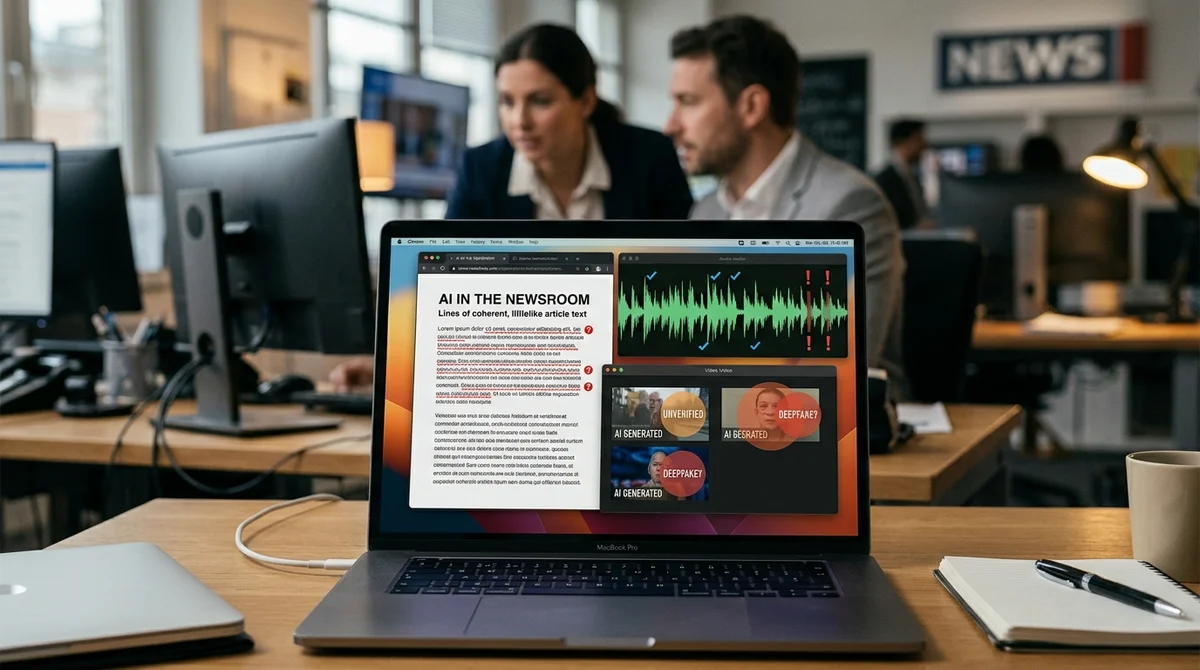
Generative AI is rapidly changing not only how content is produced, but also the fundamental sense of what can be trusted online. If the main threat used to be crude fakes and editing, the problem now runs deeper: text, voice, and video increasingly look credible by default, which means the internet is losing its status as a medium where evidence can be verified with one's own eyes. The article's author proposes viewing this not as a local problem of deepfakes, but as a continuation of the old media logic that Marshall McLuhan described through the influence of the medium on how a message is perceived.
The internet has made information distribution instant, emotional, and poorly managed. Against this backdrop, traditional authorities have weakened, and any content can easily be stripped of context and embedded in a new story. Even before the rise of generative models, the network was already fertile ground for disinformation, and with the arrival of accessible AI, the scale and speed of this problem has grown exponentially.
A good example is recontextualization: when real video, photo, or quote is transferred to a foreign situation and made to work for a new, false interpretation. Formally the material may be authentic, but its meaning is now fake. One of the key effects of the new era is the so-called "liar's dividend."
The more realistic synthetic media becomes, the easier it is for a person to reject even genuine evidence, recording, or testimony by claiming it is a neural network fake. The flip side of the same problem is "apathy to truth." When a user knows that almost anything can be faked, their motivation to work through the details diminishes.
Instead of fact-checking, a protective mode kicks in: take nothing seriously, scroll further, and don't waste energy distinguishing truth from imitation. This is dangerous not only for news, but also for law, reputation, political communication, and public trust as a whole. The paradox is that the more perfect the generative tools become, the cheaper it is to produce not just lies, but also the rejection of truth.
Text appears particularly vulnerable. Video and audio can still be checked against the biometric signs of a living person: microscopic skin color changes related to breathing and blood flow, or vocal apparatus fluctuations that are difficult to model correctly. These methods are not perfect, but they at least point the way toward technical protection.
With text, the situation is more complex: if a model writes coherently, confidently, and in the right style, a person has almost nothing to rely on except external context, publication history, and author reputation. That is why the text environment may be the first to enter a phase where distinguishing human from machine without additional metadata becomes practically impossible. From this stems the growing risk to education, expertise, and public discourse: synthetic articles, reviews, scientific papers, and comments will increasingly be perceived as ordinary background.
Yet the material is not reducible to pessimism. Technological progress creates both a threat and tools to respond to it. The logic here is simple: fighting AI fakes will probably require using AI and related verification systems.
This is not about a magic button, but about a constant race between attack and defense. Some will improve generation, others will work on detection, content provenance verification, biometric markers, cryptographic signatures, and trust infrastructure. There will be no absolute protection, but the article does not predict a complete collapse of reality: society has adapted to new media environments before, changing information consumption habits and standards of credibility.
Users will probably have to relearn digital hygiene, and platforms will need to build content origin verification not as an option, but as a basic function. The main conclusion is that the AI problem is not just that it can create fakes, but that it blurs the very idea of digital evidence. In the coming years, value will lie not so much in the words, images, or recordings themselves, but in the verified context of their origin: who published it, where it was created, whether the chain of origin can be verified, and whether there are independent signs of authenticity.
Otherwise, the internet risks becoming an environment of total doubt, where truth technically exists but socially ceases to work.
Want to stop reading about AI and start using it?
AI News is a curated feed of AI/tech news. Hamidun Academy teaches you to use AI systematically in your work.