How Google DeepMind and Competitors Are Transforming Music: Five AI Services for Track Generation
Music neural networks have quickly evolved from demos into working tools: today they can compose songs from text prompts, assist with arrangement, and…
AI-processed from Habr AI; edited by Hamidun News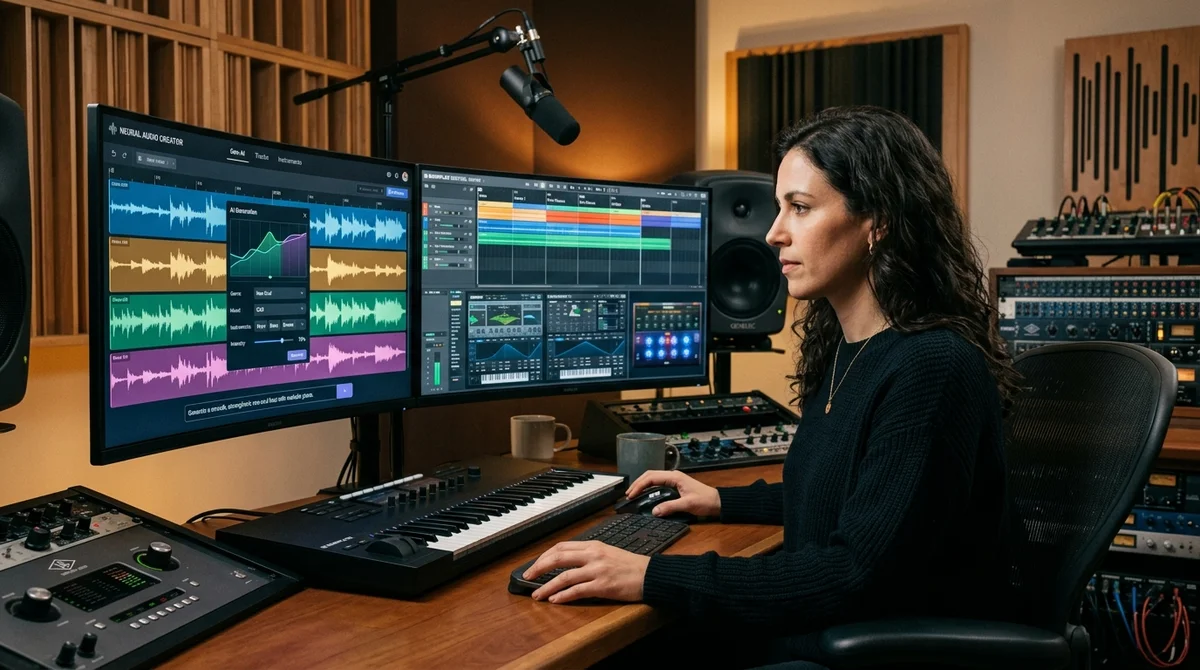
Music has entered a stage where an idea no longer needs to pass through a studio, expensive software, and years of practice before becoming a finished composition. It's enough to describe a mood, genre, tempo, or narrative, and a neural network will assemble a song with melody, vocals, arrangement, and clear structure. This doesn't cancel out the role of the musician, but it sharply lowers the barrier to entry and expands the circle of those who can release their own tracks.
The focus here is on five services that have already moved beyond laboratories and early demos. These are not experimental toys, but products used by millions of people around the world: from hobbyists making music for themselves to bloggers, marketing teams, and indie developers. Some tools allow you to get an almost finished song from a single text prompt, others are better suited for sketches, sound exploration, or quick background music production.
The main change here is not only technological but cultural. Previously, between conception and release there was almost always a chain of a composer, arranger, vocalist, sound engineer, and studio time. Now a significant part of this chain can be compressed into a few minutes of prompt work and several iterations of editing.
For professionals, it's a way to speed up the draft stage and test ideas without unnecessary costs; for beginners, it's a chance to enter music without academic training. Notably, the market has long since moved beyond small startups. Among notable players are projects backed by people with experience from Google DeepMind, solutions that have gained recognition as virtual composers, and services that ultimately proved interesting to major technology companies.
This is a good marker of maturity: AI-assisted music generation has stopped being a niche hobby for enthusiasts and entered the field of big business, where scale, licensing, output quality, and convenience of everyday use matter. At the same time, the effect of such tools is not limited to generating a track for the wow factor. They are already being used to create jingles, demos, musical sketches, soundtracks for short videos, prototypes of advertising spots, and content for social networks.
The shorter the production cycle and the lower the budget, the more noticeable the advantage of AI: you can quickly run through dozens of options, refine the mood, restructure, or change vocal delivery without re-recording. This is why the new wave of music neural networks is especially interesting to those working at the intersection of content, product, and marketing. But with accessibility comes a new set of questions.
The easier it is to create a song from a description, the more acute the issues of copyright, training data transparency, and result predictability become. The user gets speed, but often encounters standardization, limited control over nuances, and dependence on the model's internal logic. Therefore, the value of a service today is determined not only by the quality of the first generation, but also by how convenient it is to refine the material, separate tracks, change structure, and achieve the desired sound character.
It's also important how the role of the author themselves is changing. If creativity used to often begin with an instrument, now it increasingly begins with task formulation: you need to be able to describe a reference, emotion, rhythm, dramaturgy, and the track's place in a specific product. Against this backdrop, the prompt becomes part of musical work, and the skill of selection and editing is no less important than the original idea.
Those who will win are not those who press the button first, but those who can turn generation into a managed process. The conclusion is simple: AI doesn't take the humanity out of music, but rather redistributes access to creative tools. The best services from this five are valuable not because they completely replace the author, but because they make music production faster, cheaper, and more accessible.
For the industry, this means growing competition and new disputes about authorship; for users, it's a rare moment when technology truly gives more right to expression, rather than just another interface.
Want to stop reading about AI and start using it?
AI News is a curated feed of AI/tech news. Hamidun Academy teaches you to use AI systematically in your work.