Palantir and Thales Compete for FAA AI Tool for Air Traffic Management
FAA launched a competition between Palantir, Thales and Air Space Intelligence for a new AI tool for air traffic management. It's a decision support system…
AI-processed from Bloomberg Tech; edited by Hamidun News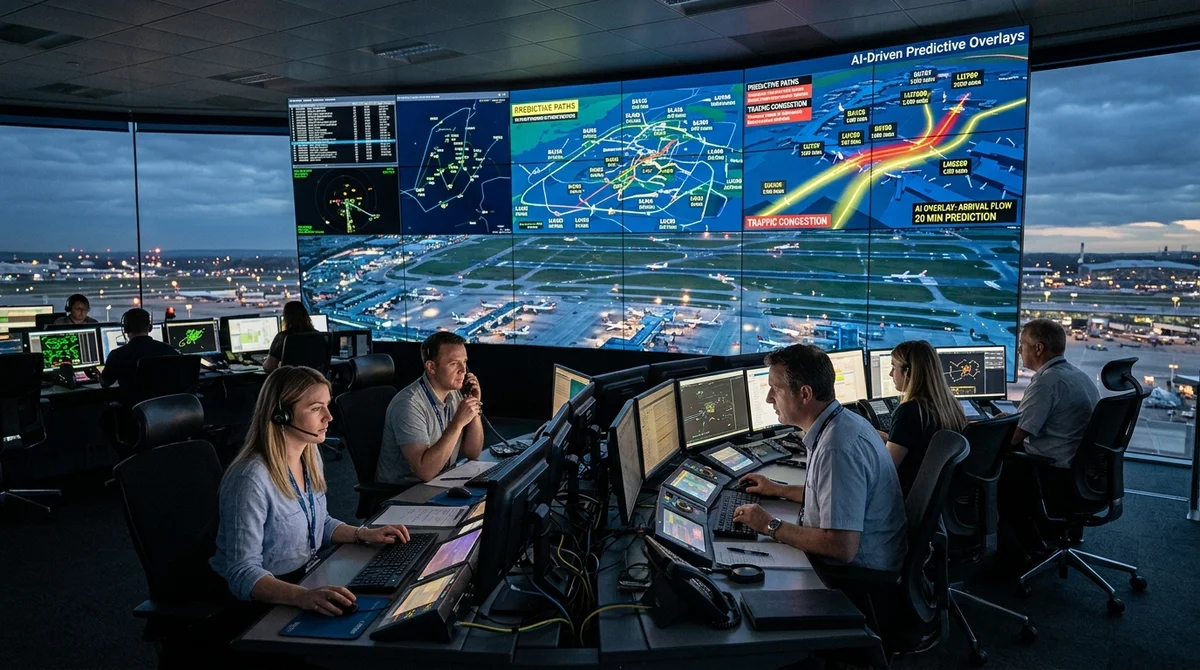
FAA launches a competition between Palantir, Thales, and Air Space Intelligence for a key AI tool for air traffic management, and the stakes in this story are far higher than in a typical IT contract. If the regulator chooses a successful solution, the U.S.
aviation system could gain a new layer of forecasting and coordination where today weather, airport congestion, and tight schedules too often turn into delays, cancellations, and cascading failures across the entire network. According to available information, the U.S.
Federal Aviation Administration has engaged Palantir Technologies, Thales, and Air Space Intelligence in competition for a new artificial intelligence-based air traffic management tool. This is not a public chatbot for passengers, but an internal system designed to help better understand the state of air traffic and make operational decisions faster. The very format of a competition is important in itself: FAA is not betting on a single vendor in advance, but comparing different technological approaches, experience with critical infrastructure, and the ability to deploy solutions in an environment where the cost of error is particularly high.
For FAA, such a system looks like a pragmatic investment. Air traffic management in the U.S.
depends on a vast number of variables: weather conditions, specific airport loads, route restrictions, airline schedules, runway availability, and numerous local factors that change rapidly throughout the day. Even when dispatchers and operators have sufficient data, it must still be synthesized into a clear picture and converted into an action plan. Therefore, AI here is viewed more as a decision support system: it can highlight bottlenecks in advance, assess flow redistribution scenarios, help with delay forecasting, and reduce reaction time to disruptions without removing the human from the control loop.
The competition participants themselves demonstrate well what exactly the regulator might expect. Palantir is known for platforms that work with large datasets and complex analytics in government and corporate projects. Thales has worked for decades in aviation, defense, and safety and navigation-related systems.
Air Space Intelligence specializes in software tools for aviation operations and real-time optimization solutions. In such a lineup, FAA is essentially comparing three strengths: data integration, industry expertise, and narrower product specialization. For the regulator, this is a logical way to understand which approach will deliver the greatest effect not in a presentation, but under real network loads.
FAA's interest in such tools reflects a broader shift: artificial intelligence is increasingly viewed not as a showpiece technology, but as a working layer for mission-critical processes. In aviation, this is particularly notable because the industry simultaneously depends on precision, resilience, and response speed. Building new airports, expanding runways, or dramatically increasing staff quickly is not feasible, but improving the quality of forecasting and coordination through software is far more realistic.
This is exactly why regulators, airlines, and technology vendors are increasingly testing tools that can not only collect data but also propose actions before a problem escalates into a large-scale operational crisis. The key takeaway is that FAA already views AI not as an experiment on the periphery, but as a candidate for the role of an infrastructure tool. If the competition leads to an operational deployment, the winner of the tender is not the only one who benefits: the entire U.
S. air traffic system could gain a more predictable and resilient management model. But the decisive factor will not be the well-known name of a participant, but the ability to prove reliability, transparency, and practical utility under real aviation loads.
It is at this stage that it will become clear whether the market is ready to offer FAA not a beautiful demonstration, but a tool for daily operations.
Want to stop reading about AI and start using it?
AI News is a curated feed of AI/tech news. Hamidun Academy teaches you to use AI systematically in your work.