Three OpenAI executives depart amid Sora shutdown and wind-down of side projects
OpenAI continues a major restructuring: on April 17, 2026, the company simultaneously lost Kevin Weil, Sora head Bill Pebbles, and enterprise CTO Srinivas…
AI-processed from TNW; edited by Hamidun News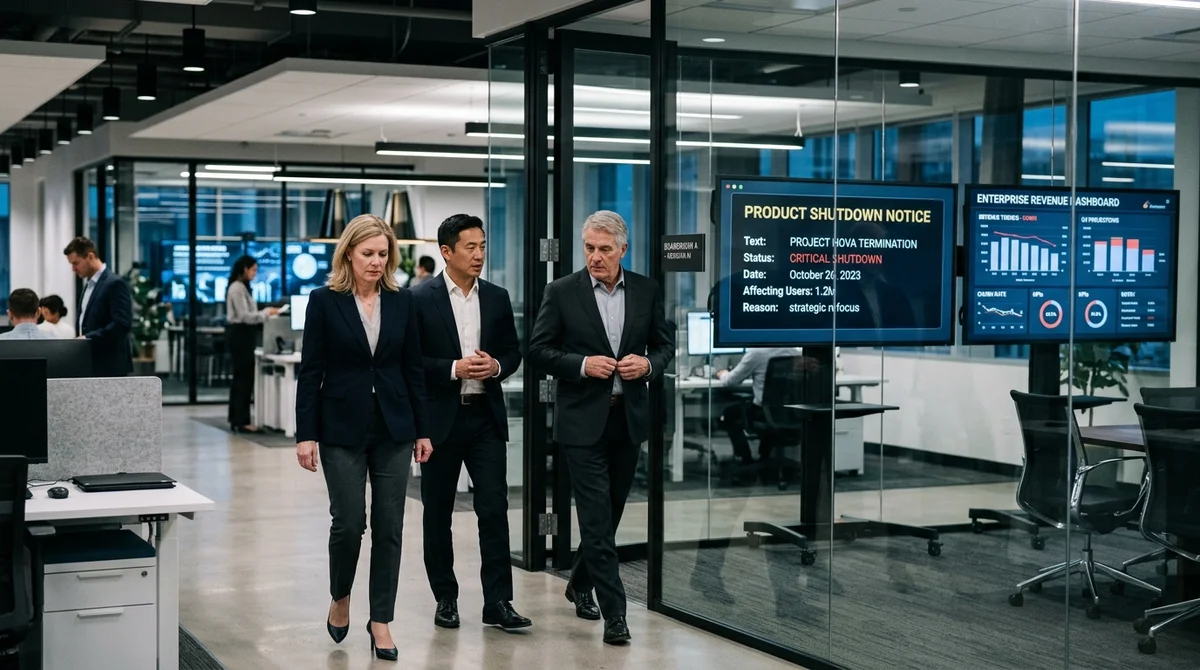
OpenAI is entering another phase of harsh restructuring: on April 17, 2026, three notable executives simultaneously left the company, and shortly thereafter it permanently shut down the user-facing version of Sora and began dismantling research initiatives outside its main revenue stream. For the market, this is not simply a series of personnel news. It is a sign that the creator of ChatGPT is increasingly transforming from a laboratory of ambitious experiments into a company that subordinates almost all decisions to a single goal—growth of corporate revenue.
Three departures were announced simultaneously: former product director Kevin Weil, Sora head Bill Pebbles, and CTO of enterprise applications Srinivas Narayanan. Weil joined OpenAI about two years ago from Instagram, where he was responsible for product, and subsequently led OpenAI for Science—a division that worked on applying AI to science and biomedicine. A day before announcing his departure, this division released GPT-Rosalind, a model for research in life sciences and drug development.
Now OpenAI for Science no longer exists as an independent structure: its team is being distributed across other research groups. Pebbles was one of the key people who assembled Sora from scratch. Narayanan spent three years helping bring ChatGPT and API to market and scaling the applied products engineering team from roughly 40 people to a large business-critical unit.
These departures are difficult to separate from the company's broader pivot. Inside OpenAI, some non-core initiatives are already being called side quests—beautiful but expensive offshoots from the main business. The most notable example is Sora.
The web and mobile versions of the service were shut down on April 26, 2026, and the API is scheduled to close on September 24, 2026. The product at its peak reached roughly 1 million users, then dropped below 500 thousand and cost the company approximately 1 million dollars per day. An additional pressure factor was intellectual property claims from the Motion Picture Association.
Against this backdrop, closing Sora looks not like a rejection of the idea of generative video itself, but as an acknowledgment that OpenAI failed to make the product's economics sustainable. In parallel, the company is winding down more research-oriented side tracks. Formally, OpenAI for Science is not being shut down but decentralized—that is, spread across other teams.
In essence, this signals the end of the separate initiative under which Weil was hired. The logic is understandable: OpenAI is concentrating on ChatGPT and API—those products that are already capable of scaling monetization in the corporate segment. The higher the computation costs and the stronger the competitive pressure, the less space there is inside such a company for long experiments without a direct link to revenue.
Against this backdrop, the triple departure looks not like coincidence but as a continuation of a two-year exodus. Out of 11 OpenAI co-founders, only Sam Altman and Greg Brockman remain at the company. Over the past two years, Ilya Sutskever, Mira Murati, Bob McGrew, John Schulman, Barret Zoph, and other executives who defined early OpenAI identity have left.
In 2025 alone, the company lost at least 12 senior executives. Some talent moved to Anthropic, some to Google DeepMind and Meta Superintelligence Labs, some to new startups. Reasons varied: from ethical questions around the US Department of Defense contract to the feeling that work was increasingly shifting from major research bets to operational polishing of ChatGPT for Microsoft and corporate clients.
The business context makes this choice understandable, but no less risky. OpenAI's monthly revenue reached approximately 2 billion dollars, annual run rate exceeded 25 billion, and in April 2026 the company closed a funding round of 122 billion dollars at a valuation of 852 billion. ChatGPT has over 900 million weekly active users, and the enterprise direction already generates over 40% of revenue and could match consumer business by the end of 2026.
But alongside this, OpenAI expects approximately 14 billion dollars in losses on 25 billion in revenue in 2026, and aggregate expenses through 2029 are estimated at 115 billion. Simultaneously, Anthropic, Google, and Meta are intensifying pressure: Anthropic already has comparable revenue scale, Google is embedding Gemini in the corporate stack, and Meta is actively poaching former OpenAI researchers. The main conclusion is straightforward: OpenAI is not falling apart, but rapidly changing its nature.
The company that symbolized the era of generative AI as a research vanguard is increasingly becoming a machine for converting market leadership into predictable corporate revenue. Closing Sora, dismantling OpenAI for Science, and the departure of people who built these initiatives show that inside the company, what matters now is not the breadth of ambitions but discipline around revenue-generating products. For clients, this may mean more stable and applied services.
For the industry—fewer beautiful side experiments and more fierce competition for the corporate market.
Want to stop reading about AI and start using it?
AI News is a curated feed of AI/tech news. Hamidun Academy teaches you to use AI systematically in your work.