Sony AI: Robot Ace Defeats Elite Table Tennis Players by Official Rules
Robot Ace from Sony AI won three out of five matches against elite table tennis players by official rules. Against professionals, the machine fell short…
AI-processed from Guardian; edited by Hamidun News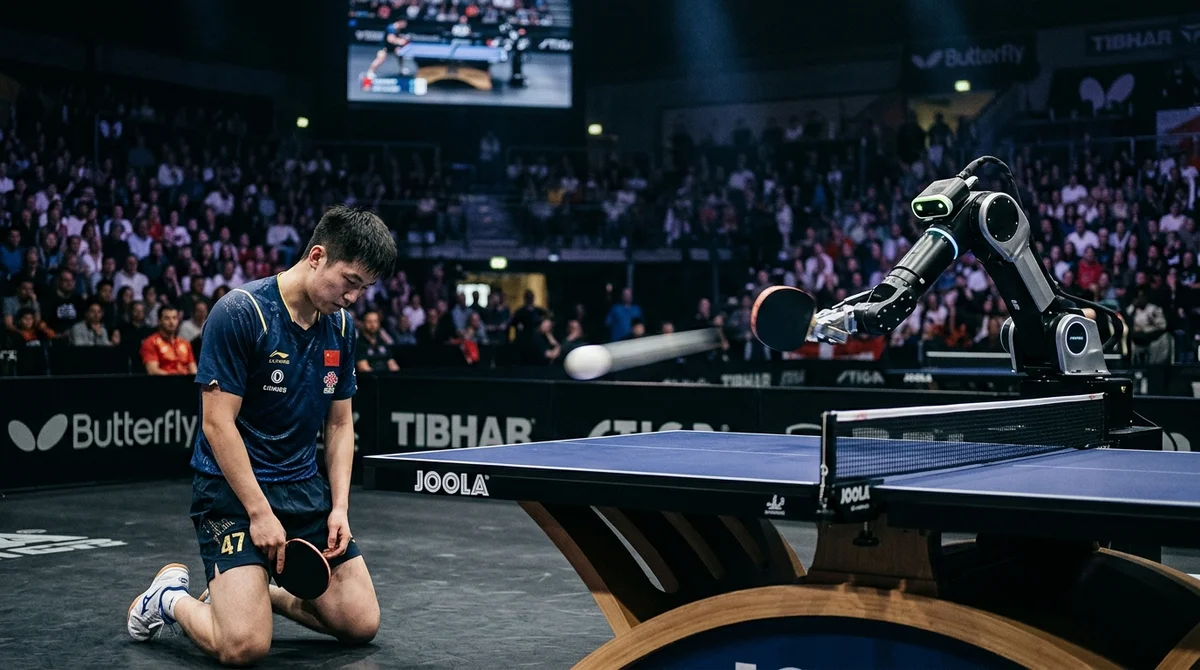
Sony AI's robot Ace has demonstrated for the first time that a machine can not only rally with a human, but win official matches against elite-level players in one of the fastest and most demanding sports. According to the demonstration data, the system played five matches under official rules and won three of them against elite opponents. However, against professionals, the results were more modest: Ace lost both matches and managed to win only one game out of seven.
This is an important caveat: we're not yet talking about complete superiority over the world's strongest athletes, but about a significant leap in the level of machine autonomy and game intelligence. It's also important to note that these were official matches under the rules of the sport, not demonstration rallies where the robot knew the pace or type of serve in advance. In such systems, results often look impressive as long as conditions are tightly controlled.
Here, the value lies in the fact that the machine was placed in the format of an understandable sports competition with points, games, and full reaction to the opponent's actions. Even partial success in such a framework is usually considered by the industry to be stronger evidence of progress than an impressive laboratory demonstration. For robotics, table tennis is an extremely demanding test of technological maturity.
It's not enough to simply move a manipulator precisely along a predetermined trajectory. The robot needs to instantly see the ball, assess its speed and spin, calculate the point of impact, choose the type of response, and synchronously manage mechanics in fractions of a second. Any delay in sensors, computation, or actuators immediately results in a lost rally.
Therefore, victory in official matches is valuable not as a sports record in itself, but as an indicator that AI and hardware have learned to work together in a very demanding real-world feedback loop. Sony AI's project called Ace is also interesting because it moves the conversation about sports robots out of the laboratory and into a more applied domain. In chess, Go, or esports, machines have long been able to surpass humans because they operate in a digital environment with full access to the game state.
Table tennis is different: the environment is physical, opponent behavior is not entirely predictable, and an error is measured not in abstract model points, but in a miss of a real ball. This is precisely why such systems are usually viewed as a demonstration of future capabilities for broader tasks—from industrial automation to service robots that will need to react quickly to dynamic situations near people. At the same time, Ace's results also show the current ceiling of the technology.
The robot is already capable of defeating very strong players, but against professionals, the human advantage persists. This means the main gap is not only in stroke speed or mechanical precision, but in the ability to consistently adapt to variable, cunning, and psychologically complex play at the highest level. For the next step, such systems will probably need even better trajectory prediction, more flexible strategy during rallies, and more robust decision quality under pressure.
Otherwise, the robot will be good in isolated scenarios, but won't be able to impose consistent competition where a human constantly changes rhythm, spin, and game pattern. The main conclusion here is not that robots are "taking over sports." What's far more important is this: Sony AI has shown a working example of a machine that can compete with humans under official rules in a fast physical sport and achieve real victories.
This is a milestone for robotics because it brings AI systems closer to a world where you need not only to calculate, but to see, move, react, and make decisions in real time.
Want to stop reading about AI and start using it?
AI News is a curated feed of AI/tech news. Hamidun Academy teaches you to use AI systematically in your work.