US Seeks to Restrict China's Access to Chip Manufacturing Equipment via MATCH Act
The US is advancing the MATCH Act, a bill that could tighten export controls on chip manufacturing equipment and limit supplies to China. Beijing believes…
AI-processed from TNW; edited by Hamidun News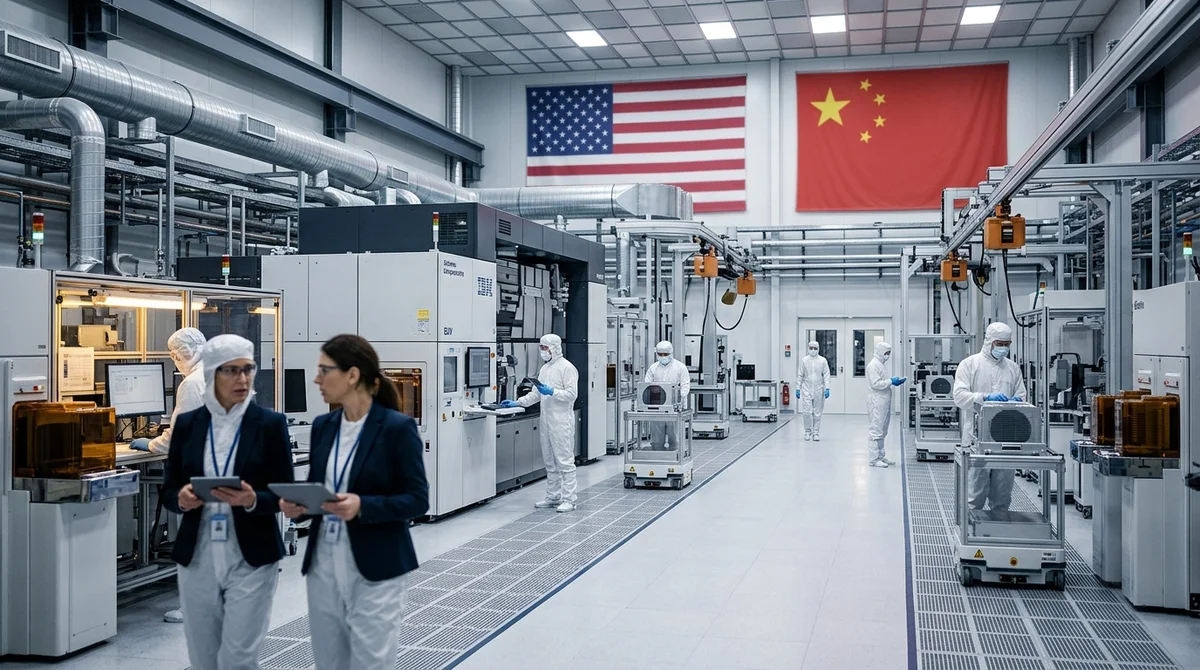
Washington and Beijing are once again intensifying their struggle for semiconductors, and this time the dispute is not about finished chips, but about machines, systems, and other infrastructure without which these chips cannot be produced at all. China's Ministry of Commerce has warned that the MATCH Act being pushed through the US Congress could not only intensify pressure on Chinese manufacturers, but also destabilize the entire global supply chain in the industry. For the market, this is a signal: technological rivalry between the world's largest economies increasingly influences the basic rules of the global industry.
The legislation in question is the Multilateral Alignment of Technology Controls on Hardware, or MATCH Act. Its idea is to synchronize export restrictions on critical equipment and technologies with US allies in order to block China's workarounds through other jurisdictions. For American lawmakers, this is an attempt to make the restrictions regime tighter and more predictable: if Washington limits supplies, and friendly countries continue to sell similar equipment, the effect of the measures is reduced.
China, on the other hand, sees this as a step toward even greater market fragmentation, where access to key manufacturing tools is determined not only by commerce, but by geopolitical loyalty. This is precisely why China's Ministry of Commerce responded so sharply. The department stated that the initiative could seriously violate the international economic and trade order, as well as undermine the stability of the global semiconductor supply chain.
This is no accident: the production of modern chips depends on a long network of specialized suppliers, where different countries are responsible for different stages — from design and materials to lithography, etching, packaging, and testing. Even targeted restrictions in such a network rarely remain targeted. When one critical node drops out of the chain, the consequences quickly spread to adjacent markets, delivery times, and production costs.
Over the past few years, semiconductors have completely transformed from a technical category into a strategic resource. They are needed not only for smartphones and data centers, but also for automobiles, defense systems, industrial automation, telecom infrastructure, and AI accelerators. That is why the dispute over equipment is particularly sensitive.
If restrictions concern not finished microchips, but the very means of production, companies' ability to expand capacity, modernize lines, and maintain competitiveness for years to come is at stake. For China, this is a question of technological sovereignty. For the United States, it is a question of control over how quickly a strategic competitor can narrow the gap in advanced manufacturing processes.
At the same time, the risks extend far beyond the bilateral relationship between the US and China. Any tightening of the rules forces manufacturers to reconsider logistics, contracts, service routes, and investment plans. This applies not only to direct supplies of new equipment, but also to access to components, software updates, service, spare parts, and engineering support, without which complex equipment quickly loses efficiency.
Companies from third countries find themselves between the demands of regulators and the interests of clients, and the market gets another round of uncertainty. In such an environment, businesses more often build additional costs into prices, take longer to conclude deals, and are more cautious with expansion investments. For an industry that already lives with long cycles and enormous capital expenditures, this means slower adaptation and a higher price for mistakes.
The main conclusion is simple: the struggle for technological leadership is increasingly less like ordinary trade competition and increasingly more like a restructuring of the entire architecture of the global electronics industry. If MATCH Act moves further and is supported by coordination with US allies, pressure on China will intensify. But at the same time, the probability will also grow that the global semiconductor industry will become less unified, less flexible, and more expensive for all participants — not only for those against whom the restrictions are directed.
Want to stop reading about AI and start using it?
AI News is a curated feed of AI/tech news. Hamidun Academy teaches you to use AI systematically in your work.