OpenAI releases GPT-Rosalind for biology: capabilities and limits of the new model
OpenAI unveiled GPT-Rosalind, a specialized model for biology and pharma. Alongside it came a Codex module providing access to 50+ scientific databases and…
AI-processed from Habr AI; edited by Hamidun News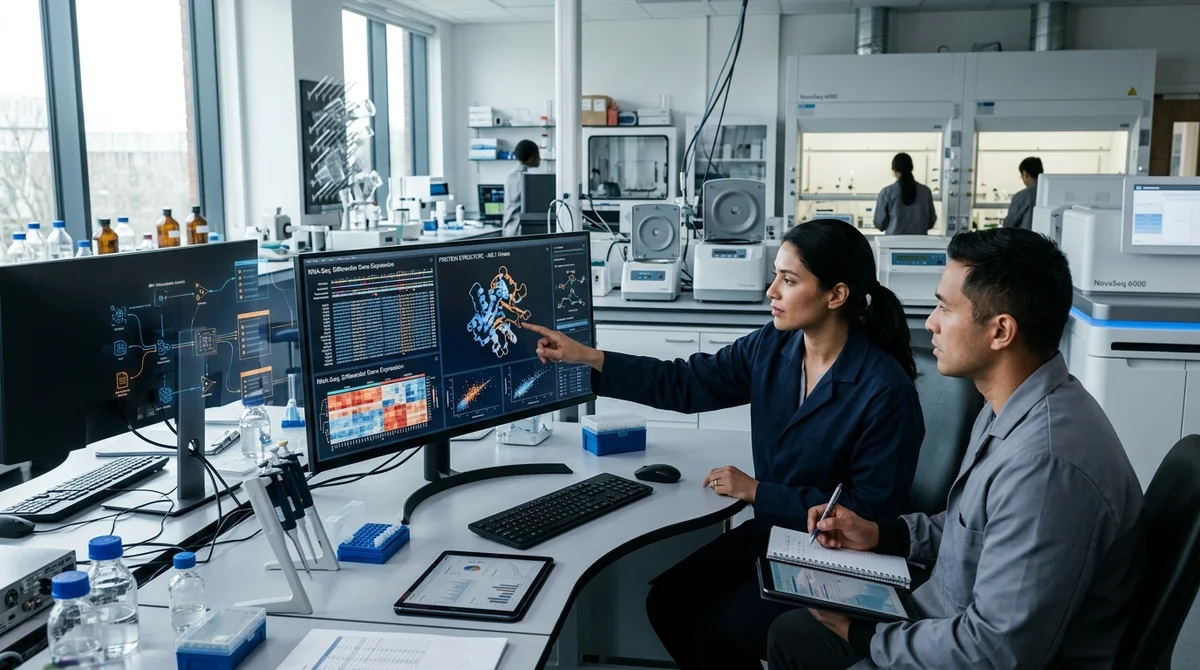
OpenAI is attempting to position itself not simply as a supplier of general LLMs, but as an infrastructure layer for biological research. GPT-Rosalind appears not as a magic button for discovering new drugs, but as a tool designed to reduce the most expensive aspect at the early stage: time spent on data collection, hypothesis formulation, and planning subsequent experiments. The motivation is clear.
In applied biology, and especially in therapeutic mRNA development, there is still too much manual assembly of the process. Researchers must simultaneously account for how well the sequence will translate, how long it will persist in the cell, and whether it will trigger an unwanted immune response. Individual building blocks for such work already exist—for example, DNA Chisel or mRNAid—but the market still lacks a comprehensive open environment that consistently brings together structural, sequence, and immunogenic constraints.
Against this backdrop, GPT-Rosalind looks like an attempt to add a common reasoning and coordination layer on top of fragmented tools. According to OpenAI's official description, the model is oriented toward life science tasks: synthesis of scientific literature, hypothesis generation, experimental planning, and multistep research scenarios in genomics, biochemistry, and protein engineering. Along with the model, the company released a free research module for Codex that connects more than 50 public databases and specialized tools.
The practical benefit here is straightforward: less manual switching between different services, less loss of context, and greater chances of assembling a long analytical chain around a single biological question. GPT-Rosalind is initially available only in research preview mode for qualified corporate clients through trusted access, while OpenAI distributes the Codex skill package much more widely. The most interesting part of the release is domain-specific benchmarks, but this is precisely where a cold look is needed.
According to OpenAI, on BixBench the model achieved a Pass@1 of 0.751 and outperformed several universal systems, including GPT-5.4, Grok 4.
2, and Gemini 3.1 Pro. On LABBench2 the company reports an advantage over GPT-5.
4 in six of eleven tasks, with the most notable improvement coming in CloningQA. OpenAI separately presents results from collaborative testing with Dyno Therapeutics on unpublished RNA sequences: the top ten answers from GPT-Rosalind fell into the 95th percentile relative to human experts, and on the sequence generation task the model reached the 84th percentile. All of this sounds serious, but the comparison has an important limitation: independent external verification of the complete model table was not available at the time of publication.
In other words, we are still talking not about a final market verdict, but about a strong, albeit internal, claim from the company. Why access was made closed is also understandable. In biology the dual-use question is too practical to ignore in a release.
Tools that help find therapeutic candidates faster could theoretically accelerate undesirable scenarios as well, so OpenAI began with a trusted-access launch for qualified Enterprise clients in the United States, with separate requirements for access management, internal controls, and organizational security. During the research preview the company doesn't even deduct regular credits and tokens if participants adhere to anti-abuse restrictions. Among the first participants OpenAI names Amgen, Moderna, Novo Nordisk, Thermo Fisher Scientific, Oracle Health and Life Sciences, NVIDIA, Allen Institute, Benchling, and the UCSF School of Pharmacy, as well as partnership with Los Alamos National Laboratory.
Meanwhile, the competitive landscape is rapidly intensifying: on April 14, 2026, AWS announced Amazon Bio Discovery, and just two days later on April 16, 2026, OpenAI presented GPT-Rosalind. In such a market, stakes are high: according to Precedence Research's estimates, AI in pharma could grow from $2.51 billion in 2026 to $16.
49 billion by 2034. The main takeaway for now is not that the new model will replace biologists or immediately kill narrow open-source tools. Rather the opposite: GPT-Rosalind operates at the level of research logic and coordination, while specialized solutions like mRNAid remain useful for specific computational optimization tasks.
If OpenAI's product truly shortens the path from hypothesis to a candidate for wet lab testing, this will be a tangible shift for the industry. But the real value of the model will be determined not by a beautiful release, but by how reproducible the results prove to be beyond the demo and how well it integrates into the existing scientific stack.
Want to stop reading about AI and start using it?
AI News is a curated feed of AI/tech news. Hamidun Academy teaches you to use AI systematically in your work.