UCL: Hybrid quantum computing and AI predicts chaotic systems more accurately
UCL researchers assembled a hybrid scheme where quantum computers help AI better predict chaotic processes like turbulence and fluid flows. In tests, the approach proved approximately 20% more accurate than conventional models, maintained forecast stability longer, and required hundreds of times less memory. If the method scales, it could benefit climate, energy, and medicine.
AI-processed from Science Daily AI; edited by Hamidun News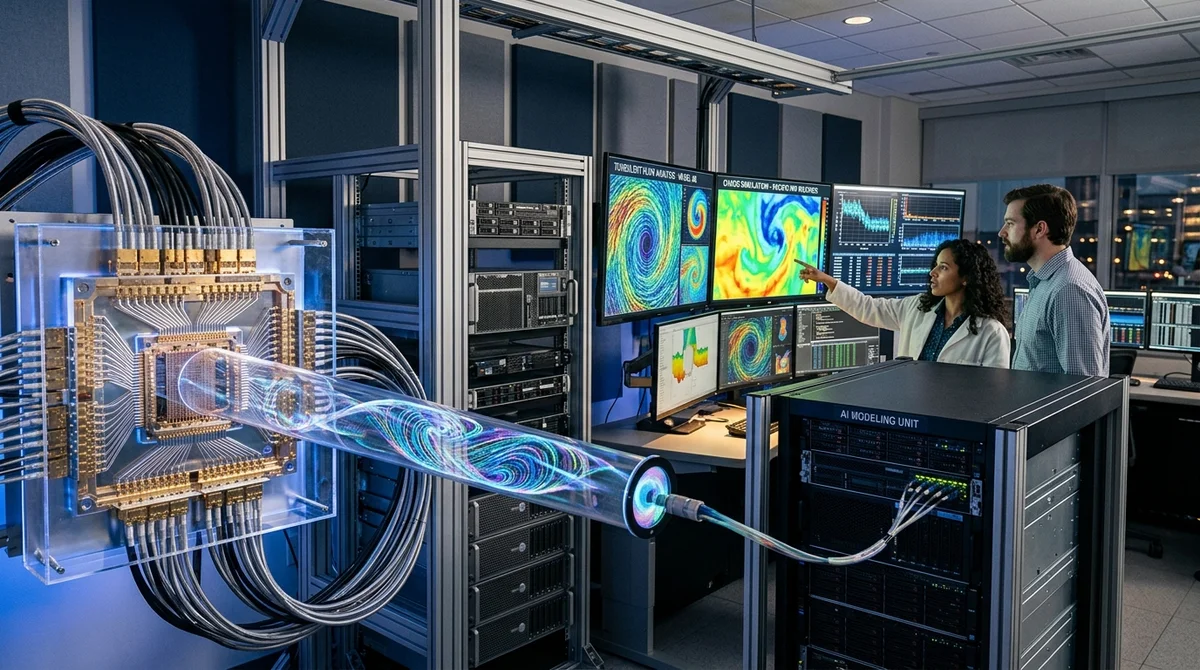
The University College London (UCL) team demonstrated that a quantum computer can already provide practical benefit—not in distant theory, but in real-world tasks forecasting complex systems. Their hybrid scheme combines quantum computing and machine learning so that AI more accurately predicts the behavior of chaotic processes over long time periods. In tests, the approach proved significantly more stable than conventional models, yielded accuracy gains of roughly 20%, and required hundreds of times less memory.
The work concerns systems that are particularly difficult to simulate using classical methods: turbulent flows, fluid and gas dynamics, processes where a small error quickly compounds and breaks the forecast. This is a typical problem for climate models, aerodynamics, energy systems, and biomedicine. Full numerical simulation of such processes can take weeks on supercomputers, while purely neural network models run faster but often become unstable when forecasts must be extended in time.
The UCL team attempted to occupy a middle ground: keep the classical AI model, but at the training stage suggest data structure using a quantum processor. Technically, the scheme works as follows: first, the quantum computer processes training data and extracts invariant statistical properties—that is, hidden patterns that persist over time even in a chaotic environment. These quantum-extracted features are then used to train an ordinary autoregressive model on a classical supercomputer.
The authors call this approach quantum-informed machine learning. An important point is that the quantum component does not participate in each prediction step and does not require constant data exchange with the classical part. This reduces hardware requirements and helps overcome typical limitations of today's quantum systems, including noise, errors, and measurement instability.
The method was tested on several tasks: the Kuramoto-Sivashinsky equation, two-dimensional Kolmogorov flow, and three-dimensional turbulent channel flow, which is closer to real engineering conditions. According to the paper in Science Advances, the new scheme improved forecast accuracy for distributions by up to 17.25% and better preserved the spectral structure of the system, in some cases yielding gains of up to 29.
36% compared to classical baseline models. For the most realistic scenario, researchers used a 20-qubit IQM quantum computer connected to computational resources of the Leibniz Supercomputing Centre in Germany. The authors specifically note that without quantum prior representation, predictions became unstable, whereas with it, the model produced physically consistent long-term forecasts and in some cases outperformed leading numerical solvers of differential equations.
The question of efficiency is particularly important. Usually, discussion of quantum computing quickly runs into the problem that the advantage is too expensive or too fragile for practice. Here, researchers demonstrate a more grounded and useful picture: the quantum component does not replace the entire pipeline, but compresses complex dynamics into a compact representation.
The paper discusses memory advantages on the order of magnitude: data volumes of several megabytes were reduced to a quantum representation on the scale of kilobytes. For scientific modeling tasks, this is critical, because memory and bandwidth often become limitations no less than raw computational power. If this approach can be scaled to larger datasets and real observations, there will be many applications.
In climate, it could mean more robust models of atmosphere and ocean. In energy, more precise design of wind turbines and systems operating with turbulent flows. In medicine, better modeling of blood flow and molecular interactions.
In transport and industry, accelerated calculations for aerodynamics and fluid systems without inevitable growth in memory costs. The main conclusion here is not that quantum computers suddenly ready to replace classical supercomputers. Rather the opposite: the research demonstrates a realistic scenario in which even today's limited quantum hardware can enhance existing AI models in narrow but critically important scientific tasks.
This is one of the most compelling examples of how practical quantum advantage may emerge not through a complete disruption of current computation, but through targeted integration into already-operational AI pipelines.
Need AI working inside your business — not just in your newsfeed?
I build production AI for companies — custom CRM, internal tools, autonomous agents, workflow automation. Owned by you, shaped to your process, no per-seat tax. Built by Zhemal Khamidun, CPO of AlpinaGPT (AI platform, 6,000+ users).
The AI world, distilled — once a week
Seven stories that actually mattered, hand-picked. No noise, no reposts, no press releases.
Done! Check your inbox for a confirmation.