Beauty Brands Accelerate AI Adoption: From Virtual Selection to Formula Development
AI is becoming a working tool for the beauty market, not just a marketing showcase. Algorithms already help customers analyze skin condition, try on shades…
AI-processed from Bloomberg Tech; edited by Hamidun News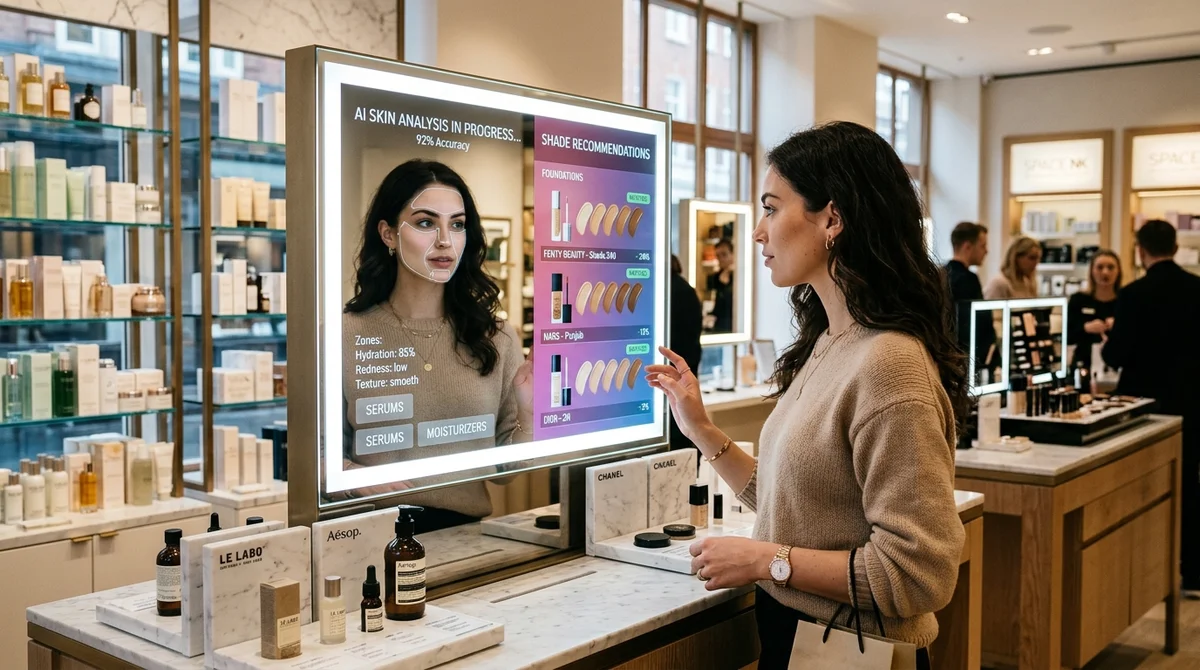
Artificial intelligence is rapidly transforming from an experimental feature into one of the foundational tools of the beauty industry: it simultaneously changes the customer experience and the internal operations of companies, from personalized recommendations to new product development.
On the consumer side, AI solves the most costly problem for brands — it reduces uncertainty before purchase.
Instead of choosing a cream, foundation, or skincare product blindly, a person can upload a selfie, undergo digital skin diagnostics, see potential issues, and receive product recommendations tailored to their specific parameters.
Another scenario is virtual makeup try-on, where the algorithm overlays shades of lipstick, blush, or foundation onto a facial image and shows how the product will look under different lighting conditions.
For the buyer, this means saving time and making a more confident decision; for the company, it means higher conversion and fewer returns.
Behind the scenes, AI works no less visibly.
Beauty companies use it to analyze large datasets on ingredient composition, active component properties, customer reviews, and market trends.
Such systems help find promising formula combinations faster, filter out weak hypotheses before expensive laboratory cycles, and more accurately understand which customer requests emerge before competitors notice them.
Previously, teams had to manually correlate research, test results, and sales signals; now, algorithms handle part of this work, accelerating the decision-making cycle.
The practical consequence of this automation is that the beauty industry becomes much more personalized.
Instead of a product line designed for an abstract average customer, brands can build offerings around narrower scenarios: sensitive skin, specific pigmentation types, climate, age-related changes, skincare habits, or even a combination of several factors at once.
For large businesses, this is an opportunity to better monetize data and build direct relationships with customers; for smaller players, it's a chance to reach the market faster with products that more precisely meet niche demand.
In this case, AI becomes not an app decoration but infrastructure that underpins recommendations, assortment, and the pace of product launches.
Separately, the way brands validate demand is also changing.
Algorithms can analyze search queries, social media discussions, marketplace reviews, and repeat purchase dynamics to anticipate which textures, formats, and claims truly interest the audience.
This matters for a category where packaging, shade, skin feel, and price equally influence the purchase decision.
When AI connects these signals into a single picture, the company gets more than just a report on the past quarter — it gains a tool for faster planning of assortment, campaigns, and even inventory distribution across sales channels.
But as convenience grows, so do quality requirements for these systems.
Any error in skin analysis, skincare recommendations, or shade matching directly undermines trust, because the user sees the result literally on their own face.
Additionally, companies must handle sensitive data carefully: images, behavioral patterns, purchase history, and product reactions.
Therefore, the winners will not be those who simply add the word AI to the interface, but those who succeed in connecting algorithms with genuine expertise from chemists, dermatologists, product teams, and testing laboratories.
The main conclusion is simple: AI in the beauty segment stops being a separate innovation and becomes part of the entire value creation chain — from initial consultation to formula manufacturing.
The more precisely companies learn to use it for personalization and research, the faster the market will move away from mass universal solutions toward a more targeted, flexible, and data-driven model.
For consumers, this means more convenient choices and fewer disappointments; for businesses, it means a new standard of speed and accuracy.
Want to stop reading about AI and start using it?
AI News is a curated feed of AI/tech news. Hamidun Academy teaches you to use AI systematically in your work.