OpenAI integrates Sky technologies into Codex for Mac and enhances background app management
OpenAI has integrated Sky technologies into Codex for Mac and significantly enhanced computer management mode. The agent now works with multiple applications…
AI-processed from Habr AI; edited by Hamidun News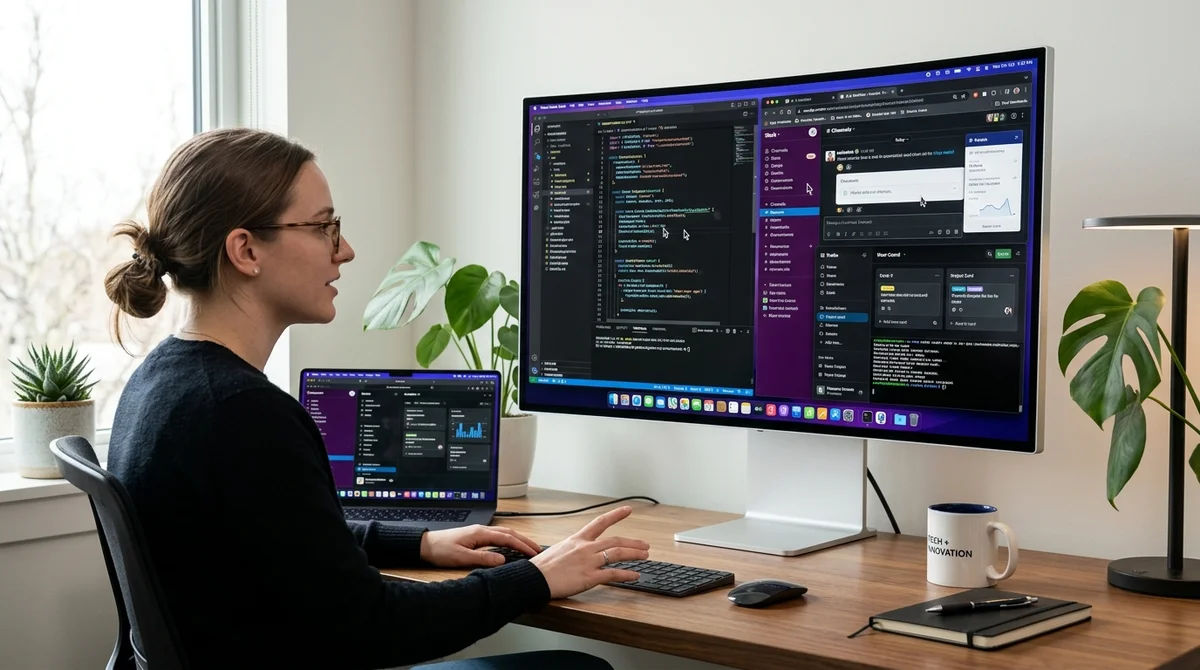
OpenAI has turned Codex for Mac from a code-writing tool into a full-fledged desktop operator: the agent can now manage applications in the background, switch between multiple windows, and perform routine tasks without bringing them to the foreground or requiring constant user intervention.
The key update is related to the Sky technology — a macOS startup that OpenAI officially acquired along with the development team.
At the product level, this no longer looks like a side experiment. Codex now has a built-in computer control mode that allows the agent to see where it clicks, enter text, open applications, and work in multiple windows at once.
Importantly, all of this happens in the background: the user can continue their work while the agent simultaneously handles tasks in other applications.
For the Mac environment, where many processes are still poorly automated, this is a notable shift.
Technically, the new approach is interesting because Codex does not rely solely on screen recording and imitating clicks based on images. Instead, the system uses macOS accessibility mechanisms that allow it to read the hierarchy of interface elements — buttons, input fields, lists, tabs, and other objects within a window.
For the language model, this is much richer than a simple screenshot: it receives not just an image, but a structured description of the interface and can more accurately understand what is in front of it.
As a result, the agent finds it easier to select the right action and relies less on fragile scenarios with cursor coordinates or workaround scripts.
This is why the new version of Codex looks stronger than many competing solutions.
Most computer control systems today are still built on a combination of screenshots, OCR, and basic automation through system commands. This approach works as long as the interface is predictable, but quickly breaks down in real-world applications.
Codex, based on early reviews, handles tasks better where you need to navigate complex windows, scroll through long feeds, open nested elements, and sequentially execute chains of actions.
An additional advantage is parallel cursors: multiple agents can work on the same Mac simultaneously without interfering with each other or stealing focus.
The practical value of the update is evident in everyday scenarios. Codex can open a music application and start the right album, even if the command is not perfectly formulated. It can review multiple work applications — for example, a messenger, RSS client, and reader — and then compile a brief summary from them.
It can install files, open them, check the result, and continue debugging without manually switching between windows.
Humans can often do such actions faster, but that is not the main point: the agent takes on the routine work that can run in the background, especially where there is no API, console commands, or full AppleScript support.
For OpenAI, this is also a strategic move. Codex looks less and less like an ordinary code assistant and more and more like an agent control center.
First, the company released the Codex application for macOS on February 2, 2026, and on April 16 added a major update with background computer control, memory, automations, and new plugins.
According to OpenAI, the service is already used by more than 3 million developers per week, and the company is clearly trying to expand use cases beyond the IDE: from code writing to interface testing, document work, browsers, and desktop applications.
The main conclusion is simple: OpenAI is betting not just on stronger models, but on deeper control over the user environment.
If Codex truly maintains its current accuracy and speed, the AI-agent market could quickly shift from chat windows to background assistants that can work in real applications as confidently as they work with text and code today.
Want to stop reading about AI and start using it?
AI News is a curated feed of AI/tech news. Hamidun Academy teaches you to use AI systematically in your work.