Strike on SABIC hits AI supply chain: PCB resin prices surge, lead times extend
A strike on SABIC's petrochemical complex in Al-Jubail is already affecting supplies of materials for printed circuit boards that underpin AI hardware…
AI-processed from TNW; edited by Hamidun News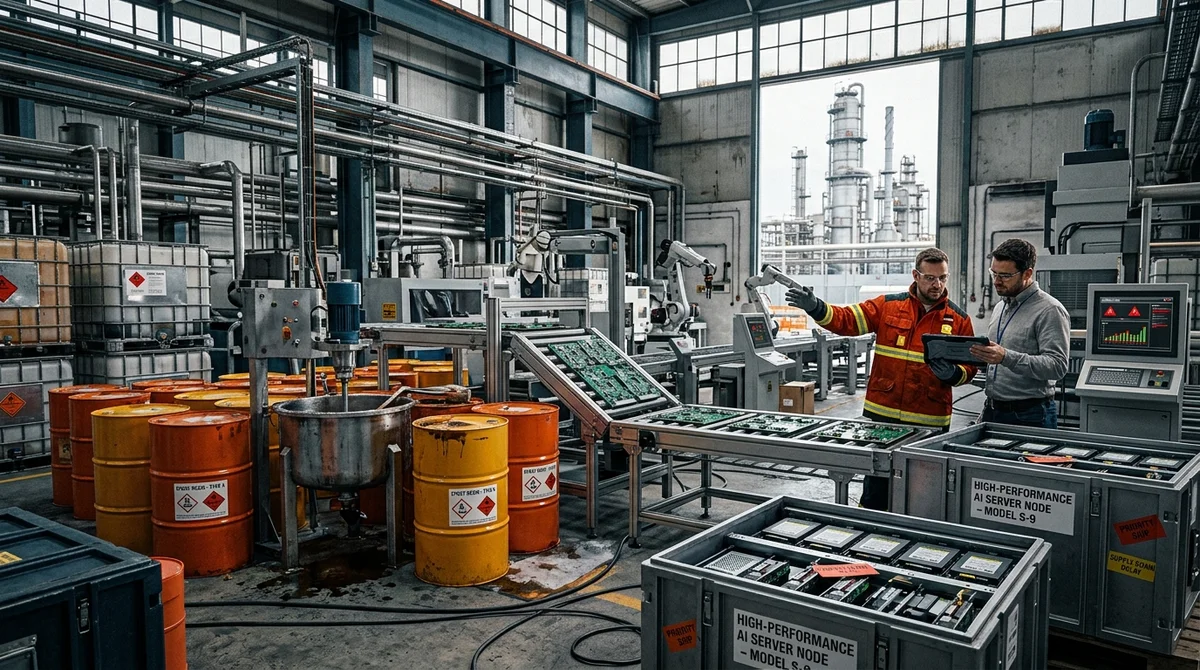
Military strike on petrochemical complex turns into a problem not only for energy, but also for the AI hardware market. After the attack on SABIC's complex in Al-Jubail in early April, production of resin stopped — the resin from which laminates for printed circuit boards are made. This is one of those materials that rarely makes headlines, but without it you can't assemble either a server motherboard, or an accelerator, or network equipment for data centers.
We're talking about epoxy and related resins used in PCB laminates — the base layer of a printed circuit board. This is where copper traces are applied that connect chips, memory, power elements and controllers. For the AI market this is critical: modern clusters require enormous quantities of boards not only inside GPU modules, but also in switches, power systems, network cards and storage racks.
If one chemical component falls out, it can slow down not one line but several links in the supply chain at once. The problem is made worse by the fact that AI servers need not the simplest boards. They must withstand high component density, serious thermal load and complex signal routing between GPU, memory, network interfaces and power circuitry.
For such products, requirements for laminates and resins are higher than for mass consumer electronics: mechanical stability is important, predictable behavior when heated and quality of high-frequency connections. This shrinks the list of interchangeable materials and makes the market sensitive even to local failures on the chemistry side. The first consequences are already visible in the numbers.
According to Goldman Sachs analysts, prices for the required resin rose by 40% in April alone. A South Korean supplier working with Samsung and AMD supply chains reported that lead times for epoxy resin stretched from three to fifteen weeks. For electronics manufacturers this is a sharp deterioration in planning: component purchases for servers and accelerators are usually synchronized on a rigid schedule, and even a few extra weeks on one material can shift the output of finished systems by a quarter.
This is especially painful for the AI infrastructure segment, where demand remains tense even without this. Accelerator manufacturers, OEM server assemblers and data center operators already live in a mode of long supply cycles, high factory utilization and competition for priority from contract manufacturers. Against this backdrop, the rise in PCB materials prices hits not only the cost of a single board.
It cascades to affect the price of the final system, availability of spare parts and timelines for capacity expansion. Even if the GPUs and HBM memory themselves are in stock, without boards and substrates they cannot quickly be converted into a ready-made server. Large buyers will probably try to buy up available volumes in advance and increase safety reserves, and this can accelerate prices even more for smaller manufacturers.
In such a situation, companies with long-term contracts and supplier priority win, while assemblers who work with lower margins and depend on the spot market lose. For startups and second-tier cloud providers this is a risk of getting infrastructure later and more expensive than planned. SABIC is a major player in the petrochemical market, and a failure at such a supplier quickly becomes a global problem, because alternatives are distributed unevenly.
It's not always possible to switch to another resin producer: in electronics, certification is important, stability of chemical composition, fire resistance, electrical properties and compatibility with specific manufacturing processes. Replacing a material often requires repeat testing, and sometimes even retooling production. That's why the market cannot instantly compensate for the lost volume, even if demand for the final electronics remains high.
The conclusion here is unpleasant but important: the AI race depends not only on chips and clouds, but on the most basic industrial materials. One strike on a petrochemical facility has already raised prices and extended supply timelines in a segment that is needed by Samsung, AMD and the entire server ecosystem. If disruptions drag on, it will increase inflation on AI equipment and remind the market that the main shortage may not arise at the level of microchips, but at the level of resin for printed circuit boards.
Want to stop reading about AI and start using it?
AI News is a curated feed of AI/tech news. Hamidun Academy teaches you to use AI systematically in your work.