Attack on OpenAI CEO's home escalates fears that AI protest may turn violent
An attack on Sam Altman's home and the subsequent attempted arson at OpenAI headquarters signal a new turning point: the conflict around AI is moving beyond…
AI-processed from Guardian; edited by Hamidun News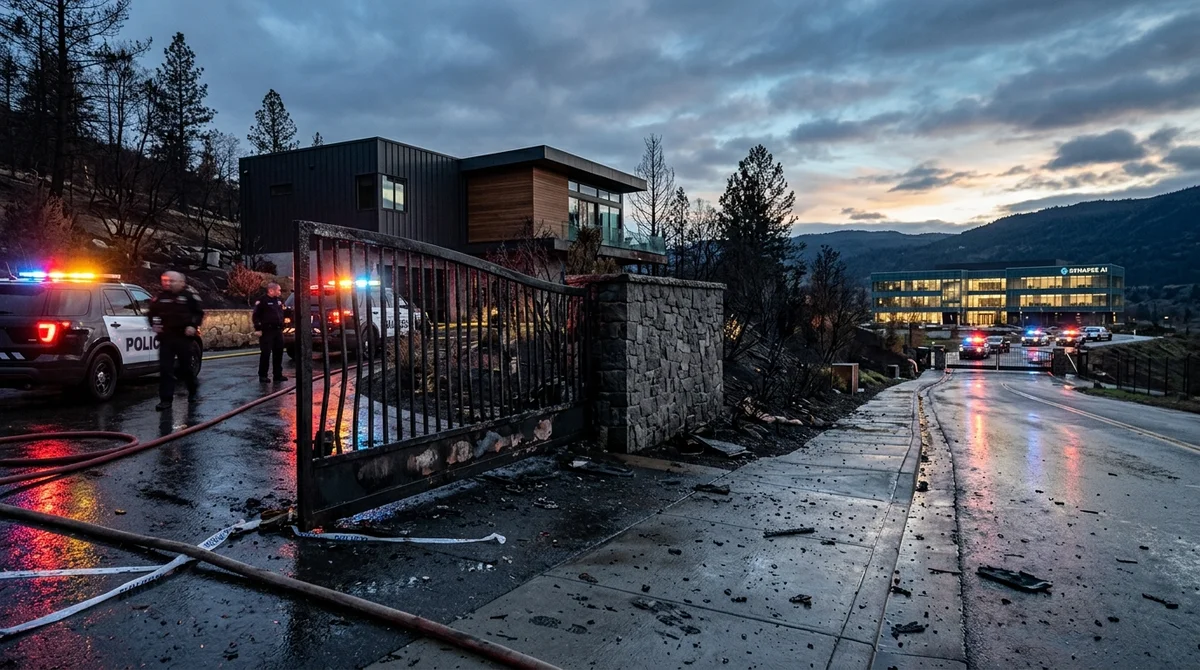
Attack on OpenAI CEO's home intensified fears that AI protests could turn violent
The attack on OpenAI's chief executive's house became a moment when the dispute over artificial intelligence stopped looking like merely an internet argument. After the San Francisco incident, the question becomes sharper: could growing discontent with AI shift from criticism of technology to physical violence against people and infrastructure? According to investigators, early in the morning of April 10, 2026, 20-year-old Daniel Moreno-Gama threw a Molotov cocktail at Sam Altman's house in San Francisco.
Fire damaged the external gates, but no one was hurt. Less than an hour later, the same person, according to authorities, appeared at OpenAI's headquarters approximately five kilometers from Altman's home, attempted to smash glass doors with a chair, and according to case materials, threatened to burn the building and kill those inside. Upon arrest, investigators found a canister of kerosene, a lighter, and a document with anti-AI theses.
Moreno-Gama is currently facing multiple state and federal charges. In California, this includes two counts of attempted murder and attempted arson, with a hearing on the charges scheduled for May 5, 2026. Investigators believe the attack was not spontaneous: according to their version, the suspect traveled from Texas specifically to reach Altman and then attack the company's office.
Case materials also mention a list of executives and investors in AI companies that was allegedly in his possession at the time of arrest. However, the defense and family of the suspect insist on a different explanation. They say the young man was experiencing a severe mental crisis, had no prior criminal record, and needed treatment rather than a political interpretation of his actions.
This nuance matters: the episode itself reads simultaneously as a story about radicalization around AI and as a story about a person in acute psychological distress. But even if in this particular case the motives were mixed, the attack itself has already become a signal for the entire industry. The reason for the resonance lies in the fact that discontent with AI has long gone beyond a narrow circle of researchers and technopolitical debates.
Criticism comes from several directions at once: some fear displacement of people from their jobs, others fear opaque data use, still others fear rising energy consumption and data center expansion, and others fear concentration of power in the hands of a few technology companies. Against this backdrop, harsher narratives thrive easily online, where AI business leaders begin to be perceived not as controversial entrepreneurs, but as personal culprits for future calamities. This very shift—from criticism of systems to demonization of specific figures—is what makes the rhetoric dangerous.
It is also important that even radically anti-AI communities publicly distance themselves from violence. Organizations advocating for slowing or restricting AI development have condemned the attack and stated they do not support such methods. This shows that a boundary still exists between political resistance to technology and direct violence.
But after the OpenAI incident, the question is no longer theoretical. If public distrust of AI continues to grow while companies themselves expand their influence faster than they explain the consequences of their work, such episodes may stop being perceived as an exception. The main conclusion is unpleasant for the entire industry: AI companies now need to think not only about the safety of their models, but also about the physical safety of people, offices, and facilities.
For society, this is also a turning point. The dispute over artificial intelligence is becoming harsher, more personal, and more emotional. And if its participants cannot return the conversation to the realm of rules, responsibility, and verifiable facts, the boundary between protest and violence will become increasingly blurred.
Want to stop reading about AI and start using it?
AI News is a curated feed of AI/tech news. Hamidun Academy teaches you to use AI systematically in your work.