Why diffusion models leave seams on 40-megapixel photos and how to give tiles memory
Diffusion models handle standard images well, but on professional 40–150 MP frames, tiling almost inevitably leaves seams, color bleeding, and texture…
AI-processed from Habr AI; edited by Hamidun News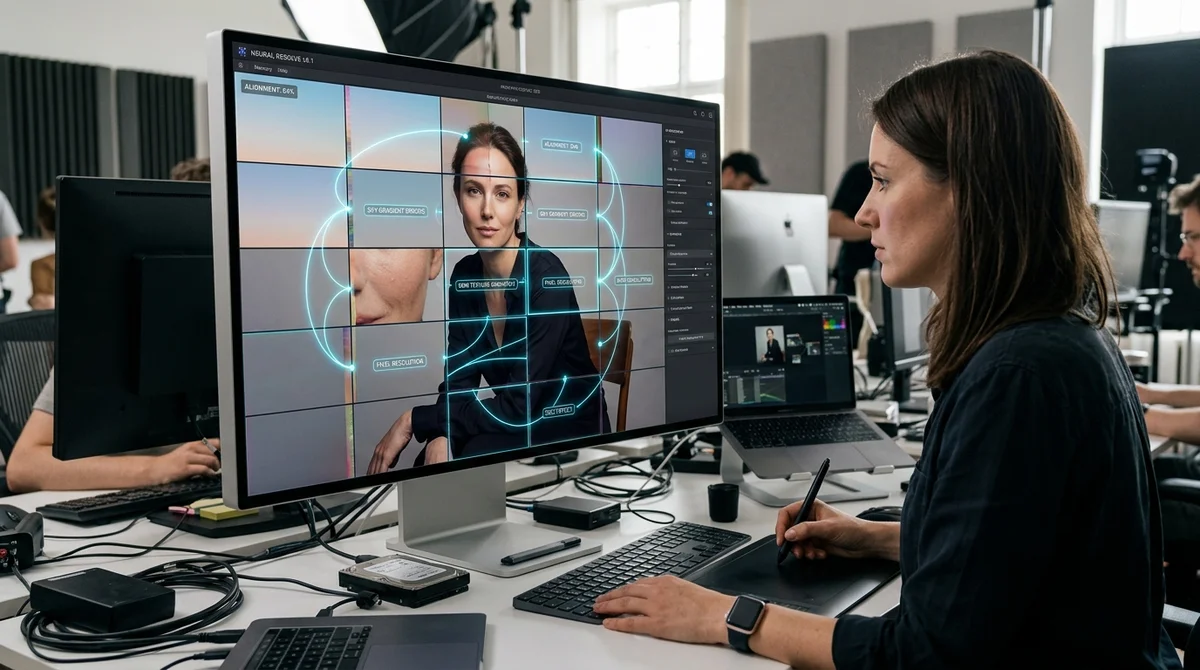
The main reason for seams on ultra-large images turns out to be not poor blending and not only a lack of video memory. The problem goes deeper: diffusion photo models don't maintain memory between neighboring image fragments. When a 40–150 megapixel frame is cut into dozens or hundreds of tiles, the model makes decisions anew each time and doesn't know what sky tone, skin tone, or texture scale it already chose nearby.
This causes steps in gradients, floating color, and visible seams that are particularly painful in professional retouching. The author approaches the topic not theoretically but from practice: behind him are twenty years of retouching and four years of attempts to adapt diffusion models to production. In studio, advertising, and magazine photography, high resolution is not a luxury but a working standard, and such frames rarely fit in a single generation or editing pass.
That's why the industry repeatedly comes to the same technique: the image is divided into 100 or more fragments, processed separately, and then reassembled. On small details this might work tolerably, but on skin, fabric, background, and light transitions, artifacts are almost inevitable.
The root of the problem is that standard tiling preserves local detail but breaks global coherence. Each tile sees only its own piece of the scene and doesn't understand what's happening left, right, top, and bottom. Even if neighboring areas overlap, the model is still capable of slightly shifting the color balance, interpreting grain differently, adding mismatched pores, or building a different rhythm of texture. Blending and masks hide some defects, but don't eliminate the cause: the photo model has no mechanism that links decisions between neighbors. That's precisely why perfect seaming on very large frames remains an exception rather than the norm.
The article suggests looking toward video diffusion, where the coherence problem has long been at the center of the architecture. A video model must remember what an object looked like in the previous frame to avoid losing face, light, texture, and detail position during movement. The author breaks down eight classes of such memory—from BCLA in SANA-Video and FramePack to SVD reshape, AnimateDiff, and other approaches—and evaluates what can be transferred to tiles and what cannot. The key question here is not the name of the method, but the principle: can you force a photo model to pass the neighboring fragment a compact context, hidden state, or general scene structure so that decisions are made not in a vacuum?
Three major ideas for practice follow from this. First—context exchange between neighboring tiles, when the model receives not only the current fragment but also compressed information about already-processed areas. Second—shared memory at the level of latents or attention mechanisms, which maintains a single color, lighting, and surface character across the entire image. Third—a multi-step scheme where a rough global representation of the entire scene is first built, and then local tiles only refine details without breaking the overall picture.
For printing, outdoor advertising, beauty retouching, and commercial photography, this is critical: any texture break or tone shift becomes immediately visible. The main conclusion is simple: the limitation lies not only in hardware and not only in image size, but in the very architecture of photo diffusion. Until the model learns to remember what already happened nearby, processing 40-megapixel and larger frames will remain a compromise between detail and integrity. If memory mechanics from video can be adapted to tiles, diffusion models will make a noticeable step from the world of impressive demos toward a full-fledged professional tool for retouching and post-production.
Want to stop reading about AI and start using it?
AI News is a curated feed of AI/tech news. Hamidun Academy teaches you to use AI systematically in your work.