Harvard Business Review: how active AI use leads to "brain overheating"
AI promised to eliminate routine work, but the most active users increasingly experience the opposite effect — the brain overheats, as it were. The new…
AI-processed from Habr AI; edited by Hamidun News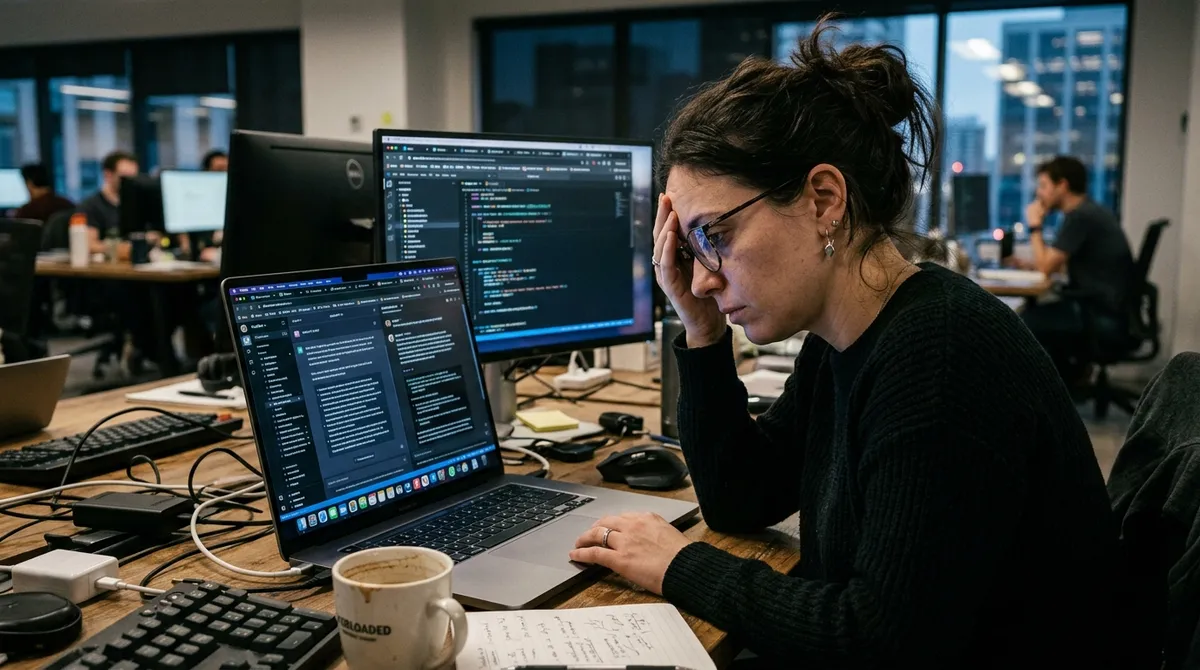
AI increasingly takes from us not just routine tasks, but also the attention that used to go toward calm, sequential thinking. Against this backdrop, a new workplace effect emerges — AI brain fry. It feels not like ordinary end-of-day fatigue, but as a strange mix of noise in the head, mental sluggishness, and loss of clarity.
You seem to have done a lot: queried a model, refined the task, got an answer, double-checked, launched another tool. But at some point you notice that solutions come harder, formulations become worse, and simple tasks start to demand too much effort. This is the phenomenon examined by authors in the Harvard Business Review for March 2026.
The article was prepared by experts from BCG and the University of California, Riverside, who surveyed 1488 American employees of large companies. Their conclusion sounds unpleasant but familiar to many teams: AI doesn't just save time — it can quietly drain cognitive resources. We're not talking about a clinical diagnosis, but a work state that emerges where automation promises relief yet adds a new layer of burden.
To get a good result, an employee must not simply "ask the AI," but precisely formulate the task, choose the right tool, assess the quality of the answer, spot errors, and integrate the result into a real process. It's not beginners who are most at risk, but precisely the most active users. The reason is that intensive work with AI consists of a long chain of micro-decisions.
You need to understand which model to use for the task, how much context to give it, whether to rewrite the prompt, how to verify facts, when to stop iterating, and which of several options to consider final. From the outside, this looks like acceleration. Inside — like constant operational management.
The more assistants, agents, code editors, and text generators you have, the higher the chance that you transform from executor to operator of a complex system. And if the system accelerates faster than you can comprehend it, your brain pays the price with overload.
This state has recognizable symptoms. Your thoughts more often break off mid-sentence, attention fractures into small pieces, and confidence in decisions drops. Sometimes a person begins to trust the model too much and misses errors because they're already tired of checking.
Sometimes the opposite happens: endless re-checks, new prompts, version comparisons, and inability to make a final call. In both cases, work quality suffers. The effect is especially pronounced where long chains of reasoning and high error costs are needed: in analytics, development, product work, research, marketing, and management.
AI is good at helping you start, quickly assembling a draft, or handling routine work, but it can also fragment the middle of the process — that part where a person needs focus, critical thinking, and the ability to hold the bigger picture. The main takeaway from this story is not that we should abandon AI. Quite the opposite: the deeper it embeds itself in daily work, the more important usage hygiene becomes.
Teams and individual specialists will need to design not only automation, but also their own cognitive load. It's useful to decide in advance which tasks AI truly accelerates, where one iteration suffices, and where it's better to think first without suggestions. It's useful to limit the number of parallel tools, set quality criteria before running the model, and leave time for manual verification without new requests.
True productivity in the age of AI is measured not by the number of prompts, but by whether you preserve the clarity of your thinking and ultimately make stronger decisions.
Want to stop reading about AI and start using it?
AI News is a curated feed of AI/tech news. Hamidun Academy teaches you to use AI systematically in your work.