China and the Robotics Revolution: How Close Are Autonomous Humanoids?
How close are autonomous humanoids to real-world work? Visits to 11 companies across five Chinese cities reveal an industry moving fast, powered by strong…
AI-processed from Guardian; edited by Hamidun News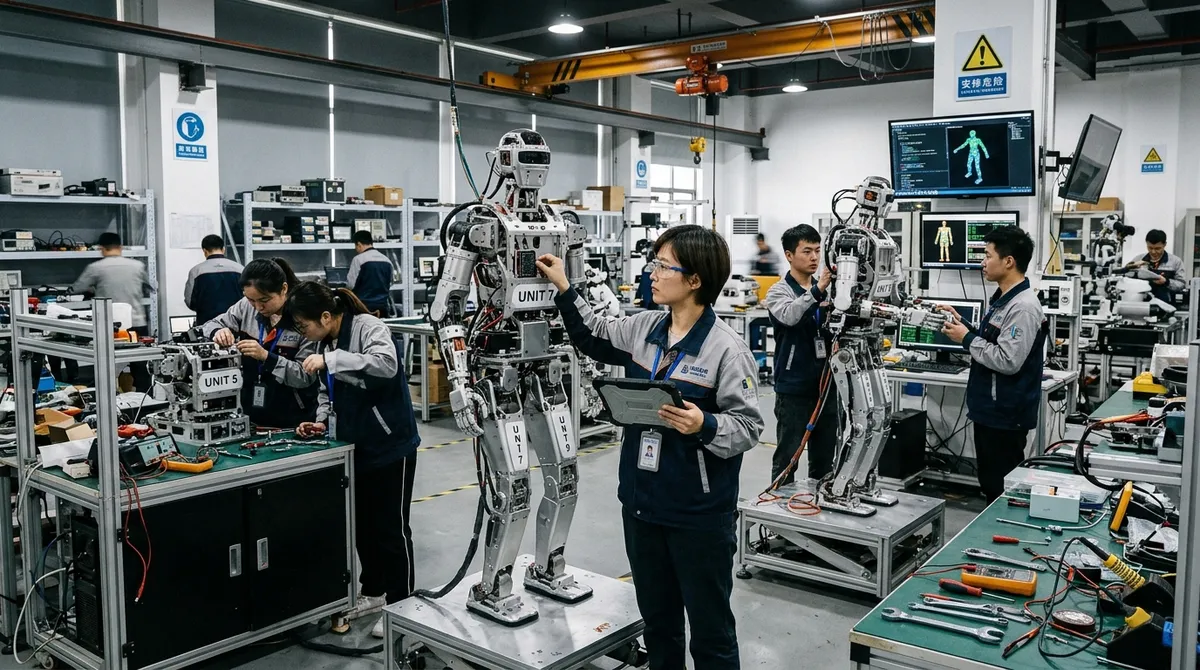
Autonomous humanoid robots in China no longer look like distant science fiction but rather as an engineering challenge with clear timelines, constraints, and costs. A visit to 11 companies across five Chinese cities shows that the industry is maturing rapidly: manufacturers are no longer selling just a beautiful future but attempting to assemble a working model that can be mass-produced, serviced, and integrated into the real economy. But this same route also makes it clear that there is still a considerable distance to truly independent machines capable of reliably working without constant human backup.
The main takeaway from such a report is that Chinese robotics has long since moved beyond laboratory demonstrations. When a journalist sees not one showcase company but 11 players in five different cities, a more complete picture emerges: this is not about a single breakthrough but about an entire industrial ecosystem. Within it, mechatronics, computer vision, control systems, batteries, actuators, and software are developing simultaneously.
For humanoid robots, this is critical because they need not one outstanding technology but the coordinated work of many components, each of which must be sufficiently cheap, precise, and reliable. This is precisely where China looks particularly strong. The advantage comes not only from engineering talent but also from a dense manufacturing ecosystem where components, contractors, assembly, and testing are closer to each other than in many other countries.
Such proximity accelerates iterations: a design can be quickly reassembled, a component replaced, a part made cheaper, or a new software version tested on real hardware. For a young industry, this is no less important than loud declarations about the future, because what will win is not the most spectacular prototype but the one that can reduce costs, increase stability, and turn demonstration into a repeatable product. At the same time, the very nature of the question—how close are we to the science fiction image of an autonomous humanoid robot—helps distinguish spectacle from readiness.
A robot can confidently walk across a stage, lift a box, or wave its hand, but this does not yet mean it is ready for full-fledged work in an unpredictable environment. True autonomy requires much more: stable navigation, contextual understanding, precise manipulation, safe behavior around humans, and the ability to handle errors without shutting down the entire system. These are the properties that typically separate impressive demos from machines that someone is willing to pay for on an ongoing basis.
Therefore, the most realistic path for humanoids today, judging from this picture, does not lie through a universal robot for all occasions but through narrower, more controlled scenarios. Initially, these could be warehouses, factories, facility inspections, material transport, or other tasks where the space is predictable, processes repeat, and profitability can be calculated in advance. In such conditions, even incomplete autonomy already makes sense if the robot reduces the burden on people, works longer than a normal shift, or takes on inconvenient and potentially dangerous operations.
A mass-market consumer robot that equally handles everything remains more of a marketing symbol than a near-term reality. From this follows a simple conclusion: the Chinese robotics revolution is important not because perfect androids will hit the streets tomorrow, but because right now the industry is forming that can step by step move closer to such a scenario. Visits to five cities and 11 companies show that the race is already happening at the level of manufacturing, integration, and economics, not just ideas.
For the market, this is a signal to look not at the loudest promises but at where robots are already starting to bring measurable benefits. That is where it will be decided how quickly science fiction turns into infrastructure.
Want to stop reading about AI and start using it?
AI News is a curated feed of AI/tech news. Hamidun Academy teaches you to use AI systematically in your work.