German Sereact Raises $110M for AI Helping Robots Predict Consequences
German Sereact has raised $110M to develop AI for more "understanding" robots. The company is building a model that doesn't just execute commands but adapts…
AI-processed from Bloomberg Tech; edited by Hamidun News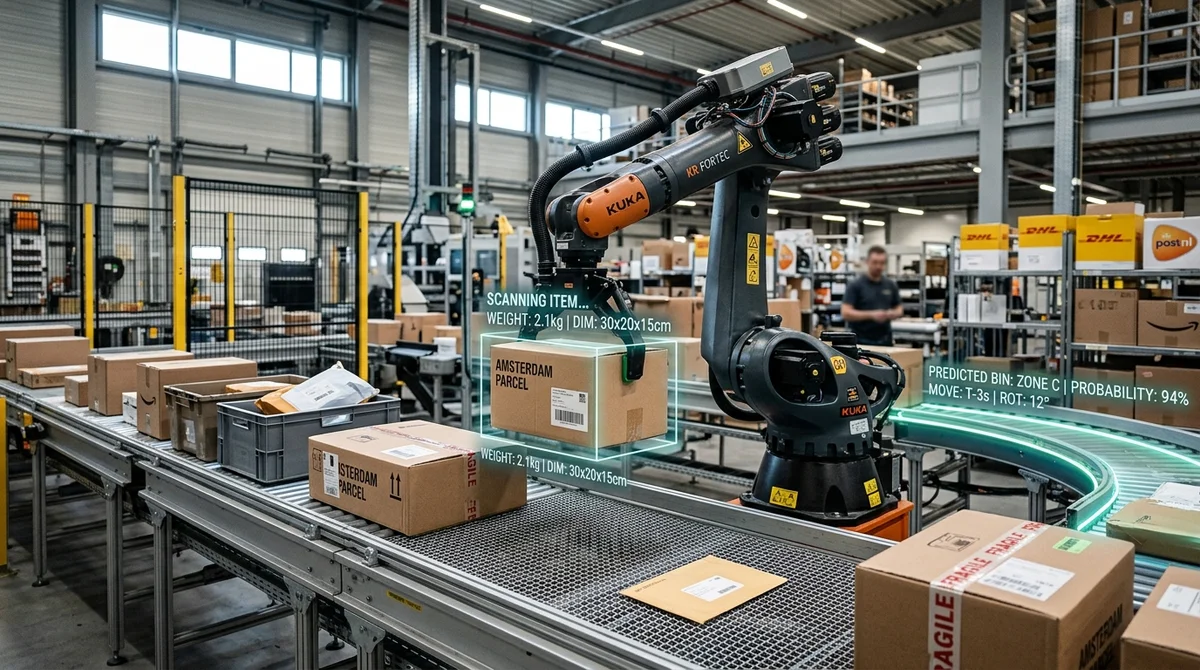
German Sereact raised $110 million to develop AI models for robots that can predict the consequences of their actions, and this is a bet not just on automation, but on a new level of machine behavior. The company wants to enable robots to better understand tasks, adapt faster to unfamiliar environments, and evaluate the consequences of their next action in advance. Essentially, it's about a software layer that should make robots less "rigid."
Traditional robotics works well where everything is predefined: an object lies at the right point, the trajectory is known, and the environment remains almost unchanged. But as soon as variability appears—the object is moved, the shape differs, the scene is partially obscured, or the task is formulated slightly differently—many systems begin to lose efficiency. Sereact is developing a model designed to bridge exactly this gap between a pre-scripted scenario and the real world.
The phrase about robots that "predict consequences" sounds like marketing, but behind it lies a quite practical idea. Before acting, a machine needs not only to choose the next step but also to assess what it will lead to: whether it will be possible to safely grasp the object, whether the next stage will block movement, whether an error will cause the entire sequence to fail. The better a robot can mentally simulate the outcome of its actions, the less manual tuning it requires for each separate process.
For business, this is especially important because the cost of implementation often depends not on the hardware platform itself, but on lengthy adaptation to a specific operation. The $110 million round shows that investors continue to believe in the AI-and-robotics combination even amid cooling interest in some high-profile AI stories. There is clear logic here: if large language and multimodal models have already taught software to work with uncertainty in text, images, and voice, the next big step is to transfer similar flexibility to the physical world.
Robots need not just to "see" and "hear," but to make decisions in an environment where errors are more costly than in a chat interface. That's why companies building a universal intelligent layer for machines look particularly attractive to capital right now. It's also important to note that Sereact is specifically a robotics software developer.
This reflects a notable market shift: value is increasingly created not only in the hardware component, but in the control model that can work across different types of equipment. If this approach scales, the company has a chance to grow not as a manufacturer of a single device, but as a supplier of "brains" for many robotic systems. For customers, this is also a plus: it's easier for business to enhance existing infrastructure than to completely replace a fleet of machines for each new feature.
For the European ecosystem, this is also a positive signal. Major AI investments today are often associated with American laboratories and platforms, but robotics remains an area where European teams have a strong engineering base and clear industrial application scenarios. If Sereact can turn its developments into a product that truly reduces the need for manual programming and accelerates robot deployment in new tasks, it will strengthen the region's position in one of the most expensive and practical segments of the AI market.
The main conclusion here is simple: the market is beginning to value not only AI that can answer, write, and generate, but also AI that can act in the physical world with awareness of consequences. Such systems can bring closer the moment when robots stop being narrowly specialized machines for one perfectly tuned operation and become more universal performers. Sereact is trying to build its next growth stage on this transition—and the $110 million gives the company the resources to test how viable this bet is in a real industrial environment.
Want to stop reading about AI and start using it?
AI News is a curated feed of AI/tech news. Hamidun Academy teaches you to use AI systematically in your work.