Google DeepMind and South Korea Launch Partnership for Scientific Breakthroughs with AI
Google DeepMind announced a partnership with South Korea to accelerate scientific research using advanced AI models. An AI Campus will open in Seoul where…
AI-processed from DeepMind Blog; edited by Hamidun News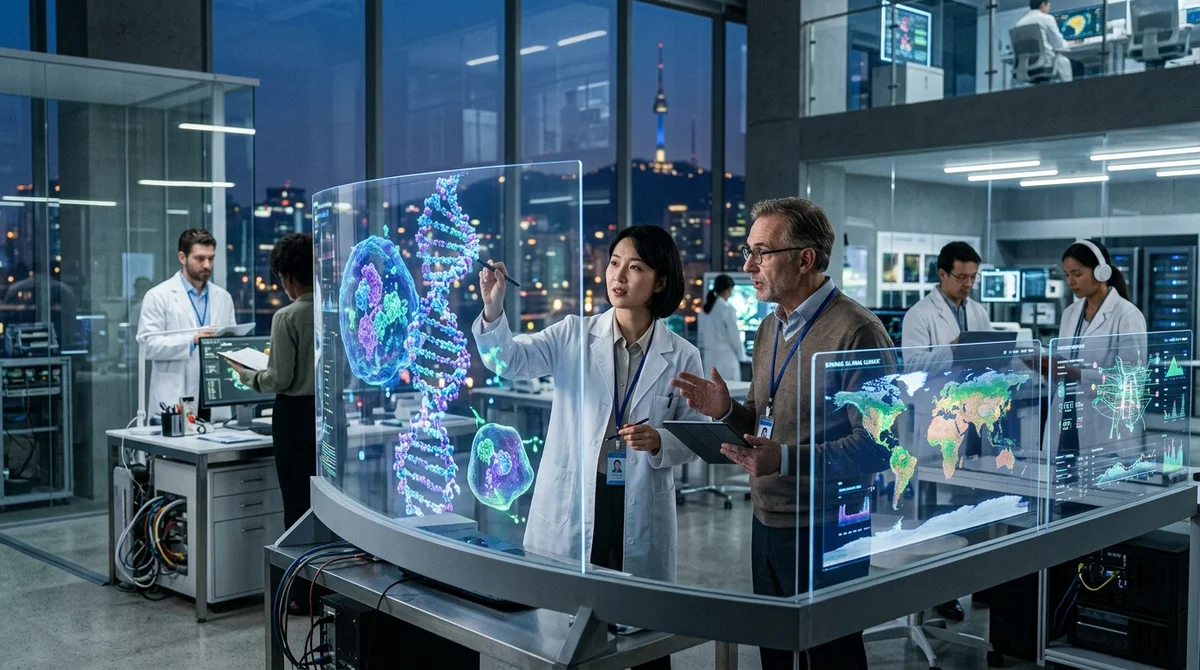
Google DeepMind announced a new partnership with the Ministry of Science and ICT of the Republic of Korea, and this is far more than just another memorandum of understanding. The parties want to embed cutting-edge AI models directly into scientific work — from genomics and drug discovery to extreme weather forecasting and power grid management. For South Korea, this is a way to accelerate research in strategic areas, and for DeepMind, it is an opportunity to expand the practical application of its scientific models beyond the laboratory and turn them into part of the national research infrastructure.
The partnership was announced on April 27, 2026, almost ten years after the AlphaGo match in Seoul, which once became a symbol of the real capabilities of modern AI for a wide audience. The new project became part of the Google DeepMind National Partnerships for AI initiative and is tied to Korea's state AI strategy. The company emphasizes that the country is already in a strong position: according to data cited by DeepMind, Korea leads in the density of AI innovation and shows the fastest AI adoption growth among the 30 largest economies.
Against this backdrop, the Ministry of Science and ICT launched the K-Moonshot Missions program — it is designed to give research productivity a boost and help solve major national challenges. To support this agenda, Google will open an AI Campus in its Seoul office — a platform where Korean universities and scientific centers can work with company experts, participate in programs, and gain access to cutting-edge tools. The partnership also coincides with the launch of a new National AI for Science Center, which the country's authorities plan to open in May.
At the first stage, Google DeepMind plans to collaborate with Seoul National University, KAIST, and three state AI Bio Innovation Hubs. The goal is not simply to demonstrate models, but to embed them into the real research cycle. Among the tools that the company directly names are AlphaEvolve, a Gemini-based agent for designing and optimizing algorithms; AlphaGenome, a model for analyzing how mutations in human DNA affect gene functions; AlphaFold, which, according to DeepMind, is already used by more than 85 thousand researchers in Korea; and AI co-scientist — a multi-agent system serving as a virtual scientific co-author for generating and testing hypotheses.
A separate direction is WeatherNext: they want to apply it to analyze extreme weather phenomena, increase the resilience of the power grid, and more efficiently integrate renewable generation into the network. If the plan works, AI here will be used not as a general assistant for correspondence or search, but as a specialized research layer on top of the existing scientific infrastructure. The deal is not limited to access to models.
Google DeepMind separately places emphasis on personnel and security. The company promises to expand contacts with Korean students and researchers, including working out internships within DeepMind. This complements a broader package of Google initiatives in the region, which already includes 50 thousand AI Essentials scholarships for people learning basic AI skills.
In parallel, DeepMind plans to work with the Korean AI Safety Institute on research and best practices for the safety of advanced models. This is an important signal: the partnership is built not only around accelerating science, but also around how to implement such systems in the state and academic circuit without losing control over risks and without a gap between laboratory capabilities of the model and the requirements of the real scientific environment. In this news, it is important not only that yet another country has agreed with a major AI lab.
What is more important is this: scientific models like AlphaFold or WeatherNext are gradually moving from the category of loud technological achievements to the category of infrastructure on which states plan to build research, education, and industrial policy. For South Korea, this is a chance to more quickly turn a strong university and engineering base into applied discoveries in biomedicine, energy, and climate. For Google DeepMind, it is an opportunity to establish itself as a supplier not only of universal models, but also of a specialized AI stack for science.
If the project in Seoul works as described, it will be another example of how the race in AI is shifting from chatbots to laboratories, power grids, and biomedical platforms.
Want to stop reading about AI and start using it?
AI News is a curated feed of AI/tech news. Hamidun Academy teaches you to use AI systematically in your work.