Meta plans to power AI data centers with energy transmitted from space
Meta has agreed with Overview Energy to reserve up to 1 GW of energy that satellites will collect in orbit and transmit to Earth at night. The first…
AI-processed from Bloomberg Tech; edited by Hamidun News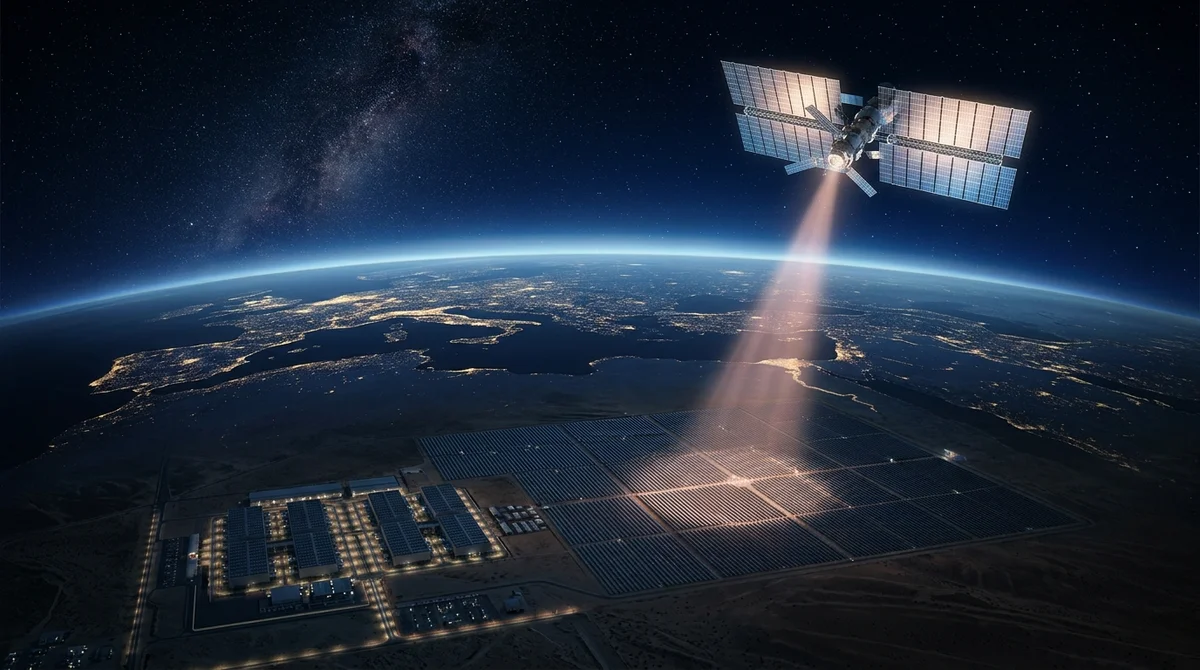
Meta is ready to buy not just new solar generation, but energy that satellites will collect in orbit and transmit to Earth at night. The company has reserved up to 1 GW of capacity with Overview Energy — betting that the electricity deficit for AI data centers will need to be closed not only with atomic energy, gas, and ground-based renewables, but also with technologies that remain on the border between engineering and experiment. The scheme that Meta and Overview are promoting works like this: satellites in geostationary orbit over the equator receive practically continuous sunlight, convert it, and send it to Earth in the form of low-intensity near-infrared radiation.
This stream should be received by already existing solar power plants. The idea is to use them not only during the day, but also at night, without building new large facilities and without separate heavy grid infrastructure. If the approach works, the capacity factor of already-built solar facilities will increase dramatically.
The deal is calculated for a volume of up to 1 GW — comparable to the power of a large nuclear reactor. Overview Energy's first orbital demonstration launch is scheduled for 2028, and commercial power delivery to the American grid, according to current plans, could begin in 2030. The financial terms of the partnership are not disclosed.
Overview itself emerged from stealth mode only at the end of 2025 and has since positioned itself as a developer of a system that does not build separate ground-based microwave or laser receivers, but tries to use already existing solar infrastructure as the final energy reception point. For Meta, this is not an exotic experiment for headlines, but a continuation of a hard race for electricity for AI. According to the company and industry estimates, in 2024 its data centers consumed over 18,000 GWh of electricity — roughly enough for a year for 1.
7 million American households. Against this backdrop, Meta has already contracted over 30 GW of clean and renewable generation, as well as 7.7 GW of nuclear energy through agreements with several suppliers.
On the same day, the company separately announced a reservation of up to 1 GW / 100 GWh of ultra-long duration energy storage from Noon Energy, with a pilot project of 25 MW / 2.5 GWh by 2028. The reason for such interest is simple: standard solar and wind generation poorly aligns with the operating mode of AI infrastructure, which needs 24/7 power.
Batteries help, but at the level of hyperscalers this is expensive, time-consuming, and requires a lot of land and materials. New nuclear and geothermal projects are more reliable, but take years to build and run into regulatory hurdles. Space-based solar energy looks like a third way: it promises round-the-clock power delivery and faster integration with already operating solar stations.
But it remains an early-stage technology with a long list of open questions — from the efficiency of the entire chain and capital costs to regulation, orbital logistics, and the impact of additional satellites on the space environment. What this means: the main problem for AI is becoming not just access to chips, but access to guaranteed electricity in gigantic volumes. A capacity reservation with Overview Energy doesn't mean Meta will actually get space-based electricity at an industrial scale in just a few years.
But it shows that major tech companies are willing to finance even pre-commercial energy technologies if they shorten the path to new gigawatts. In the coming years, competitive advantage will increasingly be determined not only by the quality of the model, but also by who first secures a reliable energy base for its training and operation.
Want to stop reading about AI and start using it?
AI News is a curated feed of AI/tech news. Hamidun Academy teaches you to use AI systematically in your work.