Sereact raised $110M for AI robots that predict consequences of actions
Sereact from Stuttgart closed a $110M Series B round. The company develops vision language action models for robots that assess situations and predict action…
AI-processed from TNW; edited by Hamidun News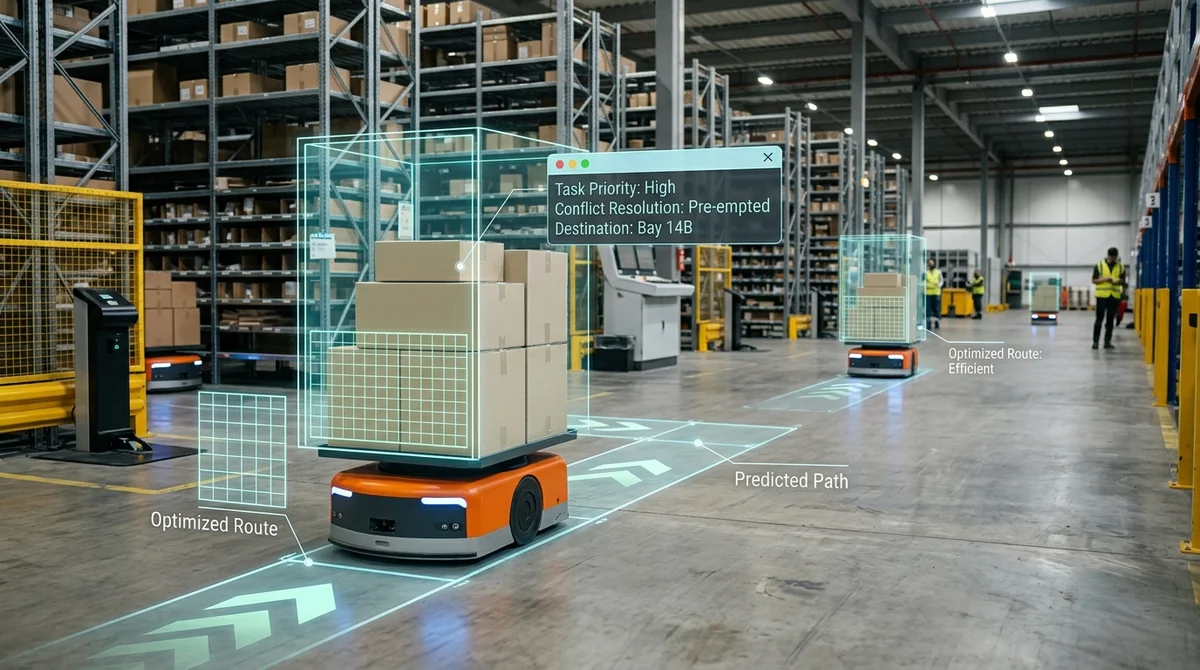
Sereact raised $110 million in a Series B round to accelerate the development of AI for industrial robots that don't just execute commands, but simulate the consequences of their actions in advance. For the market, this is an important signal: investors are willing to make large bets on systems that make warehouse and factory automation not only faster but also significantly more reliable in real physical environments. The company is based in Stuttgart and develops a software platform for robotics.
Its approach is built on vision language action models: such systems simultaneously perceive images, understand textual or operational tasks, and select physical actions. In Sereact's case, the key idea is that a robot should first assess the scene, possible options, and the probable outcome of a move before grasping an object, moving it, or performing another operation. This is especially important where mistakes are costly: in logistics, manufacturing, and working with heterogeneous goods.
The new round was led by the Headline fund. It was joined by Bullhound Capital, Felix Capital, and Daphni. The company's valuation is not disclosed, but the deal size itself looks indicative: $110 million is more than four times the previous Series A round of €25 million, which Sereact closed just 15 months ago.
Such dynamics typically mean that the market sees not an experimental technology, but a platform with a chance to become infrastructure for large-scale industrial automation. In other words, capital comes not only on promises but on early signs of scalable demand. Sereact already has practical deployments, and this is probably one of the main reasons for investor interest.
According to the announcement, its models are already working at BMW, Daimler Truck, and logistics clients. For a young robotics company, such a client list is especially important: it shows that the technology is being tested not in a lab or a demo video, but in an environment where speed, safety, non-standard objects, and constant changes on the floor must be considered. If a robot can calculate the consequences of an action before executing it, it should make fewer errors when grasping, handle uncertainty better, and adapt faster to new scenarios without rigidly programmed rules for each individual case.
Interest in such solutions is understandable. Much of the value in industrial robotics today is shifting from hardware to universal software that can work in unpredictable settings. Classical robotic systems excel on fully standardized lines, but lose efficiency when packaging shape, object placement, or operation sequence changes.
This is precisely where models combining vision, language, and action become the next stage: they promise less manual configuration, faster deployment, and more flexible automation. For Europe, this is also a strategic issue, as local companies try to take a place in a segment long dominated by American software developers and Asian equipment manufacturers. The new funding will likely go toward scaling the team, developing models, and expanding commercial deployments.
For such a business, it's not enough to show an impressive demo: you need to prove stability over the long term, integration with existing customer systems, and economic impact in concrete operations. The more real scenarios the platform goes through, the more valuable the model itself becomes and the higher the barriers for competitors. That's why the new round for Sereact is important not just as a financial milestone, but as an opportunity to establish itself as one of the notable European players at the intersection of AI and robotics.
The main takeaway is simple: the market is starting to generously fund not abstract AI for robots, but solutions that have already proven useful on the shop floor. If Sereact can turn its current pilots and deployments into a mass industrial standard, its growth will be an indicator of how quickly generative and multimodal models are transitioning from the digital realm into the physical economy.
Want to stop reading about AI and start using it?
AI News is a curated feed of AI/tech news. Hamidun Academy teaches you to use AI systematically in your work.