MIT Technology Review: OpenAI, Anthropic and the entire AI market are stuck between hype and profit
Hype around AI is already being sold as a path to profit, but the main intermediate step remains unclear. Companies promise economic transformation, though actual data is more modest so far: Anthropic doesn't see a clear spike in unemployment, and the Mercor test showed that AI agents fail at most complex office tasks. The industry needs proof, not new promises.
AI-processed from MIT Technology Review; edited by Hamidun News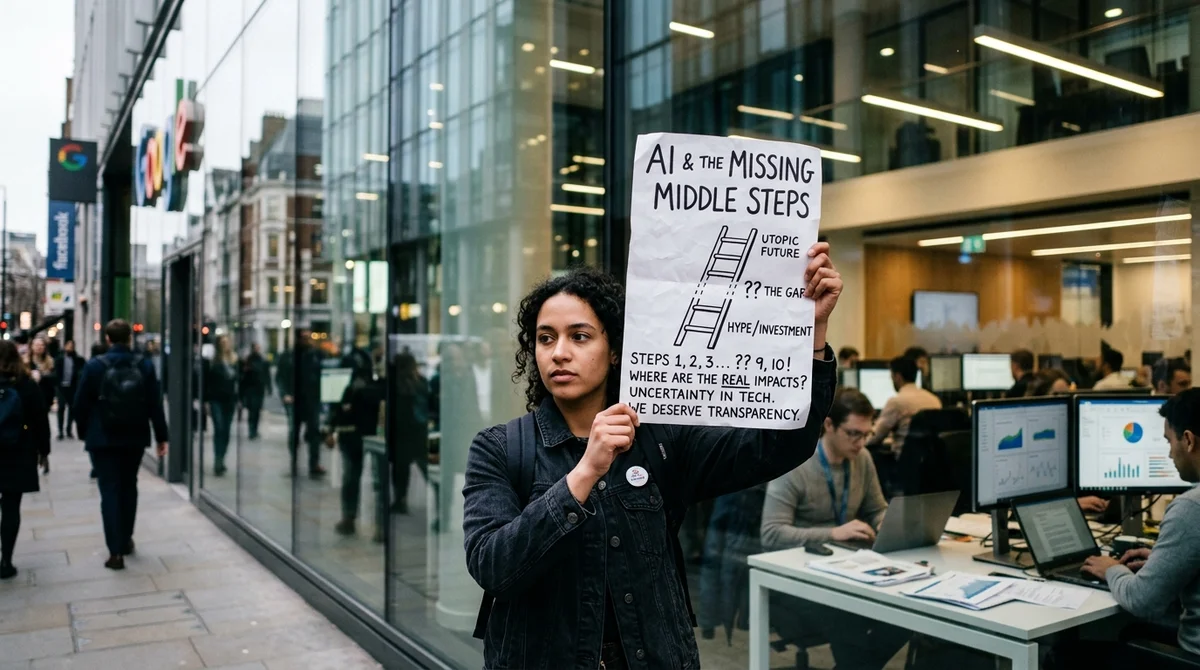
The hype around AI has already created a sense of inevitable revolution, but between loud promises and actual profit, a void remains: the industry has mastered the step of creating impressive models, yet still cannot clearly demonstrate how they reliably integrate into company operations and change the economy. The author recalls a February anti-AI march in London, where Pause AI activists distributed a pamphlet with an almost meme-like scheme: step one, grow a digital superintelligence; step two, a question; step three, also a question. This is a reference to the gnomes from South Park, whose business plan looked like this: collect underpants, then something unknown, then profit.
According to the author, this is exactly the state the entire AI market finds itself in: the technology exists, the promise of transformation exists, but the intermediate mechanism remains murky. For AI opponents, the skipped second step usually means regulation: first you need to understand what rules should limit implementation, who will write them, and who will enforce them. For technology supporters, the picture is reversed.
They already mentally stand at the point where AI saves the economy, boosts productivity, and transforms the labor market. As OpenAI's Chief Scientist Jakub Pachocki told the author, it is about an economically transformative technology. The problem is that everyone has a different road to this future, and no one has proven maps.
One study, published by Anthropic on March 5, 2026, attempts to assess AI's impact on the labor market. The company introduced a metric called observed exposure, which connects the theoretical capabilities of language models with real data about their usage. The conclusion is mixed: managers, architects, media workers, and other white-collar professions are most at risk, but actual AI penetration is far below its theoretical potential.
According to Anthropic's data, in the Computer and Math category, Claude actually covers only 33 percent of tasks, and about 30 percent of workers have zero exposure at all. At the same time, researchers have not yet found a clear increase in unemployment in the most vulnerable professions after ChatGPT's launch, although hiring of young employees in such roles may already be slowing. A second example cools the market even further.
In February, researchers from Mercor tested leading AI agents from OpenAI, Anthropic, and Google DeepMind on 480 long office tasks compiled from real practices of investment bankers, consultants, and corporate lawyers. The agents were given a realistic environment with files, documents, spreadsheets, and applications to test not a beautiful demo scene, but real work routine. The result was harsh: no system could consistently handle most of the duties.
Even the best models delivered useful partial results, but complete execution of complex work remained more the exception than the rule. This is that very skipped step. Models are not enough to simply embed into a product or sit next to an employee.
They must work within complex processes, among people, rules, checks, outdated software, and responsibility for errors. Sometimes adding AI does not speed up work, but complicates it. Yes, companies can restructure processes to fit new tools, but this requires time, money, and managerial courage.
For now, the vacuum in understanding is filled with weekly loud announcements, and one successful social media post can move expectations and even the market faster than careful data. The main conclusion is simple: the AI market now lacks not another demonstration of capabilities, but evidence from real-world operation. What's needed is greater transparency from model developers, collaborative work between researchers and business, and new evaluation methods that show not laboratory magic, but what happens after implementation.
Until this exists, promises of an imminent economic revolution remain a beautiful third step without a convincing second one.
Need AI working inside your business — not just in your newsfeed?
I build production AI for companies — custom CRM, internal tools, autonomous agents, workflow automation. Owned by you, shaped to your process, no per-seat tax. Built by Zhemal Khamidun, CPO of AlpinaGPT (AI platform, 6,000+ users).
The AI world, distilled — once a week
Seven stories that actually mattered, hand-picked. No noise, no reposts, no press releases.
Done! Check your inbox for a confirmation.