Meta Reaches Deal with Overview Energy on Orbital Solar Power Supplies for Data Centers
Meta has signed an agreement with Overview Energy to reserve up to 1 GW of orbital solar energy for its AI data centers. The idea is for satellites to…
AI-processed from TNW; edited by Hamidun News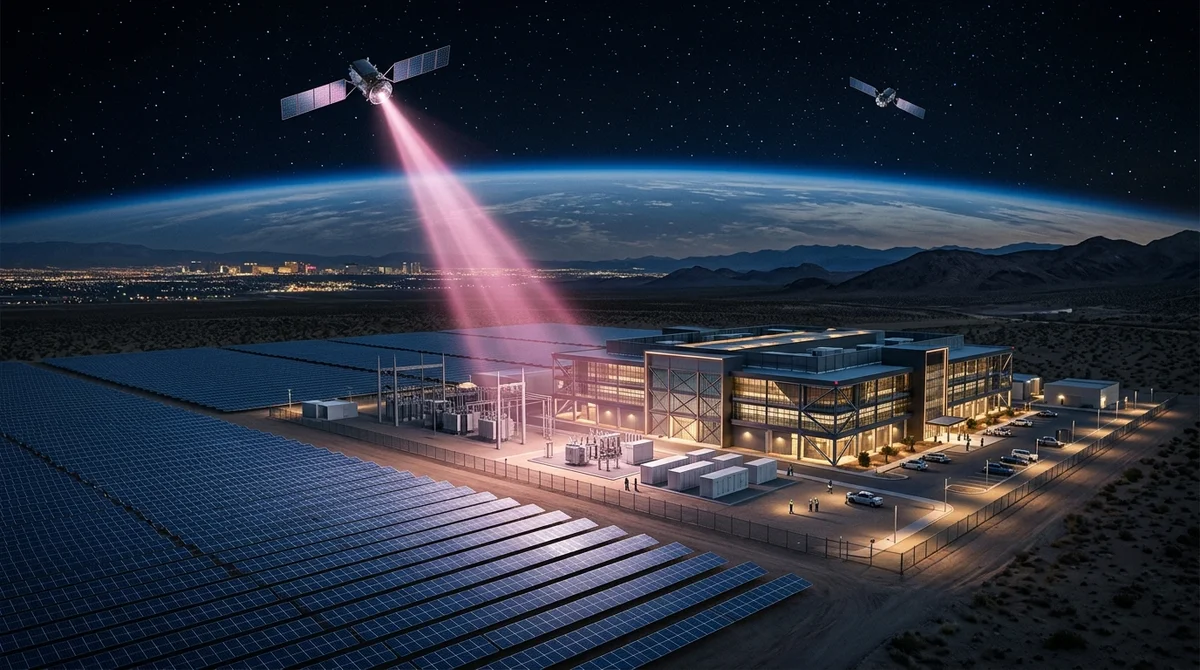
Meta is betting on one of the most ambitious energy ideas for the AI era: the company has agreed with startup Overview Energy to reserve up to 1 GW of power, which in the future they plan to transmit to Earth from orbital solar satellites. If the project succeeds, existing ground-based solar plants will be able to generate electricity not only during the day but also at night, while Meta will gain another power channel for its growing data centers. Overview's scheme differs from classical concepts of space solar energy, where microwave or powerful lasers and separate receiving stations are typically discussed.
The startup proposes a more practical architecture: satellites in geostationary orbit will continuously collect sunlight, and then transmit it to already operating solar farms in the form of low-intensity near-infrared radiation. Then the existing photovoltaic infrastructure on the ground comes into play, converting this stream into electricity and feeding it into the grid. The idea is not to build new ground infrastructure from scratch, not to occupy new land, and not to wait for a separate grid connection.
For Meta, this is primarily a question of energy for AI. Data centers must operate around the clock, but ordinary renewable sources are inherently unstable: the sun disappears at night, wind depends on weather, large battery systems remain expensive, and new nuclear projects require lengthy approvals and years of construction. In 2024, Meta's data centers consumed more than 18,000 GWh of electricity — comparable to the annual consumption of approximately 1.
7 million American households. Against this background, the company is expanding AI infrastructure, including the Hyperion campuses in Louisiana and Prometheus in Ohio, and at the same time seeking ways to increase zero-carbon power capacity. Its goal is to bring its renewable power portfolio to 30 GW.
The agreement with Overview does not yet mean that satellite energy is close to industrial scale. It is about reserving future capacity, not immediate supplies. The company plans its first orbital demonstration for January 2028, and commercial power delivery is expected to begin in 2030.
The parties did not disclose financial terms. Nevertheless, the deal is already being called the first commercial power capacity reservation from space solar energy by a major company — and probably the most notable signal that large tech companies are willing to finance even very early-stage energy technologies if they potentially solve the round-the-clock power supply problem. Overview Energy was founded in 2022 in Ashburn, Virginia, and came out of stealth mode only in late 2025.
The company claims to have already demonstrated energy transmission from a moving aerial platform to the ground, and its radiation will be invisible and less intense than sunlight; safety for people, animals, and aviation, the startup claims as one of the key advantages of the approach. But there are still many technical questions here: you need to launch and maintain powerful devices in geostationary orbit, ensure stable energy transmission on a commercial level, and prove that the entire chain will be economically sound compared to batteries, ground-based generation, and nuclear energy. It is notable that at the same time Meta announced a partnership with Noon Energy for ultra-long energy storage — another way to cover nighttime and weather generation gaps.
The main conclusion is simple: the energy race around AI is becoming no less important than the race for models and chips. Meta is not buying a ready-made solution, but is placing an option on technology that today looks experimental, but in case of success could dramatically increase the output of already built solar plants. If Overview reaches an orbital demonstration in 2028 and confirms the project's economics, the market will gain a new class of infrastructure — not instead of ground-based energy, but as its round-the-clock continuation.
Want to stop reading about AI and start using it?
AI News is a curated feed of AI/tech news. Hamidun Academy teaches you to use AI systematically in your work.