GPT-5.2 achieved top results on Tokyo and Kyoto University entrance exams
GPT-5.2 in reasoning mode achieved the best results on Tokyo and Kyoto University entrance exam tasks. In LifePrompt's testing, the model outperformed this…
AI-processed from 3DNews AI; edited by Hamidun News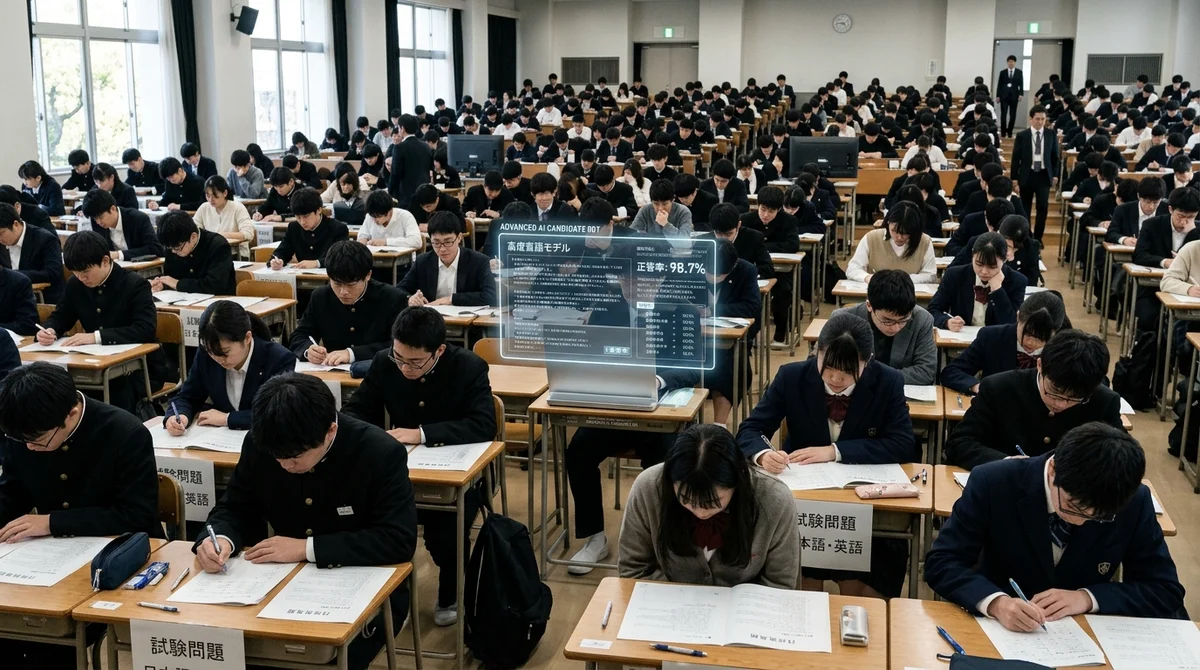
GPT-5.2 has reached yet another milestone long considered exclusively human territory: in testing on entrance exam questions from Tokyo and Kyoto universities, the model demonstrated results surpassing those of this year's applicants. And this is not merely about passing a threshold — according to LifePrompt, the system in reasoning mode achieved a level that exceeds even the highest passing scores across multiple programs, including medicine.
The tests were conducted by LifePrompt, comparing the model's answers against actual exam questions and results from the real admissions campaign. Importantly, this is neither official participation of the neural network in Japanese university admissions nor a story about enrollment: rather, it is a stress test of the model's academic capabilities in the most competitive environment. Yet precisely this format proves valuable: it allows assessment not of an abstract benchmark, but of how AI handles complex tasks on which the strongest candidates are filtered out.
The choice of venue is no accident either. Tokyo and Kyoto universities are Japan's two most prestigious and selective institutions, and medical programs traditionally rank among the most difficult to enter. If the model truly exceeds the upper threshold of passing scores in such programs, this signifies far more than mere erudition.
It is evidence of stable capability to work with tasks requiring logic, long chains of reasoning, precise calculations, and the ability to maintain context across multiple conditions. According to the test description, reasoning mode played a key role. In this mode, the model spends more time on internal analysis of the problem before delivering the final answer.
For entrance exams this is especially important: such tasks often penalize not lack of knowledge, but a single incorrect intermediate step. Thus progress in such systems increasingly resembles complete problem-solving in stepwise format rather than "statistical guessing." At the same time, this does not eliminate limitations: even an outstanding exam score does not yet prove the model is equally reliable in live dialogue, research work, or clinical decision-making.
For education, this signals implications in several directions. First, standard exams are increasingly failing to serve as pure knowledge filters if a powerful reasoning model can consistently pass them better than most people. Second, the value of preparation itself is changing: mechanical solving of familiar tasks becomes less important than the ability to formulate questions, verify intermediate steps, defend conclusions, and work in conjunction with AI tools.
Finally, such results push universities to reconsider assessment methods—incorporating more oral components, project work, and tasks where independent argumentation is critical, not merely the final answer on a test sheet. For the AI market, this is also a demonstration of where model competition is heading. The winning system is no longer the one that formulates text most elegantly, but the one that sustains long cognitive loads and maintains accuracy under pressure from complex conditions.
Academic exams are valuable precisely because they carry high error costs and clear success criteria. If a model begins confidently winning in such an environment, its potential quickly extends beyond education—into analytics, engineering calculations, certification preparation, and other fields where disciplined thinking is essential. The main conclusion is simple: the bar for "intelligent" AI has risen once again, and now the question is no longer whether a model can pass a difficult exam, but how people and institutions must restructure the rules around this fact.
For now, such tests remain more a demonstration of capabilities than a replacement for genuine expertise. But the gap between academic tasks for humans and for powerful models continues to narrow rapidly.
Want to stop reading about AI and start using it?
AI News is a curated feed of AI/tech news. Hamidun Academy teaches you to use AI systematically in your work.