DeepSeek, Qwen, and Moonshot intensify pressure on Silicon Valley with affordable models
Chinese models DeepSeek, Qwen, and Moonshot are no longer just cheaper alternatives—they've become a genuine threat to the US business model. They've nearly…
AI-processed from Bloomberg Tech; edited by Hamidun News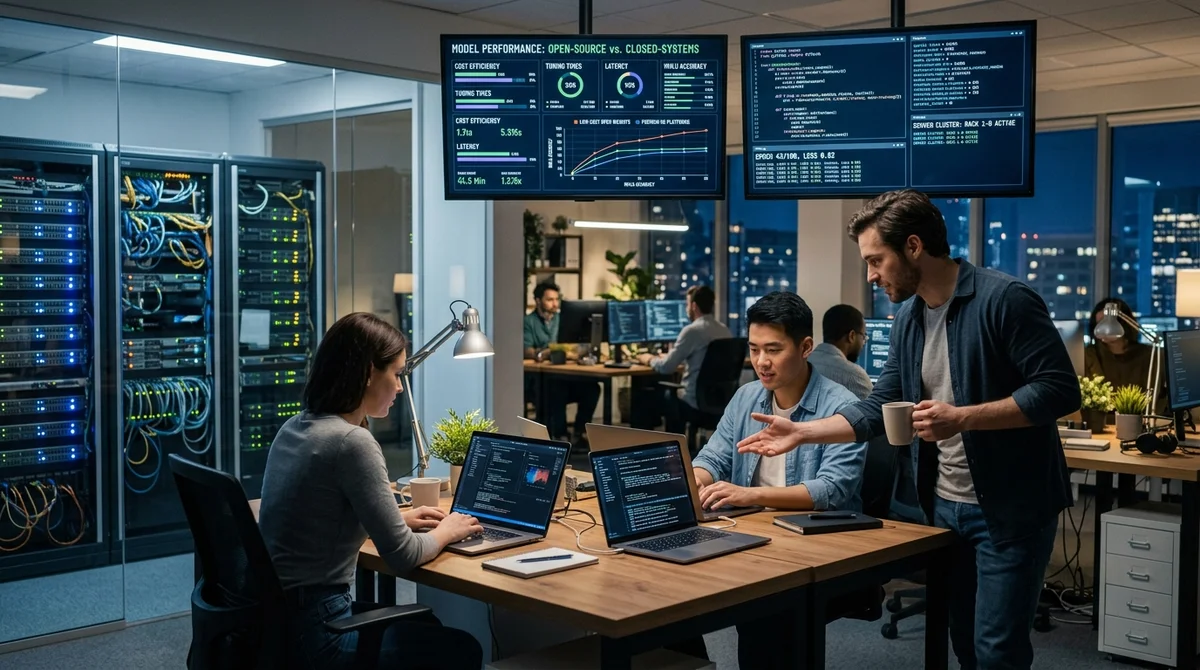
Chinese AI developers have stopped being followers and started changing the very economics of the market. DeepSeek, Qwen, and Moonshot models no longer look like a "cheaper compromise" choice: in many tasks they come close to the best American systems, but cost significantly less and give developers more freedom in customization. For Silicon Valley this is an unwelcome signal.
If the market understands that high-quality AI can be obtained without gigantic budgets, without the scarcest chips, and without tight dependence on a closed API, then what comes under pressure is not only US technological leadership, but the entire monetization model of advanced AI. The paradox is that the restrictions partially played into China's hands. American export restrictions on the most powerful chips and significantly less access to capital forced local laboratories to seek not a head-on path through endless computational scaling, but a more economical engineering strategy.
Instead of betting only on "the biggest cluster," Chinese companies accelerated work on training efficiency, inference optimization, and practical fine-tuning of models for specific scenarios. In parallel, they bet on the open-weight approach: model weights are available to developers, they can study them, adapt them, and embed them in their products. This is not just an ideology of openness, but a way to rapidly spread the technology across the economy and build an ecosystem around it.
By this logic, China began aiming not necessarily at the absolute maximum on benchmarks, but at the combination of price, flexibility, and speed of deployment. In Stanford HAI's December review, it was noted that Chinese open-weight models, after several years of lag, began catching up, and in some places even overtaking global competitors in capabilities and adoption. Researchers specifically highlighted the focus on computationally efficient models optimized for flexible use in downstream tasks.
This is an important difference from the American approach, where the best systems often remain closed and are sold as a premium service. For a business building assistants, agents, search functions, or internal copilot tools, the ability to take a strong model, fine-tune it for yourself, and reduce request costs is sometimes more important than winning a few points on a prestigious test. At the same time, to say that China has already clearly pulled ahead would be premature.
According to Epoch AI's assessment from January 2, 2026, since 2023 Chinese models on average lagged the American frontier by about seven months, and the gap at different times ranged from four to fourteen months. That is, US leadership at the very cutting edge is still preserved. But this is precisely where nervousness arises in Silicon Valley: the threat is not that DeepSeek or Qwen must necessarily be better in everything, but that the gap has narrowed to months, not years.
If a model costs significantly less, deploys faster, and is simultaneously "good enough" for most commercial tasks, the market starts counting money differently. From here comes the main challenge for American companies. Their current logic is built on enormous capital expenditures, scarce infrastructure, and selling access to closed models at high prices.
Chinese players are pressing on this construction from another angle: they offer more accessible entry, more open customization, and faster proliferation through the developer community. The wider such an ecosystem becomes, the weaker the argument looks that only a super-expensive closed model can be the foundation for a serious product. For startups, corporate teams, and integrators this means the emergence of a real alternative.
For investors—a risk that part of future AI margins will go not to those who first reached the frontier, but to those who managed to make a strong model mainstream. This also changes the very logic of competition. Not long ago the AI race was perceived as a competition where the winner is the one who spends the most on chips, data centers, and training.
Now it is becoming clear that openness, adaptability, and implementation costs are equally important. American laboratories still set the pace at the top of the market, but China has shown that you can quickly approach this level and start winning on distribution. For Silicon Valley this is bad news not because it has already been overtaken, but because it no longer has a monopoly on the best economic model for AI.
Want to stop reading about AI and start using it?
AI News is a curated feed of AI/tech news. Hamidun Academy teaches you to use AI systematically in your work.