Elon Musk and Sam Altman Head to Court: Case Could Reshape OpenAI's Structure
Proceedings have begun in Oakland where Elon Musk seeks to prove that OpenAI has strayed from its original nonprofit mission and become a commercial machine…
AI-processed from Bloomberg Tech; edited by Hamidun News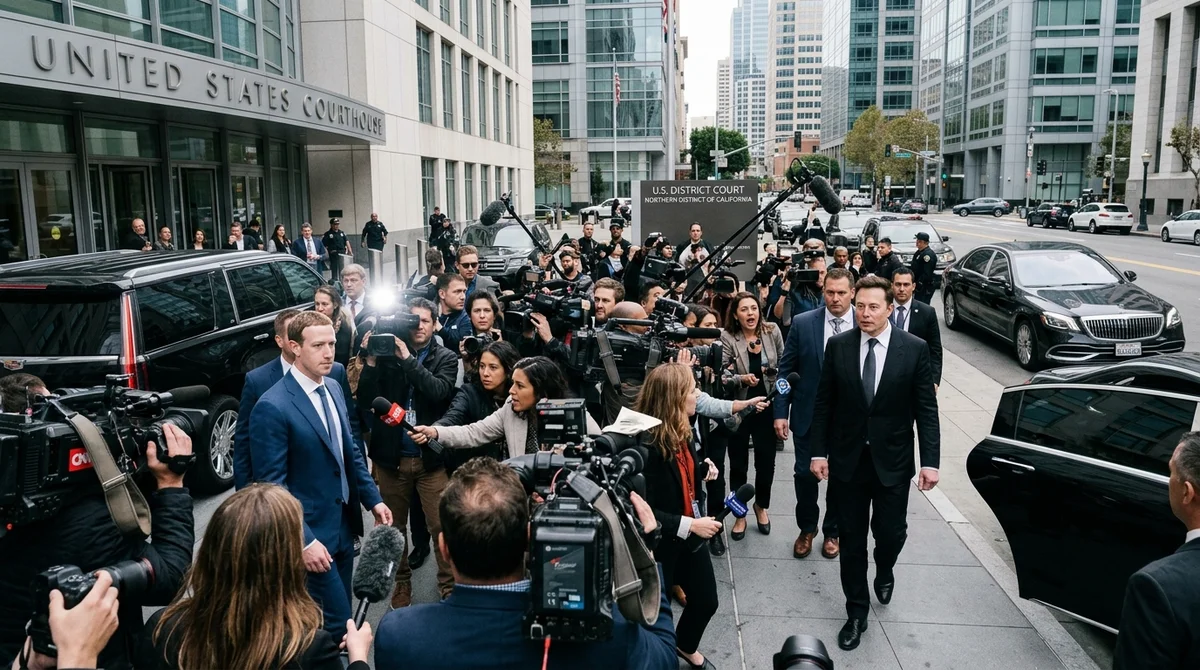
On April 27, 2026, a trial began in federal court in Oakland that could become the most significant corporate litigation in OpenAI's history. After jury selection was completed, Elon Musk and Sam Altman moved to the next stage of a dispute over what OpenAI should fundamentally be: a nonprofit organization with a mission to serve society, or a capital-intensive technology company that needs investors, revenue, and hard commercial logic to survive. For OpenAI, at stake is not only reputation but also governance structure, relations with Microsoft, and its path toward a public listing.
Musk's claims boil down to the fact that he helped launch OpenAI in 2015 as a public benefit project, invested approximately $38 million in it, and supported the idea of open research that should constrain major players like Google. He now argues that the company abandoned those promises: first by creating a commercial division, then by completely restructuring into a model where investors and partnership with Microsoft play an enormous role.
In his lawsuit, Musk is not simply demanding money. He is seeking to undo key restructuring, remove Altman and Greg Brockman from leadership, and direct any damages not to himself but to OpenAI's charitable mission. Before the trial, his team narrowed the lawsuit and dropped some fraud claims, leaving at the center of the dispute the question of whether the company violated its original nonprofit mission.
OpenAI's defense rests on the opposite version. The company says that as early as 2017, Musk himself discussed transitioning to a hybrid structure with nonprofit and commercial components, because without it OpenAI couldn't compete in the race for computing power, researchers, and data centers. According to OpenAI, the conflict didn't start over ideals but over control: Musk wanted more influence, including over the future structure, and after leaving the project, he launched his own competitor, xAI.
For the company, this trial is particularly sensitive now because the dispute is no longer about a small laboratory. In March 2026, OpenAI closed a funding round raising $122 billion at an $852 billion valuation, and its leadership openly says that further development requires even more capital and infrastructure.
The trial is structured to first address the question of liability, and only then discuss consequences. Jury selection was completed on April 27, opening statements are scheduled for April 28, and the proceedings are divided into two phases. The first phase will include an advisory jury: it will provide the court with its assessment of the substance of the dispute, but the final decision will still be made by Judge Yvonne Gonzalez Rogers. If the case reaches the second phase, discussion of sanctions and possible restructuring of OpenAI could begin on May 18 and, according to the current schedule, extend through May 22.
Expected witnesses include Musk himself, Altman, and representatives from Microsoft. This is important because the dispute has long transcended the personal feud between the two co-founders: it concerns the role of the largest partner, which became one of the main beneficiaries of OpenAI's commercialization.
The practical risk for OpenAI is that even a partial victory for Musk could slow the company down at a moment when it is simultaneously scaling products, building new infrastructure, and considering a possible IPO. If the court supports demands to reverse the restructuring or change leadership, the company will face not just a legal problem but a management shock.
For Microsoft, this is also not an abstract dispute: its stake and agreements with OpenAI are directly tied to the current corporate structure.
But Musk's defeat will mean more than a personal loss. In that case, the court would effectively confirm that an AI laboratory can start as a project with a public mission and then legally transform into a capital-intensive corporation while preserving the original rhetoric about benefit to humanity.
The main point here is not who of the two billionaires argues louder on X. The Oakland court is testing whether it's possible in the era of generative AI to combine a charitable mission, control over cutting-edge technology, and investors' appetites without a legal explosion. For OpenAI, this is a trial about its past, present, and the company's structure for years to come. For the entire industry, it's a test of where the beautiful founder legend ends and ordinary corporate reality begins.
Want to stop reading about AI and start using it?
AI News is a curated feed of AI/tech news. Hamidun Academy teaches you to use AI systematically in your work.