Canonical to Add AI Capabilities to Ubuntu for Accessibility and New Workflow Scenarios
Canonical is preparing a significant pivot of Ubuntu toward embedded AI within the coming year. The distribution will add features that work both in the…
AI-processed from The Verge; edited by Hamidun News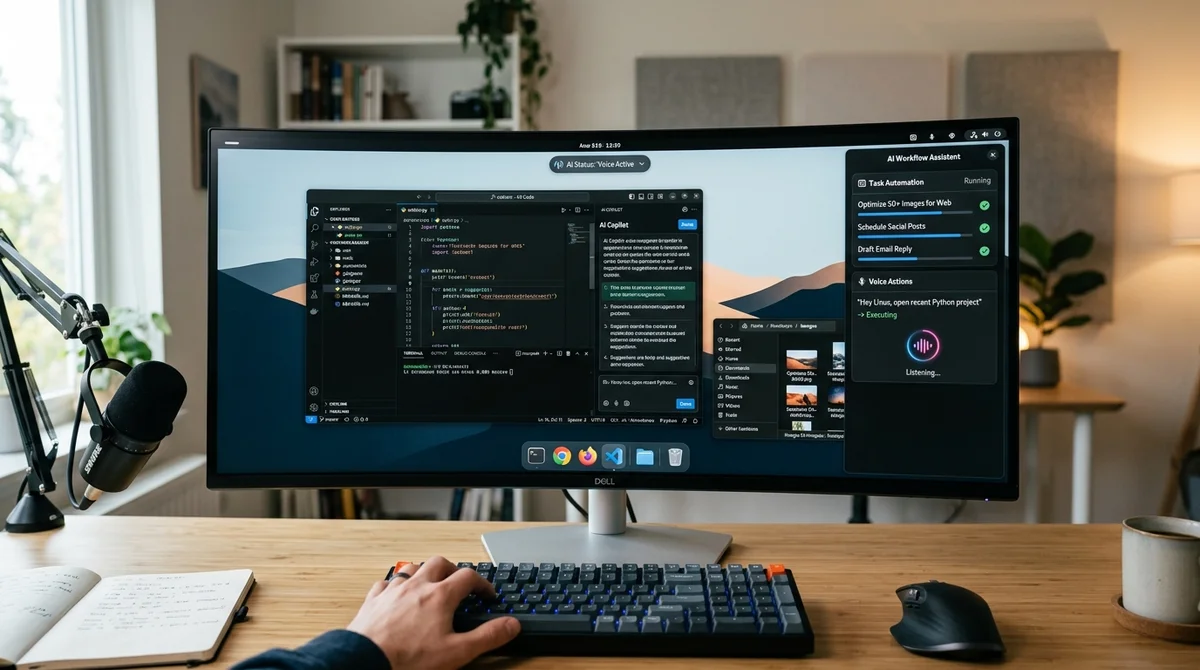
Ubuntu, one of the most popular Linux distributions, is preparing for a notable turn toward integrated artificial intelligence. Canonical plans to add a set of AI features to the system over the next year that will not only run separate models alongside the OS, but will enhance the familiar workflows of Ubuntu itself — from accessibility features to more complex automated actions. For the Linux market, this is an important milestone: AI is starting to be viewed not as an external addition, but as part of the basic user experience.
The plans were described by Canonical Vice President of Engineering John Siezer. According to his description, the company sees AI development in Ubuntu moving in two directions. The first is improving existing operating system capabilities using models running in the background.
The second is the emergence of separate AI-native functions and work scenarios for those users who truly need such tools. The formulation matters in itself: Canonical is not just talking about a chatbot inside the desktop, but describing a broader layer of system capabilities built directly into the everyday operation of the OS. Among the examples already mentioned are more advanced speech-to-text and text-to-speech tools.
For Ubuntu, this is a logical entry point. Speech recognition and voice synthesis functions are directly related to accessibility, meaning they can bring practical benefits not only to AI enthusiasts, but also to ordinary users who need more convenient input, text vocalization, or support for scenarios with visual and motor limitations. Such improvements are typically perceived much more calmly than loud experimental assistants, because they solve understandable problems and don't require completely changing the familiar way of working with the system.
The second direction looks even more interesting. Canonical directly mentions agent-based AI capabilities for task execution, though a detailed list of scenarios has not yet been disclosed. Translating this into the language of everyday work, it could involve assistants that understand the context of user actions and can do more than simply answer a question in a separate window.
In the Ubuntu ecosystem, such tools could potentially be useful for system configuration, working with files, finding needed parameters, preparing commands, summarizing text, or automating repetitive steps. At the same time, it's important that the company is currently describing a development framework rather than a finished product with a complete feature set. The choice of Ubuntu for such a course is particularly telling, because it is one of the most widespread and recognizable Linux distributions both on the desktop and in the development community.
Any changes in Ubuntu quickly become a benchmark for partners, hardware manufacturers, corporate customers, and neighboring projects in the open source ecosystem. Therefore, this is not just a local Canonical initiative, but a possible signal for the entire Linux segment: users increasingly expect AI to be built into interfaces, system services, and daily workflows, rather than existing separately in a browser or third-party application. At the same time, Canonical faces the issue of trust.
The Linux audience is traditionally sensitive to issues of control, transparency, and privacy, so the fate of these features will depend not only on their convenience, but also on exactly how they are implemented. For such a platform, it is fundamentally important whether the models will run locally or through the cloud, how easy it is to disable AI components, how data access rights are arranged, and how transparently system behavior is explained. Even if the company hasn't yet revealed all the technical details, these questions will likely become the main focus of discussions about future Ubuntu releases.
The main conclusion is simple: Canonical wants to make AI in Ubuntu not a separate showcase, but a system layer that gradually integrates into already familiar functions and is supplemented by new scenarios for those who need them. If the company can maintain a balance between usefulness, control, and unobtrusiveness, Ubuntu will have a chance to demonstrate one of the most practical approaches to integrating AI into a desktop operating system. If not, the Linux community will quickly remind everyone that what they value here is not only new capabilities, but also freedom of choice.
Want to stop reading about AI and start using it?
AI News is a curated feed of AI/tech news. Hamidun Academy teaches you to use AI systematically in your work.