Taylor Swift Files Trademark Applications for Voice and Image Due to AI Risks
Taylor Swift has begun legally securing rights to her own voice and image amid rising deepfake concerns. The singer's company filed three trademark…
AI-processed from Guardian; edited by Hamidun News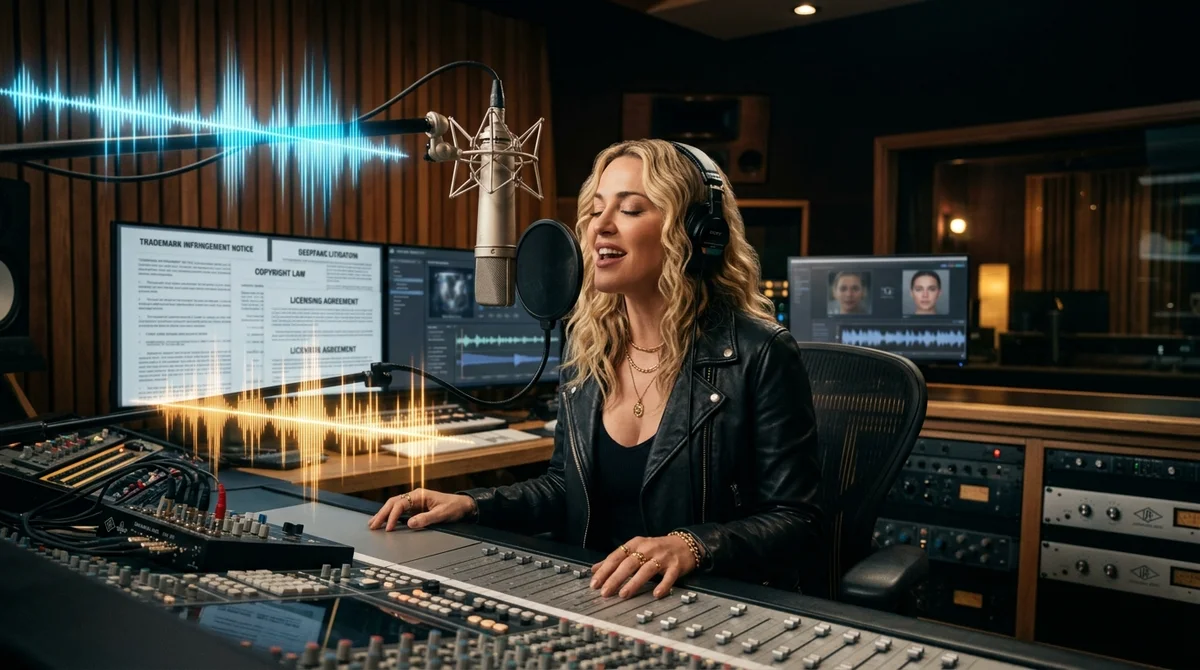
Taylor Swift moves fight against AI fakes from public complaints to legal ground. Her company has filed for trademarks related to her voice and image, which appears to be an attempt to preemptively close one of the most vulnerable fronts for celebrities: unauthorized voice copies, deepfakes, and commercial use of recognizable image without consent from rights holders. On April 24, 2026, the company TAS Rights Management filed three applications.
Two of them relate to sound trademarks and cover the phrases "Hello, this is Taylor Swift" and "Hi, this is Taylor." The third application is related to protecting her visual image. This set of applications shows that this is not a symbolic gesture, but rather a fixation of specific identity elements that are already easily copied by generative models and can be used in advertisements, fake audio messages, synthetic interviews, and other content that looks plausible to the audience.
The reason is clear: AI systems have drastically simplified the creation of materials in which a celebrity supposedly says something, supports a product, releases new music, or participates in a campaign they have nothing to do with. For artists of Swift's level, this is not only a reputational risk but also a direct business question. Her voice, manner of delivery, name, and visual recognizability work in streaming, merchandise, licensing, concert business, and brand partnerships. If all of this can be relatively cheaply imitated, protection must be preventative rather than reactive. In essence, it's about protecting not one track or one video, but the entire commercial shell of the artist as a brand.
It's particularly important that this is specifically about trademarks, not just copyright. Copyright typically protects specific works: a song, recording, text, video. But when a dispute arises around a short audio phrase, a signature greeting, or the most commercial image, copyright mechanisms alone may not be sufficient. A trademark provides a different type of argument: it helps show that a certain sound, phrase, or visual identity is associated with a specific rights holder and can mislead the audience if used by someone else.
In the age of AI, this is especially useful because counterfeiting is often built not on direct copying of an old recording, but on a plausible imitation of a recognizable style. For lawyers and platforms, this is a more convenient construct when you need to quickly justify removing content or making a claim against a brand that decided to use a synthetic copy of a famous person.
The context around the application is also telling. Shortly before this, Matthew McConaughey chose a similar strategy, also formalizing rights to his own voice and image. This means the entertainment industry is beginning to perceive generative AI not as a one-time nuisance, but as a long-term legal and commercial risk. Platforms can remove obvious fakes, but that's not enough: public figures and their management need tools that work before disputed content is published, during negotiations with brands, and in courts. The clearer the rights to specific identity elements are formalized, the easier it is to demand blocking, compensation, or cessation of use.
For the music market, this is also a signal to other artists: you now have to protect not just a catalog of songs, but the person themselves as a set of licensable characteristics. This means a simple shift: fighting AI imitations becomes not just technological but infrastructural. Those who will win are not those who complain loudest about deepfakes, but those who preemptively formalize rights to key elements of their identity and can quickly prove their ownership.
Taylor Swift's applications are not just protection for one singer, but an early model of how major public figures will build their defense in the era of mass synthetic content.
Want to stop reading about AI and start using it?
AI News is a curated feed of AI/tech news. Hamidun Academy teaches you to use AI systematically in your work.