OpenAI and Qualcomm Prepare AI-Smartphone Where Agents Could Replace Conventional Apps
OpenAI seems to be seriously moving into hardware: according to Ming-Chi Kuo, the company is making a smartphone where the main interface will be AI agents…
AI-processed from TNW; edited by Hamidun News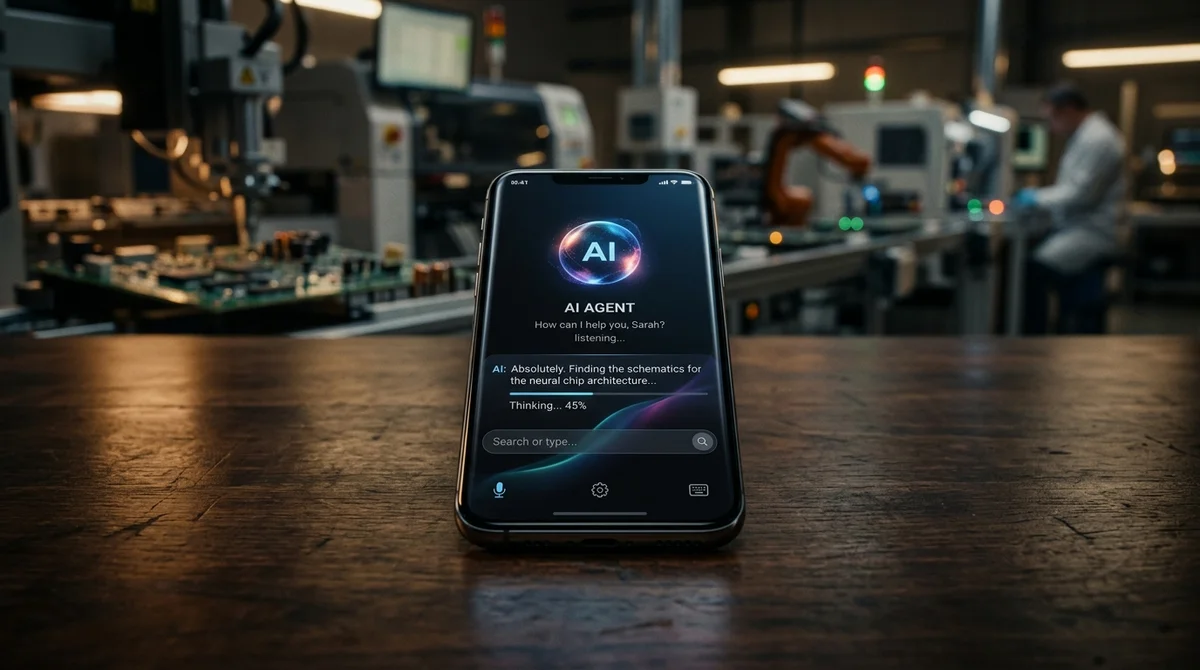
OpenAI and Qualcomm are preparing an AI smartphone where agents can replace familiar apps
Based on supply chain data, OpenAI is not just making another smartphone, but a device with different interaction logic: instead of the usual set of applications, AI-agents should be at the center of the system. If the project actually reaches release, the market could receive one of the first mass-market phones where a user doesn't open icons, but sets tasks to an intelligent assistant that will itself choose the needed service, action, and sequence of steps. According to analyst Ming-Chi Kuo of TF International Securities, OpenAI is developing a smartphone built around an agent scenario.
The key idea is that the phone's interface should shift from an app-first model to an agent-first model. This is an important difference. Today, even the most advanced AI features on mobile devices usually remain an overlay over the existing ecosystem of applications.
The user still switches between messenger, browser, notes, maps, delivery, and other services. In OpenAI's case, the concept appears to be the opposite: the agent becomes the main entry point, while applications either fade into the background or become completely invisible infrastructure.
The composition of partners indirectly speaks to the maturity of the project. According to Kuo, Qualcomm and MediaTek are jointly participating in the development of a custom processor for the device, and Luxshare Precision Industry will not only become the exclusive manufacturer, but also helps with joint design. Already this looks atypical.
Qualcomm and MediaTek usually compete with each other rather than work together on a mass-market mobile chip. If such cooperation really exists, it means the project requires non-standard architecture and possibly a new balance between local computing on the device, energy efficiency, and continuous operation of AI models. For a phone designed to keep an agent active most of the time, the chip question is not a detail but the foundation of the entire product.
And Luxshare's involvement brings the story closer to real hardware: when such a manufacturing partner is involved in a project, it usually means it's no longer just a beautiful idea on slides, but design, components, assembly, and scaling up production.
For OpenAI itself, such a step would look like a logical continuation of the fight for the AI interface. Today the company controls the model and the application, but does not control the end device, sensors, power consumption, background task execution, and OS access rules. Its own phone would give it much more space for experiments: from voice interaction by default to deep integration of memory, camera, search, shopping, navigation, and personal scenarios. The idea of making applications optional in such a design no longer sounds like a marketing slogan. If an agent can book, correspond, order, compare, and launch the necessary actions on its own, the user really starts to think not in screens but in intentions.
But this is exactly where the main risk lies. A smartphone without the familiar logic of applications must be not just interesting but noticeably more convenient than today's iPhone or Android flagship. Users tolerate dozens of icons not because they love chaos, but because applications are predictable: you know where to tap, what will open, and how to undo an action. The agent model promises to remove unnecessary steps, but in return must provide transparency, control, privacy, and very high reliability. One powerful language model is not enough—you need a system that works stably in real everyday scenarios, doesn't drain the battery in half a day, and doesn't turn every task into an endless dialog with a bot.
If the supply chain leak is correct, OpenAI is beginning an offensive not only on the application market, but on the very model of mobile computing itself. This does not guarantee success: the industry has already seen devices that tried to reinvent the interface and failed to become a habit. But the fact that the project is accompanied by chipmakers and a contract manufacturer changes the tone of the conversation. It's no longer about a distant fantasy, but about a product that could theoretically reach the shelf and test in practice whether a user is ready to entrust the phone not with a set of taps, but with their own intentions.
Want to stop reading about AI and start using it?
AI News is a curated feed of AI/tech news. Hamidun Academy teaches you to use AI systematically in your work.