World Press Photo announces photo of the year and sets boundary for generative AI
World Press Photo selected the photo of the year and set a firm boundary for the generative AI era. Carol Guzy's photograph 'Separated by ICE' won, showing…
AI-processed from The Verge; edited by Hamidun News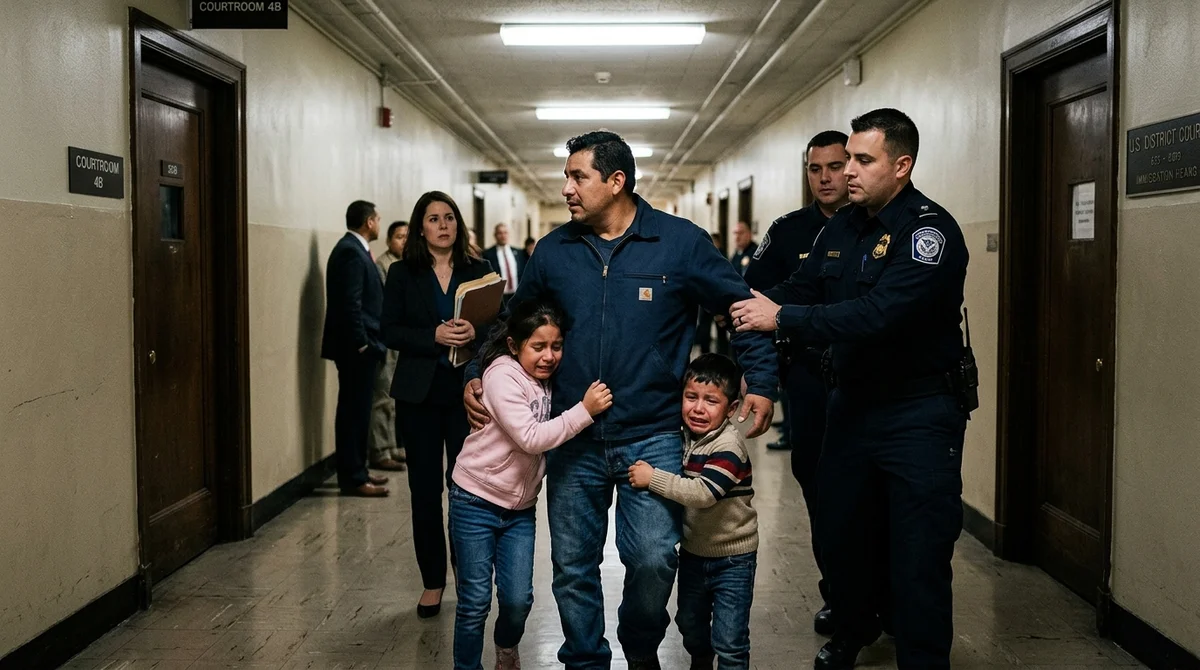
World Press Photo in 2026 has perhaps given the clearest answer to the debate about what counts as photography in the age of generative AI: a photograph should be a recording of a real physical moment, not a synthetically assembled image. The winner was Carol Guzy's shot "Separated by ICE" — a scene after an immigration hearing where children clung to their father at the moment of his detention by ICE officials. The winner was announced on April 23, 2026.
The photograph, taken on August 26, 2025, in the Jacob Javits federal building in New York, shows Luis, who was detained by agents of the U.S. Immigration and Customs Enforcement Service (ICE) after an immigration court hearing.
For the jury, this is not just an emotional frame, but evidence of how state policy is experienced by a specific family in a specific second. This documentary status turned out to be central to the conversation about the boundary between photography and AI. This work has another dimension as well.
The photograph was taken inside one of the few federal buildings in the U.S. where journalists were allowed to document such scenes at all.
According to the competition organizers, photographers came there day after day to document the consequences of immigration hearings. This transforms Guzy's work from a single powerful photograph into part of a systemic chronicle: it shows not an exception, but a recurring mechanism in which a bureaucratic procedure ends in family separation. World Press Photo formulates the boundary with AI as directly as possible in the competition rules: images created by AI are not considered photography.
According to the competition, photography arises when a camera captures light on a sensor or film, thereby preserving a physical moment. Therefore, the competition prohibits synthetic images and generative retouching at the post-processing stage. At the same time, the organization acknowledges that modern shooting and editing processes already include computational tools, and therefore allows some AI-based enhancement tools — but only if they do not change the frame's content, do not add new information, and do not remove what actually entered the lens.
This is an important caveat, because the dispute has long gone beyond fine art photography. In photojournalism, a photograph works as testimony: the editorial staff, the subjects of the story, and the audience must understand what actually happened in front of the camera and what the machine added. Because of this, World Press Photo did not limit itself to general words about "authenticity," but requires original files from works that reach the final stages, and specifically points out that some AI tools like "smart" image enlargement programs automatically violate the rules.
In other words, the question is no longer whether to use AI at all, but where technical processing ends and reality replacement begins. The selection of finalists only strengthens this message. The best works of the year also included shots of the humanitarian catastrophe in Gaza and trials of Achi women in Guatemala.
The topics are different, but the principle is the same: an image is valuable not for its spectacle, but for what holds the viewer before a difficult reality and gives it visual confirmation. In this sense, the competition protects not "old photography" as a craft, but the public function of visual testimony. This rule is not imposed on the competition's scale in a vacuum.
In 2026, the jury chose from 57,376 photographs submitted by 3,747 authors from 141 countries. The winner receives 10,000 euros, and an exhibition with the laureates' work opened in Amsterdam on April 24 and will then travel to dozens of venues around the world. That is, the World Press Photo decision is not an internal debate within the professional community, but a guide for a large segment of the international media industry.
When such a competition says that generation is not equal to photography, it quickly becomes a practical standard for editorial offices, agencies, and photographers themselves. The main conclusion here is that the era of generative AI has not canceled photography, but has forced a more precise definition of its boundaries. If an image claims documentary status, its value now increasingly depends not only on the strength of the frame, but also on the transparency of its origin.
World Press Photo has essentially established a simple rule: you can improve technical quality, but you cannot synthesize an event. For news photography, this may be the most important guide for the coming years.
Want to stop reading about AI and start using it?
AI News is a curated feed of AI/tech news. Hamidun Academy teaches you to use AI systematically in your work.