Nothing launched Essential Voice AI dictation for smartphones with support for over 100 languages
Nothing introduced Essential Voice — built-in AI dictation for smartphones that works in any application. The service converts speech to clean text, removes…
AI-processed from TechCrunch; edited by Hamidun News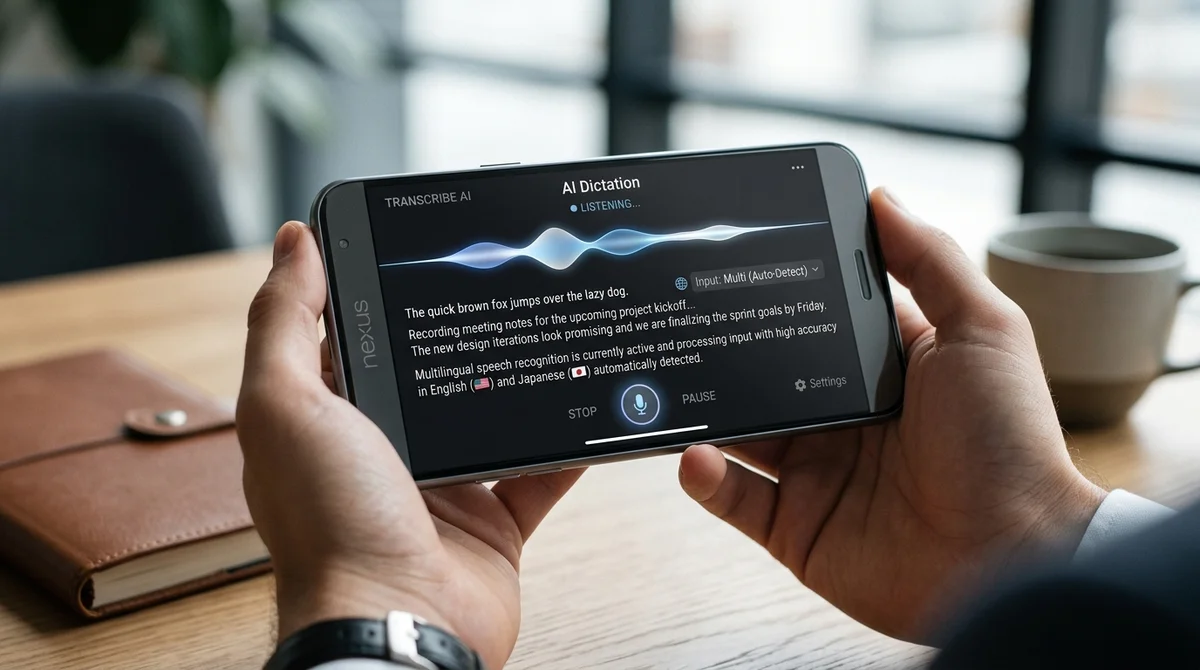
Nothing is expanding its AI lineup not with another chatbot, but with a practical feature that can be useful every day: the company introduced Essential Voice, a built-in dictation tool for smartphones capable of transforming live speech into neatly formatted text. The focus is not just on word recognition, but on more convenient mobile input: the service removes filler words, works in any application, and immediately prepares the text in a form suitable for sending, note-taking, or work messaging. Nothing announced the launch on April 24, 2026.
Essential Voice is integrated at the system level and, according to the company, should free users from the need to switch between separate dictation applications and the main smartphone interface. The tool accepts voice input, converts it to text, and immediately renders the result in a readable format. It's not just about basic transcription: the system removes common pauses and interjections like 'uh' and 'um' to produce a cleaner message on output. For scenarios where the same data is entered repeatedly, custom voice shortcuts are available. For example, you can link a short command to a full address, link, template phrase, or recurring text snippet.
Currently, the feature is available on Nothing Phone (3). For Phone (4a) Pro, the release is scheduled by the end of April 2026, and for Phone (4a) — in May. Dictation can be launched in two ways: via a dedicated Essential key on compatible devices or directly from the keyboard. This is an important detail, because Nothing is trying to integrate voice input into the normal user workflow, rather than leaving it as a niche feature hidden deep in settings.
The company also emphasizes the speed factor: according to its assessment, the average user types about 36 words per minute on a smartphone, while speaking text can be roughly four times faster. This thesis forms the basis for positioning Essential Voice as a productivity tool, not a decorative AI add-on. Another notable feature is text translation from one language to another directly during input. At launch, Essential Voice supports over 100 languages, making the feature potentially useful not only for personal correspondence, but also for work in international environments, travel, and client communication.
In upcoming updates, Nothing also promises to add editing style customization by application categories. The idea is that the AI will be able to process the same voice draft differently depending on context: more formally for work tasks and more freely for messages. If this feature is implemented carefully, dictation will begin to compete not only with standard speech recognition services, but also with products that combine transcription, editing, and answer templates.
This is not a unique move in the market. In recent years, AI dictation has become a fast-growing segment: alongside earlier products, Wispr Flow, Superwhisper, Willow, Monologue and other tools have emerged, with new solutions appearing almost every week. Recently, Google also presented its own dictation solution, so interest in the category clearly extends beyond startups. But Nothing has an important advantage: the company is among the first to try to offer such a feature not as a separate application, but as a system layer within the smartphone.
It is precisely this integration that could be the main advantage, because users don't need to change their usual way of working — voice simply becomes another standard input method alongside the keyboard. For Nothing, this is a modest announcement in scope but significant in its implications. The company is not promising to reinvent mobile AI, but rather taking a specific everyday scenario and making it faster. If Essential Voice truly works stably across any application, cleans text well, and switches between languages smoothly, voice input will have a chance to become a mass habit rather than a rare feature 'for when your hands are busy'.
Want to stop reading about AI and start using it?
AI News is a curated feed of AI/tech news. Hamidun Academy teaches you to use AI systematically in your work.