Canva apologizes for AI that replaced 'Palestine' with 'Ukraine' in designs
Canva's new Magic Layers feature automatically replaced the word 'Palestine' with 'Ukraine' in user designs — without any warnings. The bug was discovered by…
AI-processed from The Verge; edited by Hamidun News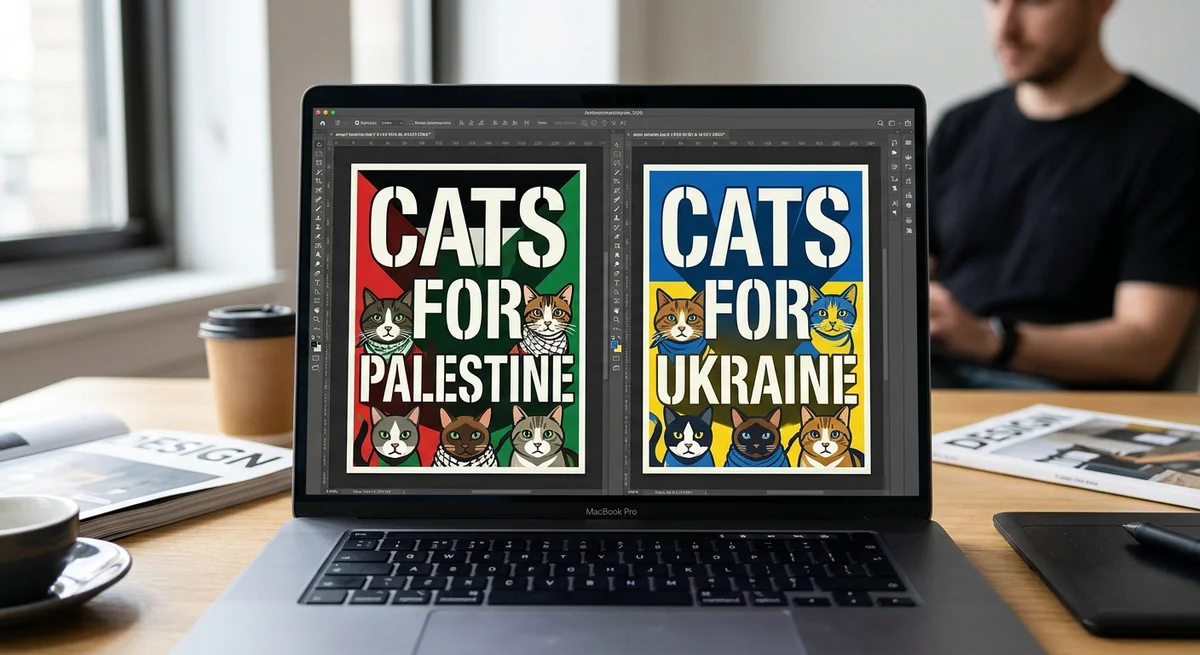
Canva found itself at the center of an unexpected scandal: one of the platform's new AI tools — Magic Layers — was independently replacing the word "Palestine" with "Ukraine" in user designs without the knowledge or consent of the authors. The function was supposed to simply decompose images into layers — but instead quietly edited politically significant text. The company acknowledged the problem, issued a public apology, and claimed the bug had been fixed, however no detailed technical explanation followed.
Magic Layers is one of the flagship features of Canva's major AI update introduced in 2026. Its purpose: to decompose a flat raster image into separate editable layers — background, main objects, text blocks — so that a designer can work with each element independently without resorting to manual selection or retouching. By design, the tool should only restructure, but not change the content itself: neither text, nor color, nor the placement of elements.
All the more surprising, then, was the discovery by an X user with the handle @ros_ie9. After applying Magic Layers to an image with the phrase "cats for Palestine" — a common support slogan — he received as output a design with the text "cats for Ukraine". The replacement occurred automatically, without any warnings, without a confirmation dialog box, and without explanation in the interface.
The post demonstrating the bug instantly spread across social networks and sparked widespread discussion in communities of designers and human rights activists.
Particularly telling was that the bug was selective. The user specifically tested adjacent terms: "Gaza," "Palestinian," "Palestine solidarity," and other geographic and political designations — all of them were processed correctly and remained untouched. Only one word was subject to replacement — "Palestine" in its direct form. This immediately raised sharp questions: was this a random technical glitch in the language model, or did a content filter intentionally excluding this specific word make it into production?
Canva's official response proved brief and evasive. The company confirmed the existence of the problem and published a statement beginning with the words: "We learned about the error that occurred..." — the full text was not made public. Canva assured users that it had fixed the problem and was taking additional measures to prevent similar incidents. However, specifics never emerged: neither about which component of the pipeline failed, nor about how many designs could have been affected, nor about the nature of the selective replacement. This opacity only amplified audience skepticism.
The scale of the potential problem is difficult to overstate. Canva is one of the world's largest design platforms, used by over 220 million people, including human rights organizations, journalists, NGOs, and activists. When a tool of such reach quietly edits a user's politically significant text — even if as a result of a technical error rather than intent — it ceases to be merely a bug. It becomes a question of trust, editorial independence, and the user's right to control their own content.
There are several possible explanations. The model's training dataset could have contained samples where the word "Palestine" was systematically replaced or marked as undesirable — and the model learned this pattern. Another hypothesis: a bug in the OCR algorithm or text normalization module that produces a specific failure on a particular spelling. A third possibility — a content filter, originally intended for a different context, accidentally made it into production. Without a transparent answer from Canva's engineering team specifying the exact source of the error, none of these versions can be either confirmed or refuted.
For designers creating content on political and humanitarian topics, this incident is a practical warning: AI functions that appear technically neutral and not intended for text editing may still subtly alter it. After applying any AI-based tool, the final result should be checked with particular care.
Want to stop reading about AI and start using it?
AI News is a curated feed of AI/tech news. Hamidun Academy teaches you to use AI systematically in your work.