Startup with controversial founders will create an army of humanoid robots for the Pentagon
San Francisco startup Foundation Future Industries, founded by the former head of a failed fintech and the son of a high-ranking politician, secured military…
AI-processed from TNW; edited by Hamidun News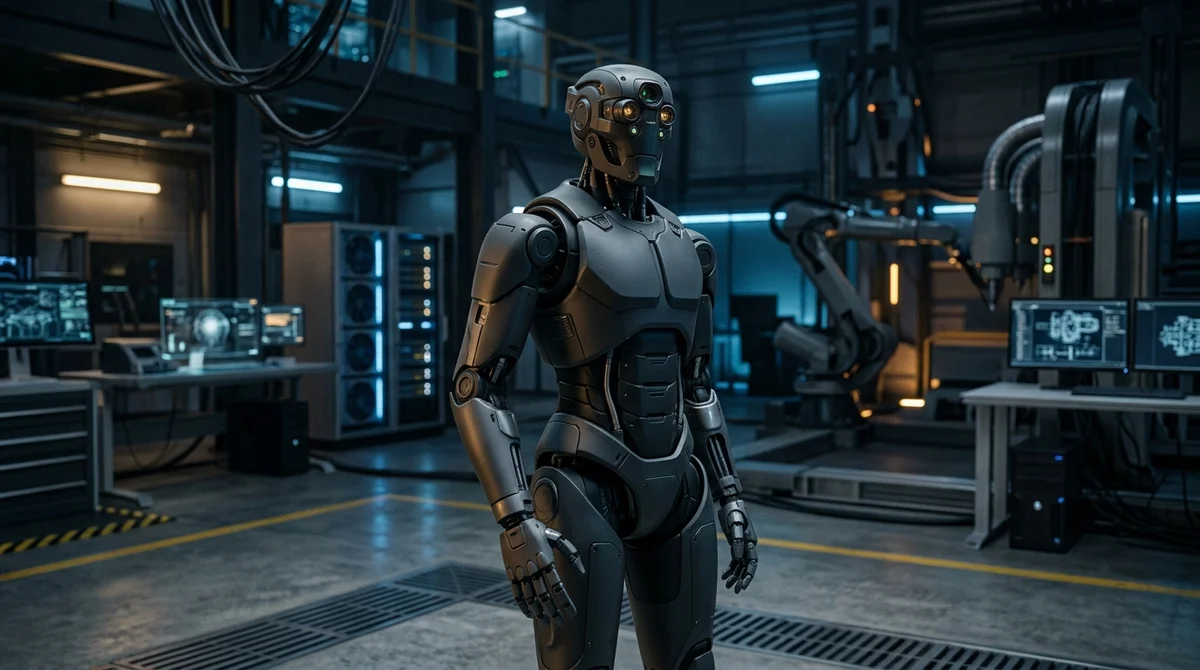
Silicon Valley has long sought to distance itself from the military-industrial complex, mindful of mass protests by technology workers against projects linked to the Pentagon. However, today this paradigm is undergoing fundamental transformation. A young startup, Foundation Future Industries from San Francisco, founded in spring 2024, has quietly but steadily secured contracts worth twenty-four million dollars from the U.
S. Army, Navy, and Air Force. Their goal sounds simultaneously ambitious and frightening: to create a genuine army of humanoid robots capable of storming enemy positions and operating on the front lines.
The situation becomes particularly intriguing due to the rather eclectic composition of the company's leadership, which includes a former chief executive of a bankrupt fintech venture and the son of a high-ranking political figure.
This significant financial injection underscores a broader transformation in the American defense establishment's approach to technological innovation. For decades, military procurement was controlled by giant conglomerates whose development processes took years and consumed enormous budgets. Today, the Department of Defense increasingly turns its attention to agile startups funded by venture capital and operating with the ruthless efficiency of the technology sector. Foundation Future Industries represents the vanguard of this new wave, demonstrating that startup speed and boldness can be successfully integrated into national security infrastructure. The necessity of deploying autonomous systems is accelerating against a backdrop of geopolitical tension and the changing nature of modern warfare, where minimizing human casualties becomes an absolute priority.
The centerpiece of this ambitious military contract is Phantom MK-1, a humanoid robot whose technical specifications blur the line between science fiction and the harsh reality of the battlefield. Standing 175 centimeters tall and weighing approximately 80 kilograms, its physical dimensions are deliberately designed to mirror the parameters of an average infantryman. This is not merely an aesthetic choice, but a fundamental engineering necessity.
By mimicking human form, Phantom MK-1 gains the ability to move freely through environments, use vehicles, and penetrate buildings constructed exclusively for humans. The machine possesses nineteen degrees of freedom in the upper body alone, enabling complex and fluid movements. Combined with fully articulated five-fingered hands, the robot is capable of handling standard infantry equipment, opening doors, and overcoming obstacles without requiring specially designed interfaces.
Beyond mechanical dexterity, the true potential of Phantom MK-1 lies in its sensory and cognitive architecture. The robot employs a vision system primarily relying on cameras and advanced spatial assessment algorithms rather than excessive dependence on active sensors like conventional lidar. In real combat conditions, active sensors can easily betray a unit's position by emitting detectable signals, making passive visual perception a critical advantage.
This approach demands enormous computational power for real-time processing of visual data, interpretation of complex environments, distinction between combatants and civilians, and lightning-fast decision-making during breakthrough operations. It is here that the convergence of modern multimodal neural networks and physical robotics becomes a decisive factor, bringing the logical capabilities of artificial intelligence directly to the theater of war.
The consequences of deploying autonomous humanoids in combat roles on the front lines are profound and far-reaching. At the tactical level, sending machines to conduct dangerous breakthrough maneuvers could radically reduce human casualties. However, this technological leap generates unprecedented ethical and operational dilemmas. Responsibility for actions undertaken by an armed machine, potential algorithmic bias in target identification, and the risk of conflict escalation remain largely unresolved problems. When the threshold for use of force is lowered due to absence of risk to one's own soldiers' lives, governments may more readily make decisions to initiate military operations. Moreover, this dynamic shifts the balance of power toward nations with dominant technological ecosystems, making artificial intelligence a defining factor in global security.
As Foundation Future Industries advances through its multimillion-dollar testing phases, the traditional boundaries between commercial innovation and military equipment continue to dissolve rapidly. We are witnessing the birth of a new military paradigm where software updates and robot iterations dictate the pace of tactical superiority. The success or failure of Phantom MK-1 will serve as an indicator for the entire defense technology sector, potentially unleashing a new wave of investment in militarized robotics. Ultimately, the question is no longer whether autonomous humanoids will fight in future conflicts, but how quickly they will become the standard vanguard of modern armies, fundamentally rewriting the rules of warfare.
Want to stop reading about AI and start using it?
AI News is a curated feed of AI/tech news. Hamidun Academy teaches you to use AI systematically in your work.