Computing Power Over Checks: Why Sequoia Is Distributing Hardware to AI Developers
Venture capital fund Sequoia Capital has found an unconventional way to support AI development, traditionally an area where direct investment isn't feasible…
AI-processed from TNW; edited by Hamidun News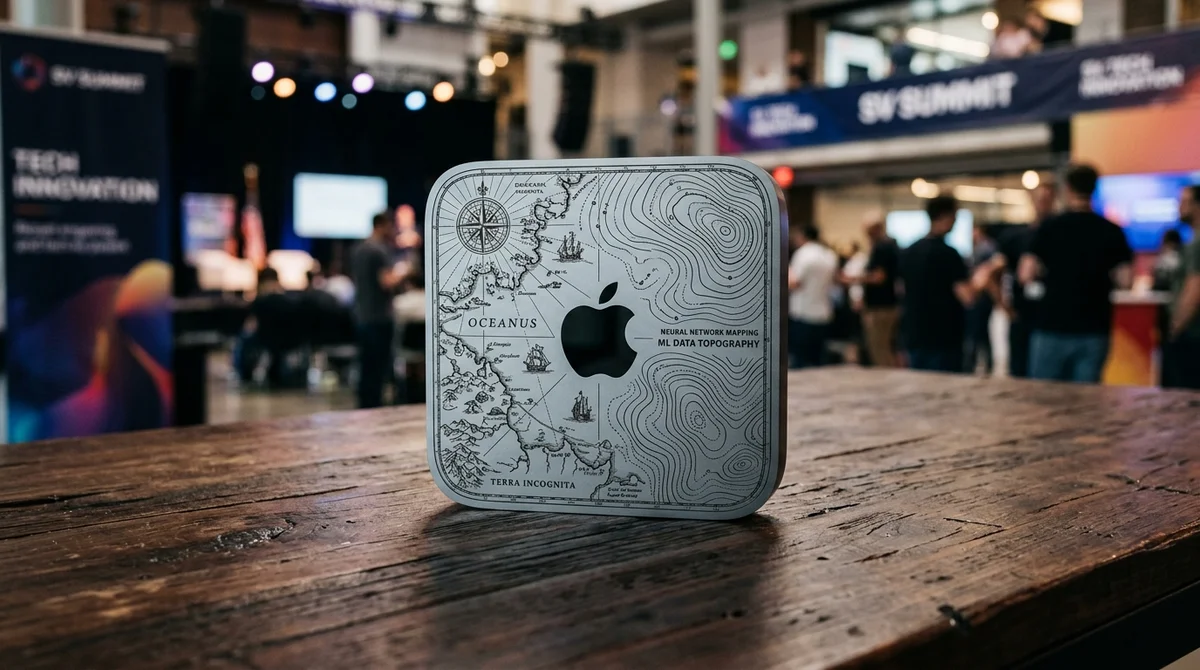
Venture capital in Silicon Valley is undergoing a quiet but tectonic transformation. The era when an investor's influence was measured exclusively by the zeros on a check and aggressive conditions in corporate contracts is giving way to more subtle strategies. A vivid marker of this shift was the recent action of Alfred Lin, a managing partner of the legendary Sequoia Capital fund. At a closed event "AI at the Frontier," he did not announce new mega-rounds of funding, but instead personally handed out custom Mac Mini computers to two hundred participants. This seemingly simple gesture conceals a deep understanding of how artificial intelligence's future is being forged today.
Each of the gifted computers was transformed into a physical artifact, symbolizing the intersection of tradition and cutting-edge technology. The Mac Mini casings were adorned with unique laser engravings in which elements of ancient cartography organically interwove with contour graphs of machine learning. Beyond aesthetic value, the devices contained digital "easter eggs": Sequoia's manifesto about supporting creative minds and outsiders, as well as a quote generated by a neural network. However, the essence of this initiative lies not in the souvenir appeal of the gift, but in the very fact of unconditional transfer of equipment for projects that the fund cannot, by its nature, invest in.
To understand Sequoia's logic, one must examine the technical landscape of modern artificial intelligence. The choice of Mac Mini as a gift is far from accidental. Thanks to Apple Silicon architecture and unified memory, these compact machines have become the favorite tool for engineers working with local language models. Unlike traditional PCs, where video memory volume is rigidly limited by expensive graphics cards, the Apple architecture allows the use of dozens of gigabytes of shared RAM to load neural network weights. This makes Mac Mini an ideal platform for local inference, experiments with open-source models, and development of edge AI that does not depend on costly cloud APIs.
The main paradox of the situation is that the most innovative and groundbreaking work in AI today often happens outside the framework of traditional corporate structures. Decentralized networks, academic consortiums, open-source movements, and artificial intelligence safety initiatives—all these formats do not entail the issuance of shares that a venture fund could purchase. Sequoia Capital, like other industry giants, understands this problem: if you try to impose a venture model on a decentralized community, you will only drive away talent. But if you cannot buy a stake in a company, you can invest in the environment itself in which these talents exist.
By distributing computing power, Sequoia Capital is essentially acting as an infrastructure provider for independent researchers. The fund subsidizes the most scarce resource of our time—access to hardware. This creates enormous loyalty within the community. Developers get tools for independent work, while the fund secures its place at the very center of the ecosystem, watching ideas germinate at their earliest, not yet commercialized stage.
The consequences of this approach for the entire industry are difficult to overstate. We are witnessing how the competition for engineers' minds is shifting to even earlier stages. Competition among investors now unfolds not at the level of startups seeking seed funding, but at the level of individual visionaries and small research groups who for now only need computers and freedom of action. Other major funds will have to reconsider their methods of interacting with the community in order not to be left on the sidelines while Sequoia builds relationships with the creators of tomorrow's technologies.
Ultimately, Alfred Lin's initiative is a classic long-game strategy adapted to the realities of the AI revolution. Sequoia Capital is not simply distributing equipment; the fund is sowing soil from which new computing paradigms will inevitably grow. And when today's independent researchers tomorrow stumble upon a commercially successful breakthrough and decide to launch a company, they will certainly remember whose machine stood on their desk during the days of their first experiments.
Want to stop reading about AI and start using it?
AI News is a curated feed of AI/tech news. Hamidun Academy teaches you to use AI systematically in your work.