The Price of Intelligence: How Elon Musk's Mega Data Center Is Changing Memphis's Ecology
The arms race in artificial intelligence has a tangible price. The massive "Colossus" data center built by Elon Musk's xAI in Memphis to train the Grok model…
AI-processed from Habr AI; edited by Hamidun News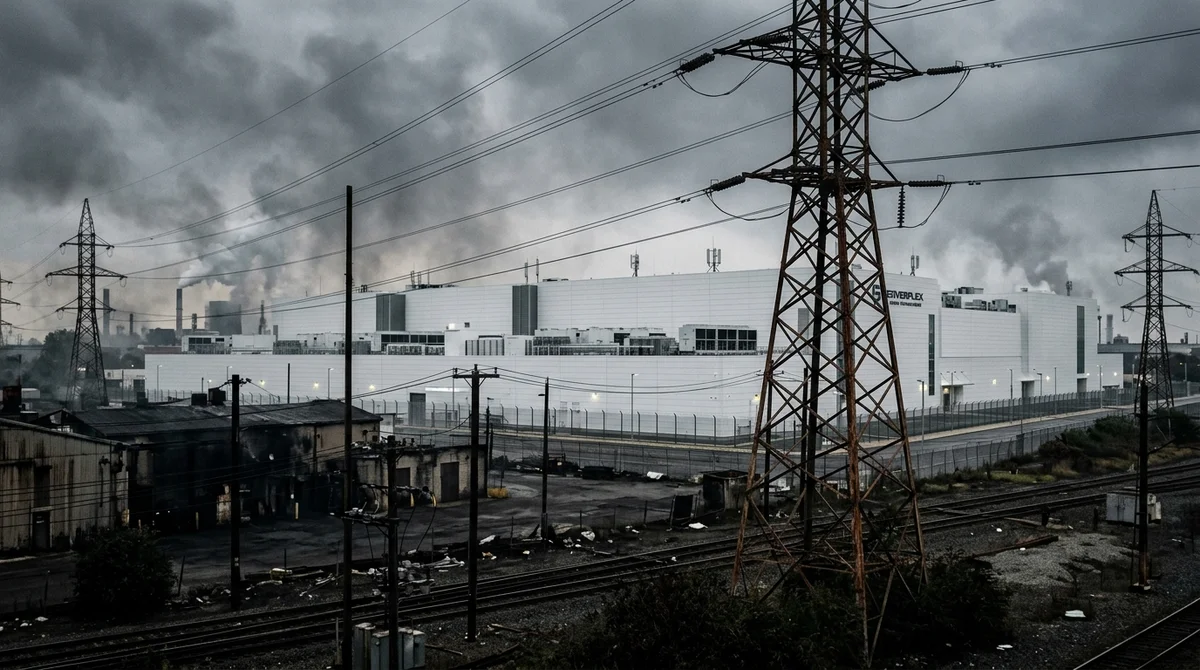
Modern technologies have accustomed us to thinking of the internet as something ephemeral and weightless. We use the metaphor of a "cloud" to describe the invisible space where our photographs are stored, data is processed, and the answers of generative neural networks are born. However, the physical embodiment of this digital world has quite a concrete weight, size, and even smell.
In southwest Memphis, among abandoned coal plants and operating gas turbine installations, the air is saturated with the aromas of soot, gasoline, and hot asphalt. It is here, in an industrial area where the air burns in your throat from industrial emissions, that "Colossus" is located—a colossal data processing center of the xAI company. This hangar with snow-white walls, exceeding in area a dozen football fields, represents a testing ground where Elon Musk is trying to create a new form of digital consciousness.
For local residents, this futuristic project has become a return to the era of heavy industry, when corporate ambitions were placed above the environmental well-being of the territory.
"Colossus" serves as the physical heart for training Grok, one of the most ambitious artificial intelligence models in the world. The dizzying pace of industry development requires technology giants to constantly increase their computational power. To surpass competitors from OpenAI and Google, xAI engineers need to combine tens of thousands of advanced graphics processors into a single incredibly dense computing network.
Computing clusters for AI are fundamentally different from servers that simply store web pages or videos. During intensive training, model parameters are updated trillions of times per second, forcing processors to work at maximum frequencies. As a result, server racks heat up to such temperatures that cooling them requires industrial water supply and ventilation systems that consume additional energy on a colossal scale.
Training a modern language model is no longer simply a programming task—it is a monumental challenge for fundamental engineering.
The scale of energy consumption by this facility challenges the imagination and forces us to reconsider our ideas about the environmental friendliness of the IT industry. If "Colossus" operates at full design capacity for a year, it alone will consume as much electricity as is required to power two hundred thousand average American homes. Moreover, according to statements by Elon Musk himself, at full deployment, this mega-cluster and two neighboring auxiliary xAI data centers will require almost two gigawatts of power.
In annual terms, such volumes of energy exceed the needs of the entire Seattle—a major metropolis with a developed economy, twice over. The electricity that powers these silicon brains does not arise from nowhere. It comes from nearby power plants, some of which are forced to increase the burning of fossil fuels to satisfy the new demand.
Behind these astronomical figures lie real consequences for local communities and the environment. Non-profit organizations such as the Memphis Community Against Pollution are raising the alarm, pointing out that technological progress in Silicon Valley is achieved at the expense of quality of life in industrial cities. While investors and developers talk about the imminent arrival of singularity and the prospects of superintelligence, Memphis residents are forced to tolerate round-the-clock construction equipment noise, forests of new high-voltage poles, and potential deterioration of air quality. Environmental justice becomes a new variable in the equation of technological development. Districts that traditionally suffer from a lack of investment in clean infrastructure now bear the brunt of the expansion of tech giants' capabilities.
The situation in Memphis is only the first harbinger of the impending global infrastructure crisis that the entire technology industry will soon face. Companies like Microsoft, Google, and Amazon are already realizing that existing power grids are simply not ready for the exponential growth in demand from next-generation data centers. The drive for leadership in artificial intelligence forces corporations to make paradoxical decisions: delaying the decommissioning of polluting plants or seriously investing in the revival of nuclear energy. We are witnessing how a virtual arms race collides with the harsh limitations of the physical world. Engineers try to optimize microchip architecture, but any increase in energy efficiency leads only to even greater scaling of systems.
Ultimately, the physical limits of infrastructure may become the main factor constraining the development of artificial intelligence. If the industry does not achieve a radical breakthrough in energy generation or find fundamentally new sources of clean energy, the neural network race will hit a hard ceiling of power grid capabilities. The story of Colossus in Memphis eloquently proves that the path to an almighty artificial intelligence is paved not only with brilliant mathematical formulas but also with thousands of tons of burnt fuel.
The price of creating a digital god is now measured not only in billions of dollars of venture capital investments but also in gigawatts of energy, transforming the appearance of our cities and the planet as a whole.
Want to stop reading about AI and start using it?
AI News is a curated feed of AI/tech news. Hamidun Academy teaches you to use AI systematically in your work.