Multi-billion-dollar deal: Meta transitions AI agents to Amazon Graviton5 processors
Meta has signed a multi-billion-dollar agreement with Amazon to lease tens of millions of ARM cores on Graviton5 in AWS cloud infrastructure. The decision…
AI-processed from TNW; edited by Hamidun News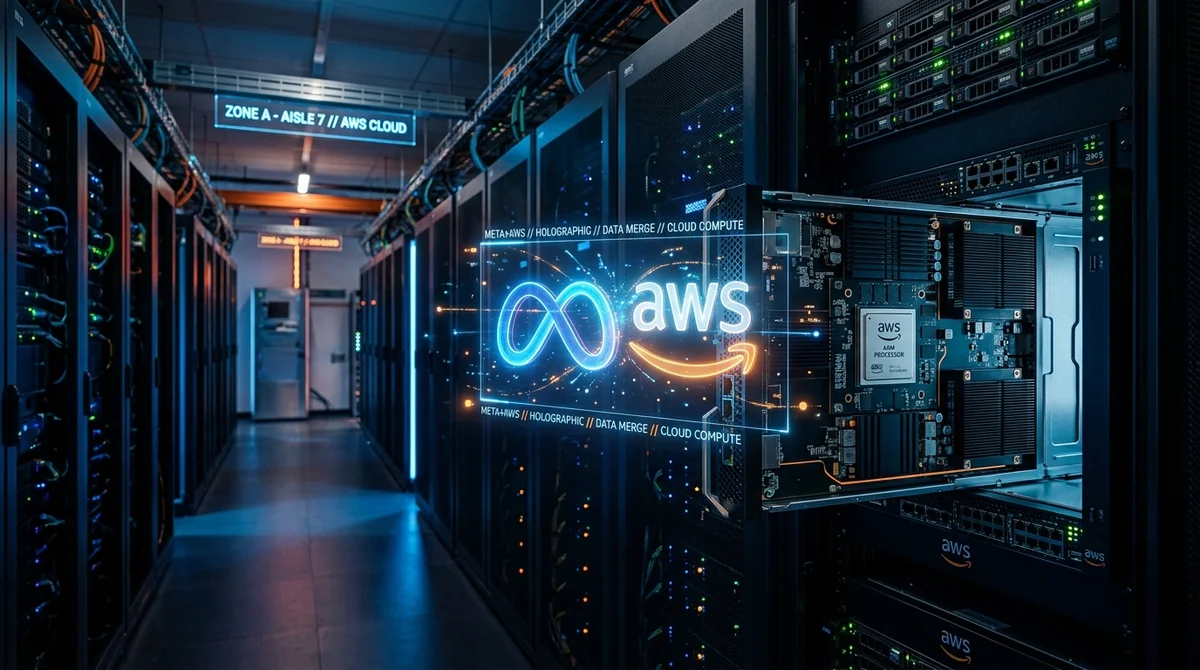
Even a 135 billion dollar capital budget proves insufficient when it comes to building infrastructure for a new generation of artificial intelligence. Meta has officially acknowledged this reality, signing a multi-billion dollar multi-year agreement with Amazon Web Services. The technology giant is leasing tens of millions of proprietary ARM processor cores from Amazon Graviton5 to power its rapidly growing AI services. This unprecedented move underscores a critical inflection point in the industry: the scale of computing required for modern autonomous systems exceeds even the wealthiest corporations' capacity to build their own data centers.
Over the past several years, Mark Zuckerberg's company has aggressively expanded its physical infrastructure, creating massive compute clusters based on Nvidia graphics accelerators to train large-scale language models from the Llama family. The record budget was supposed to ensure complete computational independence for Meta. Yet the paradigm of AI usage is changing faster than supply chains can deliver server racks and construct concrete walls of new data centers. Meta leadership realized that relying exclusively on proprietary hardware resources no longer satisfies the explosive demand for deploying finished products, forcing the company to turn to cloud resources from the market's leading player.
The most intriguing technical detail of this deal lies in what exactly Meta is purchasing. The corporation is not leasing access to Amazon's specialized AI accelerators or traditional graphics processors. Instead, it is booking massive volumes of Graviton5 — classic general-purpose central processors built on the ARM architecture. This choice reveals fundamental changes in how neural networks operate in real-world conditions. The industry is rapidly moving away from simple chatbots toward autonomous AI agents capable of performing complex multi-step tasks. While text generation itself requires the heavy computational lifting of graphics cards, the orchestration of agent actions, verification of logic, and real-time process management fall entirely on central processors.
Agent workloads function in a completely different way than pure content generation. When a user asks artificial intelligence to analyze data, find information on the internet, and prepare a report, the underlying system constantly sends queries to external interfaces, analyzes raw code, and evaluates conditional logic. Graphics accelerators are extremely inefficient at solving such sequential tasks. Graviton fifth-generation processors, originally designed for high energy efficiency in cloud environments, offer an ideal architecture for managing millions of such simultaneous micro-decisions without burning megawatts of expensive power. Effectively, Meta divides the process: graphics chips continue to generate ideas, while central processors assume the function of continuous action.
This partnership sends a powerful signal to the entire cloud computing and semiconductor market. Historically, Meta has been one of the most convinced advocates of owning its own infrastructure. Turning to AWS for basic computing resources represents an enormous validation of Amazon's strategy in developing its own processors. The deal proves that even giants capable of purchasing Nvidia chips by the hundreds of thousands find enormous value in specialized and economical ARM solutions from cloud providers. Moreover, it establishes a new standard for the industry: hybrid architectures, where proprietary data centers perform the heavy lifting of training neural networks, while public clouds absorb the elastic, unpredictable workloads of deployed AI agents.
Ultimately, the agreement between Meta and Amazon offers a glimpse into the future of corporate artificial intelligence. The next battle in the technology sector will unfold not only over creating the most intelligent language model, but also over owning the infrastructure capable of efficiently supporting millions of autonomous assistants running in the background. As neural networks become active participants in business processes, classic central processors experience an unexpected renaissance. Meta's massive investments show that the era of AI agents requires a fundamentally different computational foundation, where orchestration logic and absolute energy efficiency become as critical as raw computational power.
Want to stop reading about AI and start using it?
AI News is a curated feed of AI/tech news. Hamidun Academy teaches you to use AI systematically in your work.