Neural Networks Enter the Clinic: Isomorphic Labs' AI-Designed Drugs Advance to Human Trials
Isomorphic Labs, an Alphabet subsidiary and spin-off of the legendary DeepMind lab, is poised to upend the pharmaceutical industry. The company's President…
AI-processed from Wired; edited by Hamidun News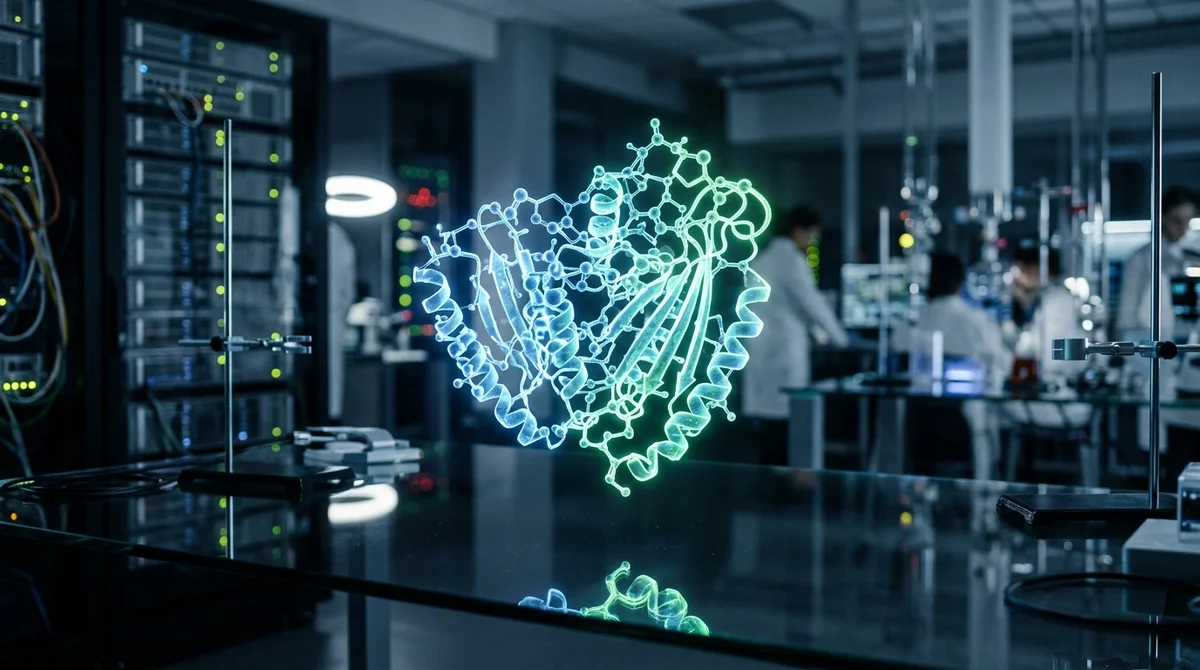
The pharmaceutical industry has spent years living on promises that artificial intelligence would soon change the rules of the game, radically shortening the path of a molecule from laboratory to pharmacy shelf. Now these abstract promises are taking physical form. At the WIRED Health conference in London, Isomorphic Labs president Max Jaderberg made an announcement that could divide the history of modern medicine into "before" and "after."
The Alphabet subsidiary, which grew out of the legendary DeepMind research laboratory, is officially preparing to move an entire line of drugs designed by neural networks to the stage of human clinical trials. This is no longer just theoretical calculations or beautiful three-dimensional models on data center screens, but real chemical compounds ready to meet the most complex testing ground possible — the human organism.
To understand the true scale of this event, one must return to the origins of Isomorphic Labs' creation. At the foundation of this ambitious project lies the monumental scientific success of the AlphaFold system, which several years ago solved a half-century problem of predicting protein folding. By deciphering the three-dimensional structures of practically all proteins known to science, researchers obtained the most detailed map of the building blocks of life.
However, a map alone is not yet medicine. Isomorphic Labs was spun out as a separate company precisely to transform these unprecedented biological data into commercial therapeutic solutions. Jaderberg's announcement confirms that the transition from purely fundamental science to applied molecular engineering has been successful, and the company has already formed a broad and promising portfolio of new medications.
The traditional drug development process is an extremely inefficient and exhausting marathon that typically lasts ten to fifteen years and costs pharmaceutical corporations billions of dollars. Much of this time and astronomical budget is spent on blind trial and error: scientists test millions of existing chemical compounds in hopes of finding the one that will bind to the right target without killing the patient with its toxicity. Isomorphic Labs' approach radically changes this outdated paradigm.
Rather than looking for a needle in an endless haystack, their artificial intelligence algorithms work as molecular architects. They design molecules from scratch that are perfectly suited to a specific protein, while simultaneously predicting their side effects, solubility, and ability to cross the complex biological barriers of the body.
However, the transition to human clinical trials is an uncompromising moment of truth that carries colossal risks. No matter how perfect the machine learning algorithms are, computational biology still faces the phenomenal unpredictability of living systems. What works perfectly in silico — in computer simulation — and shows excellent results in vitro — in a laboratory test tube — can behave completely unexpectedly in the bloodstream of a living human due to cascading biological reactions.
This is precisely why the entire healthcare industry will be watching the first phases of these clinical trials with special attention. The success of Isomorphic Labs would be irrefutable proof that generative artificial intelligence is capable not only of generating coherent texts or photorealistic images, but also of constructing safe, effective physical objects that save human lives.
The consequences of successfully completing these trials will extend far beyond one corporation and will shake the very foundation of the global healthcare system. The largest players in the traditional market, who are already beginning to conclude multi-million dollar contracts with startups in the field of computational biology, will be forced to completely restructure their R&D centers. We will witness how technology giants finally erase the boundary between Silicon Valley and traditional Big Pharma.
The ability of algorithms to quickly design pharmaceutical drugs means that humanity will be able to respond to new viral threats in the shortest possible time, as well as create narrowly targeted therapies for rare genetic diseases whose development was previously considered economically unfeasible by corporations due to the small number of patients.
The announcement made on the WIRED Health stage marks the beginning of a completely new era in science — the era of programmable pharmacology. If Isomorphic Labs' drugs prove their absolute safety and therapeutic effectiveness during human trials, we will finally transition from the historical era of serendipitous discoveries to the era of purposeful engineering of human health. Artificial intelligence ceases to be merely a powerful analytical tool for scientists; it becomes a full-fledged creator of new medical solutions, rapidly approaching the day when developing a life-saving drug for a new disease will take only a few months rather than long decades.
Want to stop reading about AI and start using it?
AI News is a curated feed of AI/tech news. Hamidun Academy teaches you to use AI systematically in your work.