Robot Ace Dominates Table Tennis: Why This Is a Breakthrough for Robotics
Engineers have unveiled Ace, a robot capable of playing table tennis at the level of experienced athletes. The machine can instantly read ball trajectory…
AI-processed from Wired; edited by Hamidun News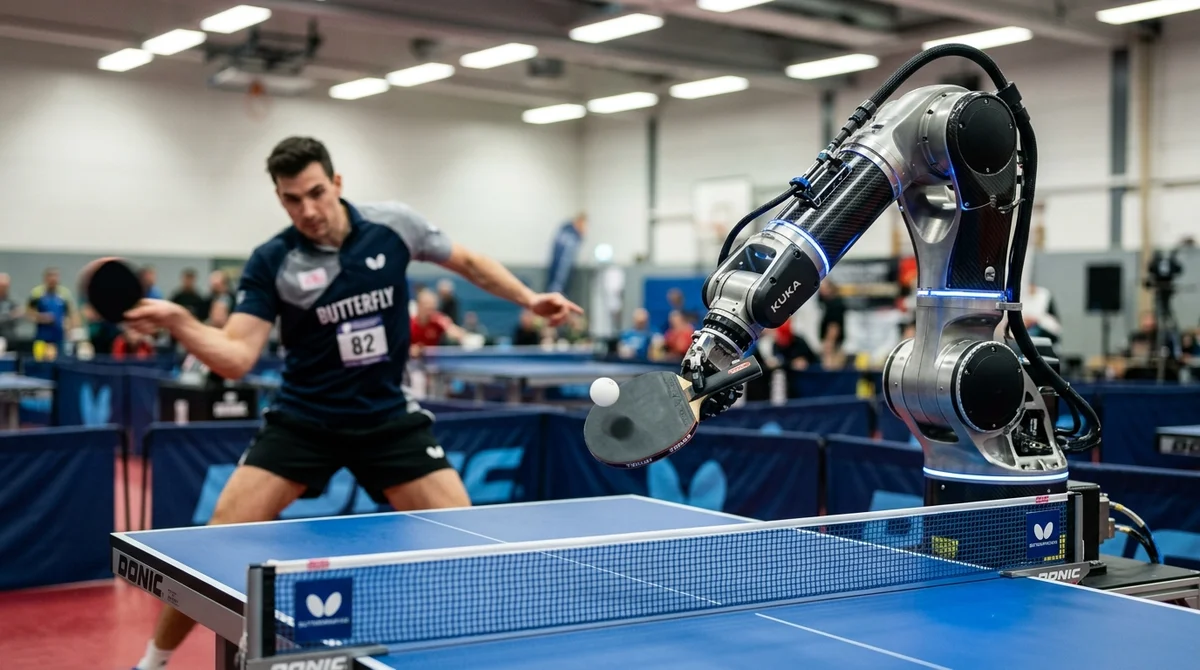
For over a decade, table tennis remained one of those sports where the superiority of human reaction and intuition seemed indisputable. However, the emergence of a robot named Ace has forever changed this fragile balance of power. This machine is capable not merely of mechanically returning the ball, but of building a complete game, reading the most complex spins, adjusting the angle of the racket in milliseconds, and maintaining intensive exchanges with live opponents. What at first glance appears to be an expensive attraction or a demonstration of engineers' sporting ambitions is actually a crucial milestone in the development of physical artificial intelligence and high-speed robotics.
To understand the true scale of this achievement, it is necessary to appreciate the incredible physical and computational complexity of table tennis. Unlike chess or Go, where thinking time is virtually unlimited and the environment is absolutely static, ping-pong requires instant decision-making in a chaotic physical world. The ball travels at speeds sometimes exceeding a hundred kilometers per hour, crossing the table in a fraction of a second.
Moreover, it can have unpredictable top or bottom spin, drastically changing the trajectory of the rebound. Until recently, robots suffered from high latency between the camera's visual perception and the manipulator's physical movement. They excelled at moving heavy boxes or spot-welding car bodies, but proved completely helpless against a light plastic ball requiring microsecond precision.
The engineers who created Ace solved the fundamental problem of synchronizing computer vision and mechanical response. The system relies on a fundamentally new neural network architecture that processes visual data at hundreds of frames per second, simultaneously predicting the aerodynamics of the ball's flight. The moment the cameras detect a human player's racket movement, the algorithm instantly calculates thousands of possible trajectories and selects the optimal interception position.
At the same time, complex servos controlling the joints of the robotic arm receive commands with minimal delay. The manipulator does not simply move to the required point in space; it continuously corrects the angle of the racket surface depending on the spin the opponent imparted to the ball. This synchronization of perception, prediction, and action occurs in a single continuous cycle, allowing the robot to act intuitively, like a living athlete.
A key aspect of Ace's testing was its interaction with real people of varying skill levels. The machine does not simply memorize certain patterns; it adapts to the specific style of a particular player during the match. During testing, the robot demonstrated the ability to maintain lengthy rallies, gradually increasing the pace and complexity of shots depending on the opponent's skill. This means that artificial intelligence has learned to understand the physical limitations of its opponent and manage game dynamics. Such adaptability elevates Ace from simple mechanical ball-returners to the category of full-fledged intelligent agents capable of functioning safely and effectively in the same physical space as a human, flexibly adapting to their unpredictable behavior.
The technological breakthrough behind Ace's tennis victories has enormous consequences for numerous industries far removed from sports. The machine's ability to instantly react to rapidly changing physical objects opens the path to creating a fundamentally new generation of industrial manipulators. In the factories of the future, such robots will be able to catch falling parts, prevent emergencies on moving conveyors, or work with fragile materials at enormous speeds. Similar high-speed machine vision algorithms will find application in autonomous vehicles for instant evasion of suddenly appearing obstacles. In medicine, surgical robots with such reaction capability could automatically compensate for micro-movements of the patient during the most complex microsurgical operations, where the slightest inaccuracy could be fatal.
Today, the Ace robot confidently defeats humans at the table tennis table, but this triumph should be viewed only as a training ground for much more ambitious tasks. We are witnessing a historic transition from slow, rigidly programmed robotics to dynamic, reflexive machines capable of living and acting at the rhythm of the human world. The machine's confident performance in ping-pong proves that the technological barrier between digital intelligence and physical dexterity has finally been overcome. In the coming years, machines with such a level of reaction will inevitably leave the laboratories, becoming an integral part of our everyday reality and forever changing our understanding of what artificial mechanisms are capable of.
Want to stop reading about AI and start using it?
AI News is a curated feed of AI/tech news. Hamidun Academy teaches you to use AI systematically in your work.