Automation Collapse: Why AI Agents Urgently Need New Interaction Infrastructure
Modern corporations are actively deploying autonomous AI agents to solve business tasks. These algorithms excel at isolated assignments, analyzing data and…
AI-processed from AI News; edited by Hamidun News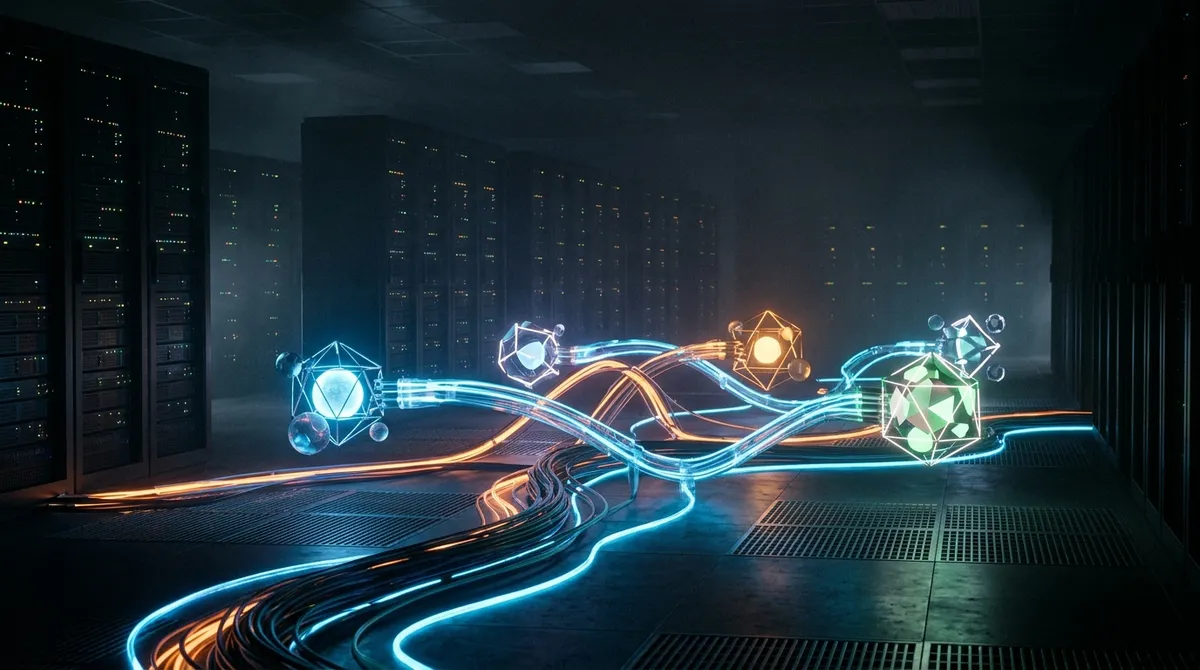
Corporate networks have fundamentally changed over the past year. They are no longer mere passive repositories of data, waiting for queries from humans. Today they are bustling digital metropolises inhabited by autonomous AI agents. These independent digital workers independently analyze complex tasks, process massive volumes of information, and make decisions with a level of autonomy that seemed like science fiction just a few years ago. However, as the initial euphoria from AI agent implementation fades, corporate IT architects face a massive systemic crisis. Individual agents may excel at isolated tasks, but when they attempt to coordinate collaborative work, exchange complex context, or function across different cloud environments, their interaction system rapidly degrades, transforming automation into chaos.
To understand the true causes of this impending collapse, we must examine how corporate AI evolved. The industry hastily integrated large language models into every possible workflow, spawning thousands of narrowly specialized agents. Companies created one agent to manage supply chain logistics, another to generate personalized marketing campaigns, and a third to reconcile financial anomalies.
Each was designed in its own technical vacuum, using unique protocols, different prompt formats, and localized memory structures. Business expected that simply deploying multiple smart algorithms into a single corporate network would organically result in a seamless, fully automated enterprise. Instead, it turned out that placing brilliant but structurally incompatible workers in one room produces not an effective team, but an incredibly expensive and meaningless cacophony.
The technical reality of this friction is what engineers now call interaction framework degradation. Imagine a scenario where a supply chain agent discovers a critical shipment delay and must immediately instruct a customer service agent to notify key clients. Transmitting context in such cases rarely goes smoothly.
These independent actors face tremendous difficulty sharing system state, authenticating access rights across different cloud infrastructures, and preserving the nuances of logic behind a specific decision. Without a dedicated mechanism for inter-agent communication, they are forced to rely on fragmented software interfaces or, paradoxically, constantly require human intervention to bridge the gaps. This failure leads to a phenomenon known as "automation losses": endless cycles of redundant server requests, lost tasks, hallucinations during responsibility transfer, and catastrophic computational resource leaks.
The solution to this impending technological impasse is the deployment of robust interaction infrastructure. It is important to understand that this is not simply another updated network protocol or a complex integration platform for developers. This is a fundamental management layer designed specifically to control non-human actors.
Effective interaction infrastructure dictates, at both physical and logical levels, how AI agents discover each other on the network, verify their digital identities, and establish secure channels for exchanging deep context. In essence, it acts as the central nervous system of the corporate network, ensuring that an agent working in one provider's environment can seamlessly transfer a complex task with multi-level reasoning to an agent in a completely different cloud without losing a single parameter from the original request.
The implementation of this comprehensive architecture carries profound implications for the future of business operations and the entire technology industry. Enterprises that continue to thoughtlessly deploy isolated AI agents without basic interaction infrastructure will very soon hit a hard ceiling on automation return on investment. Their networks will become cluttered with redundant algorithms whose management and troubleshooting will cost more than savings from human labor.
Conversely, organizations that are first to implement this unifying architecture will make a qualitative leap from managing individual digital assistants to coordinating true swarm intelligence. They will be able to create dynamic assemblies of AI agents capable of self-organizing around complex business problems, breaking them into manageable components, and solving them collaboratively in real time.
Ultimately, the corporate software paradigm is shifting from pursuit of individual isolated model intelligence toward ensuring the efficiency of the collective system as a whole. The next trillion-dollar market in the technology sector will belong not so much to the creators of the smartest autonomous neural networks as to the architects building digital highways to connect them. Interaction infrastructure will become the very foundation upon which next-generation corporate automation is built. It is the critical missing link that will transform a disparate collection of impressive AI experiments into a single, coherent, and hyperefficient corporate mechanism.
Want to stop reading about AI and start using it?
AI News is a curated feed of AI/tech news. Hamidun Academy teaches you to use AI systematically in your work.