Chinese Humanoid Robot Completes Half-Marathon in 50 Minutes — Faster Than World Record
In the Beijing suburbs, a humanoid robot completed a half-marathon in 50 minutes 26 seconds — 7 minutes faster than the current men's world record. This is…
AI-processed from Bloomberg Tech; edited by Hamidun News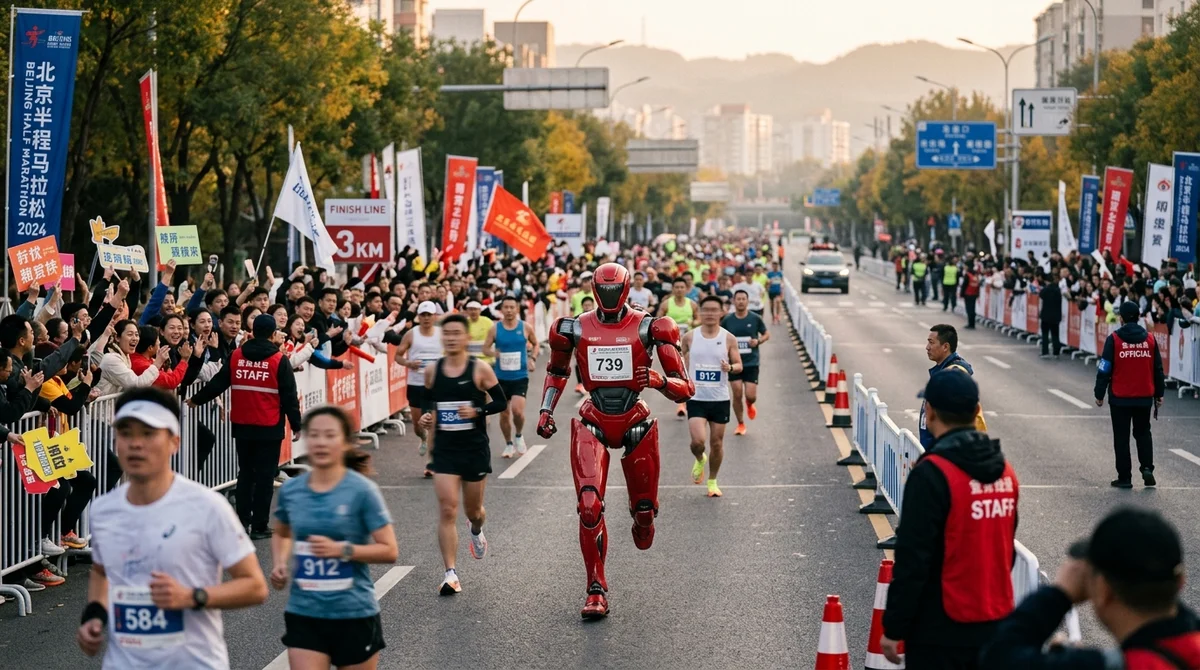
On Sunday morning in the suburbs of Beijing, a red humanoid robot crossed the finish line of a half-marathon with a time of 50 minutes 26 seconds. For comparison: the men's world record in this discipline is 57 minutes 31 seconds. The machine outpaced the fastest human on the planet by approximately seven minutes.
This event instantly spread across global media as a vivid illustration of how rapidly China is advancing in robotics. The race took place as part of an organized competition featuring several humanoid robots from different Chinese companies. The half-marathon course—21.
0975 kilometers—requires not only speed, but also endurance, stability on uneven surfaces, and the ability to adapt to changing conditions. The red robot demonstrated all of this without stopping or falling. Context matters: running is significantly harder for robots than it appears.
Bipedal locomotion is one of the most challenging engineering problems in robotics. Humans unconsciously correct their balance thousands of times per second, adapt to terrain, and distribute load. For a robot, every step is a real-time optimization problem involving dozens of degrees of freedom, controllers, sensors, and neural networks.
The fact that the machine not only completed the distance but also posted a time faster than the world record speaks to a qualitative leap in motion control systems. China has made humanoid robotics a state priority. In 2023, China's Ministry of Industry and Information Technology released a roadmap: mass production of humanoid robots by 2025, and a significant share of the global market by 2027.
Dozens of companies—Unitree, Fourier Intelligence, UBTECH, and others—are actively competing for leadership. Government subsidies, closed markets for technology development, and a massive pool of engineering talent create conditions that are difficult to replicate elsewhere. American and European companies are not standing still either—Boston Dynamics, Figure AI, Agility Robotics, Tesla with Optimus are moving in a similar direction.
But the pace China has demonstrated over the past two years is forcing analysts to revise their forecasts. If in 2022 the timeline for commercial humanoids was estimated at 10-15 years, the discussion now centers on 3-5 years until the first real industrial applications. A half-marathon run is a rigorous stress test.
Extended continuous loading tests mechanics, batteries, and software simultaneously. Fifty minutes of running without overheating, without loss of balance, without critical failures—this is a reliability check approximating real industrial scenarios. A robot capable of running a half-marathon will likely endure eight hours on a warehouse conveyor.
The horizon for humanoid robots appearing in commercial operations is rapidly approaching. Logistics, manufacturing, construction, elder care—industries long awaiting a solution to the labor shortage problem. The Beijing race is another signal that physical AI is ceasing to be fiction and becoming engineering reality.
Want to stop reading about AI and start using it?
AI News is a curated feed of AI/tech news. Hamidun Academy teaches you to use AI systematically in your work.