Reform UK Deputy Leader Accused of Publishing AI-Fabricated Rally Photo
Richard Tice, deputy leader of Britain's Reform UK party, posted a photo of a pre-election rally—and immediately faced scrutiny. Deepfake experts and social…
AI-processed from Guardian; edited by Hamidun News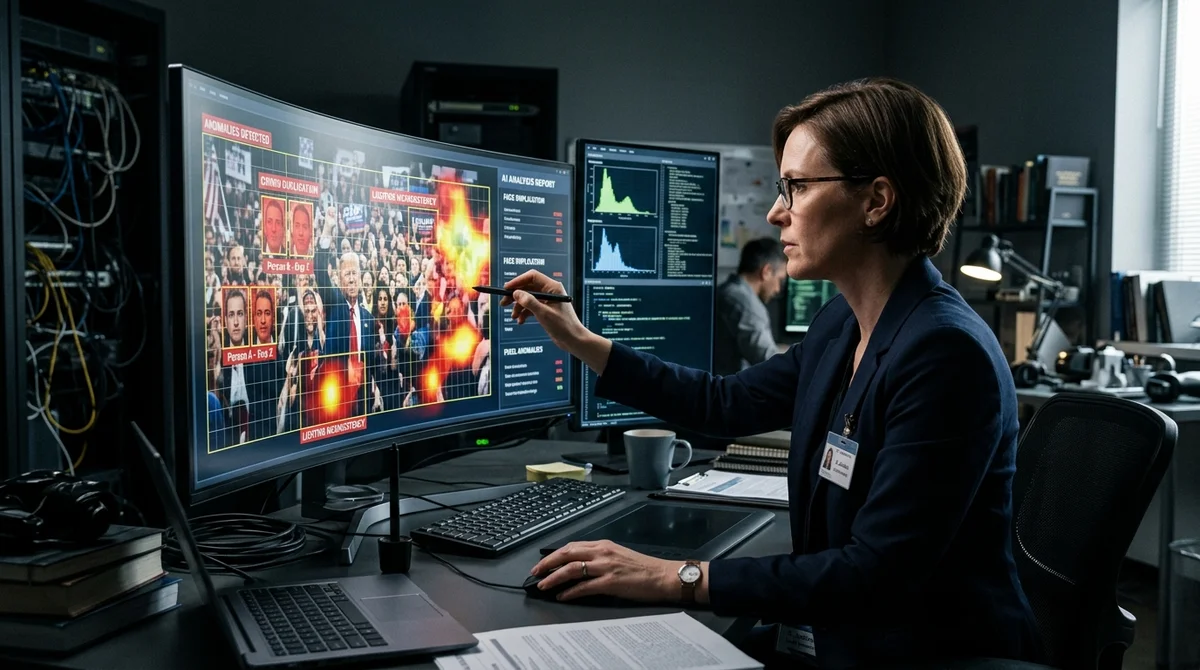
Richard Tice, deputy leader of Britain's right-wing Reform UK party, has become embroiled in scandal after publishing a photo of a campaign rally that digital forensics experts and social media users have determined to be AI-generated or substantially edited using artificial intelligence. The story began on Sunday when Tice posted an image to his accounts that purportedly showed a crowded rally of party supporters. The photo was intended to underscore broad public support for Reform UK amid the height of the election campaign.
Instead, the photograph sparked a wave of criticism: subscribers noticed a series of details inconsistent with an authentic image. The Guardian engaged media analysis specialists who identified five key indicators pointing to AI generation or post-processing. The first and most telling is the geometry of the crowd.
In the image, people are arranged with unnatural symmetry, characteristic of image generation algorithms: a real crowd is always heterogeneous and chaotic, with irregular spacing between individuals. Here the figures appear to be "stamped" from a single template. The second indicator is faces.
At first glance, one notices blurriness or implausibly smooth features among people in the background. Generative models still struggle with detail in the middle and background planes: faces lose individuality and become an averaged "human template." The third is background artifacts.
In the transition zones between figures and surroundings, characteristic blurring and illogical object continuations are visible—a classic trace of diffusion models, which generate pixels statistically rather than based on scene understanding. The fourth indicator is hands and fingers. AI models traditionally struggle with hand anatomy.
One specialist found limbs in the image with an incorrect number of phalanges—a detail nearly impossible in a real photograph. The fifth is lighting. Shadows in the image fall at different angles, which is physically impossible with a single light source.
This indicates either crude compositing from multiple images or that the neural network generated lighting for each element independently. Tice's team and Reform UK itself have not yet issued official comments on the photograph's authenticity. The UK currently lacks mandatory requirements to label political content created using AI—unlike several American states that have already enacted such laws.
The incident unfolds against the backdrop of a broad discussion about the role of generative AI in politics. In 2024–2025, several election campaigns worldwide faced accusations of using synthetic images to create fictional "evidence" of public support—from simulating packed halls to fabricated quotes from opponents. The Tice case is notable also because the detection was carried out not by professional laboratories but by ordinary users without specialized tools.
This is the new reality: the boundary between authentic and synthetic continues to blur, and responsibility for discerning it increasingly falls on readers themselves.
Want to stop reading about AI and start using it?
AI News is a curated feed of AI/tech news. Hamidun Academy teaches you to use AI systematically in your work.