How YOLO and OpenCV Learned to Parse Transport Waybills — and Why That Isn’t Enough
OCR reads everything, but it does not understand document structure — and that is the main problem in automating transport waybill parsing. An analysis of…
AI-processed from Habr AI; edited by Hamidun News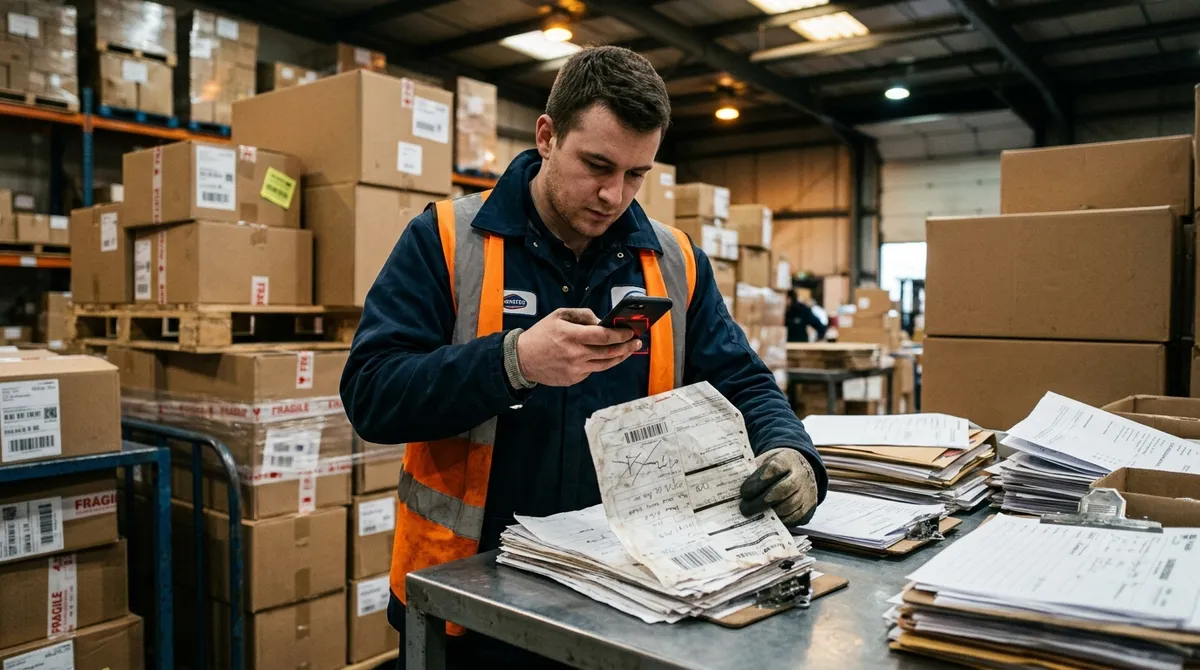
When OCR calls a transport document "read," it means just one thing: the system extracted characters. Understanding where the shipper is, where the cargo is, and where the total amount is — that's a completely different task, and OCR doesn't solve it by default. Modern computer vision libraries like YOLO, OpenCV, and models from Hugging Face can recognize objects, text blocks, and structures in just a few lines of code.
This is convenient for prototyping, but beneath the simplicity lie serious limitations. Out-of-the-box models are trained on general datasets — they don't know what your specific invoice form looks like, which fields are mandatory, and which are optional notations. The article examines a real case: how to build a system that automatically extracts data from transport documents.
Documents arrive in different formats — scans with low resolution, phone photos, PDFs from various accounting systems. OCR in such a scenario is just the first step. Then real engineering begins.
The first limitation any team faces is input data quality. YOLO excels at detecting objects in clean images, but transport documents are rarely perfect: crumpled paper, skewed camera angles, poor lighting, overlapping stamps and seals. OpenCV helps with preprocessing — perspective alignment, noise filtering, contrast normalization — but each such step requires manual tuning for a specific document type.
Universal parameter values don't exist. The second limitation is semantics. A detector can draw a rectangle around the number "15,000," but it doesn't know whether this is the unit price, the total amount, or the invoice number.
For this, you need additional logic: understanding table structure, row order, relative field positions. The authors describe an approach using NLP models from Hugging Face for classifying found text blocks — the model learns to distinguish field types by context of neighboring elements. The third problem is real-world performance.
When the task grows from one-time parsing into a stream — tens of documents per minute, or a video analytics scenario where frames need to be processed in real time — architecture requirements change drastically. The authors describe inference pipeline optimization: request batching, model quantization, choosing between CPU and GPU depending on task volume and acceptable latency, and asynchronous processing as a way to squeeze maximum performance from available hardware. A separate section covers post-processing results — what happens after the detector returns coordinates and text blocks.
Here you need validation rules (correct INN format, correct date format, matching total sums), conflict resolution logic (when two fields compete for one value), and error handling mechanisms. Without this layer, the system will read — but not understand. The practical conclusion sounds simple: the tools exist, they work, but the task "understand the document" they don't solve automatically.
YOLO is a detector, not an interpreter. OpenCV is pixel processing, not meaning. Hugging Face provides a rich selection of pretrained models, but fine-tuning for a specific domain is still necessary.
A real document parsing system is a pipeline of several models, post-processing and validation rules, where each layer adds semantics to what the previous one only saw. The boundary of applicability of ready-made solutions runs where recognition ends and understanding begins. The more specific the domain — logistics, medicine, legal documents — the further this boundary moves away from "just take a model" and the closer it gets to custom development from scratch.
Want to stop reading about AI and start using it?
AI News is a curated feed of AI/tech news. Hamidun Academy teaches you to use AI systematically in your work.