Sediment Palace: local memory for AI agents built on a geological-layer model
In 2025, AI agents can do almost everything—except one thing: remember. A developer proposed Sediment Palace, a local memory built around a sedimentation…
AI-processed from Habr AI; edited by Hamidun News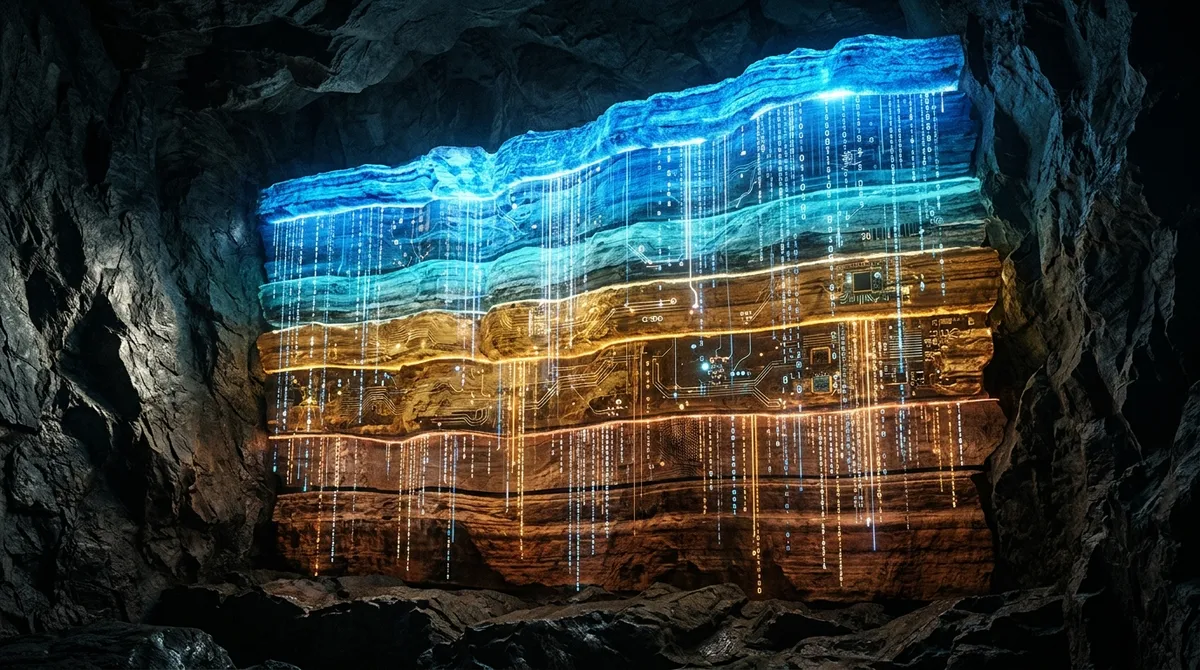
AI agents in 2025 have reached impressive heights: they write code, analyze documents, conduct negotiations, and manage tools. But most of them have a fundamental weakness — memory. Or rather, its absence between sessions, or extremely crude ways of organizing it.
A developer who published material on Habr took two existing concepts and combined them into something new — the Sediment Palace system. The essence of the model lies in an analogy with geology: memory is organized not as a flat list of records and not as a vector space, but as a layered structure where data literally "settles" over time. Fresh information — events from the last minutes or hours — is in the top layer.
It's accessible quickly, takes up lots of space, and is uncompressed. As time passes, records sink deeper: they compress, aggregate, lose details, but preserve essence. The oldest layers are like fossils: accessible, but in heavily compressed form, and you resort to them rarely.
This is a direct analogy to how human memory works. We remember clearly what we ate for breakfast today, vaguely what happened a month ago, and retain only compressed "imprints" of events from many years past. The brain does exactly what Sediment Palace tries to reproduce in software: automatic compression of old experience while preserving its key patterns.
Unlike classical approaches — RAG systems on vector databases or simple context windows — the sedimentation model works locally and deterministically. There is no need for external database APIs, no probabilistic embedding search, no dependence on the model's context window size. The agent itself manages what it remembers and in what form.
The author acknowledges: the idea is not entirely original. He took two foreign approaches — the concept of hierarchical memory and the metaphor of geological layers — and combined them into a working architecture. This honest acknowledgment is what makes the publication valuable: in the field of AI tools right now there is a huge amount of work that reinvents the wheel without citing predecessors. Here — it's the opposite.
The practical applicability of the system is particularly evident in scenarios with long-lived agents: personal assistants, automated researchers, monitoring agents. For tasks where a session lasts not minutes but days or weeks, Sediment Palace offers a compromise between the completeness of history and the cost of storing it.
An important question arises when getting acquainted with the concept: how does the agent decide what exactly to compress and what to discard when transitioning between layers? This is the boundary where architectural elegance runs up against practical difficulties. Any heuristic of "importance" is inevitably subjective — and this is where the main challenge for such systems lies.
Nevertheless, the very fact of the emergence of such projects is telling. The developer community is increasingly engaged not in model power, but in the infrastructure around them. Memory, tools, orchestration — this is the next frontier. Sediment Palace is one of the experiments on this frontier, worthy of attention.
Want to stop reading about AI and start using it?
AI News is a curated feed of AI/tech news. Hamidun Academy teaches you to use AI systematically in your work.