Meta* AI Solved a Century-Old Math Problem: Breakthrough or Hype?
In October 2024, news outlets buzzed with sensation: artificial intelligence developed by Meta* (recognized as an extremist organization and banned in…
AI-processed from Habr AI; edited by Hamidun News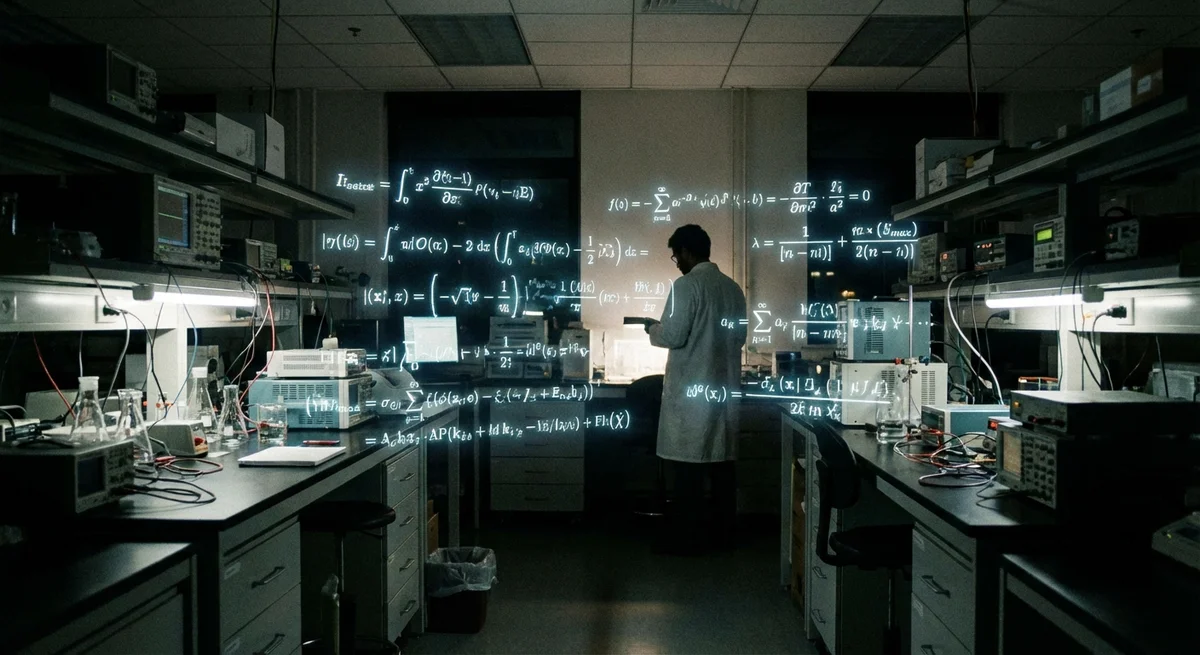
In October 2024, news outlets buzzed with sensation: artificial intelligence developed by Meta* (recognized as an extremist organization and banned in Russia) solved a mathematical problem that had been considered unsolvable for an entire century. This concerns determining the stability of solutions to equations describing dynamically changing systems, such as oscillations of a pendulum or spring. In other words, AI was able to predict whether the behavior of these systems would remain predictable in the long term.
The news caused understandable excitement. Mathematics, with its abstract concepts and strict logic, has traditionally been considered a field dominated by human intelligence. AI's success in solving a complex mathematical problem raises the question: is artificial intelligence capable not only of automating routine calculations, but also of making breakthrough discoveries, surpassing even the most distinguished mathematicians?
To understand the significance of this achievement, it is necessary to delve into the context. The problem being studied is related to the theory of dynamical systems, which finds application in various fields of science and technology – from physics and engineering to economics and biology. Equations describing dynamical systems often turn out to be extremely complex, and their exact solution is impossible. Therefore, scientists strive to determine whether a solution is stable, that is, whether a small change in initial conditions will not lead to dramatic changes in the behavior of the system. Stability is important for forecasting and controlling such systems.
Meta*'s AI used machine learning methods to analyze a large amount of data and identify patterns that had eluded scientists. The model was able to establish the conditions under which solutions to equations remain stable. Although the specific details of the algorithm are not disclosed, it is known that it combines elements of symbolic computation and numerical modeling. It is important to note that AI did not simply provide a ready-made answer, but provided proof of its correctness, which is a key requirement in mathematics.
The significance of this breakthrough for science is enormous. First, it opens new possibilities for studying complex dynamical systems that traditional methods cannot handle. Second, it demonstrates the potential of AI as a powerful tool for scientific discovery. Third, it raises the question of the future of mathematics and the role of humans in this science. Will AI eventually replace mathematicians, or will it only become their assistant, accelerating the research process? The answer to this question remains open for now.
For users and the industry as a whole, this means accelerating the development of many technologies. From more accurate weather and financial market forecasts to creating more reliable and safe engineering systems – the application of results obtained with the help of AI can be very wide. Moreover, this achievement stimulates further investment in AI and machine learning research, which in turn will lead to new breakthroughs and innovations.
In conclusion, solving a century-old mathematical problem with the help of AI is a significant event that testifies to the growing potential of artificial intelligence in science. Although we are still far from completely replacing human intelligence, AI is already becoming a powerful tool capable of solving complex problems and opening new horizons in various fields of knowledge. This is the beginning of a new era in science, where humans and machines will work together to unravel the mysteries of the Universe.
Want to stop reading about AI and start using it?
AI News is a curated feed of AI/tech news. Hamidun Academy teaches you to use AI systematically in your work.