Models Search for 'AI Face Model' Jobs — and Become Tools for Scammers
Telegram channels are flooded with 'AI face model' job postings — employers seek people willing to participate in video calls up to 100 times a day. WIRED journalists studied dozens of such channels and discovered: hired women become the 'face' of fraudulent schemes without realizing it. Their images are used through AI tools to deceive victims and siphon money.
AI-processed from Wired; edited by Hamidun News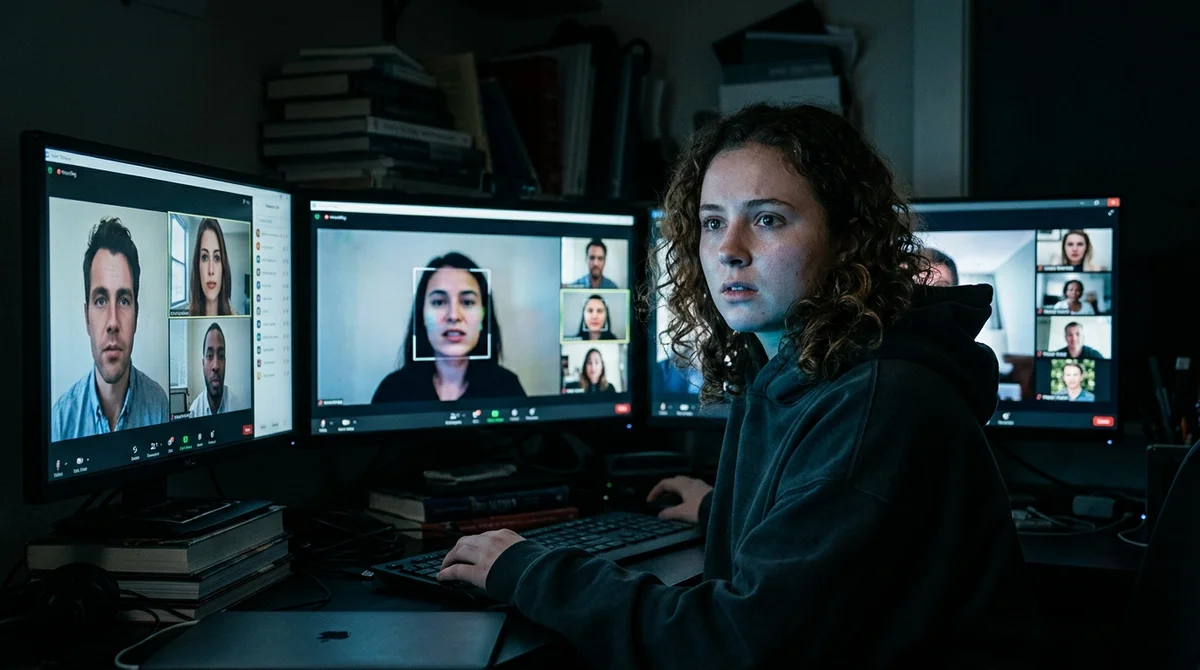
Thousands of people search for side work online — and some stumble upon unusual job postings: become an "AI face model" and earn money simply by participating in video calls, up to 100 sessions a day. The work seems strange but harmless. In reality, it conceals an industry-scale fraud operation.
Journalists from WIRED have studied dozens of Telegram channels and discovered systematic postings recruiting "AI models" — people whose faces will be used in schemes involving artificial intelligence. The channels vary in character: some position themselves as freelance platforms, others as video modeling agencies. Most candidates are women.
Employers promise flexible schedules, high pay, and simple requirements: good appearance, on-camera presence, and willingness to work from morning until night. Not a word about the actual purpose of the work. According to the investigation, hired individuals, unknowingly, become the "face" of classic fraud schemes: romance scams, investment fraud, and financial manipulation.
Their images and videos are used to create deepfakes or as live cover — the victim sees a real person on screen and lets their guard down. As a result, people transfer money to someone who never existed. The scheme operates through several scenarios.
In some cases, the "model" conducts the call following a pre-written script — effectively acting as a scammer, though not fully aware of it. In others, their image or video stream is used in real-time through AI face-swapping tools (face swap), while the actual words are spoken by someone else off-camera. The second variant is technically convenient because the "model" formally "did not deceive" — although they factually participated in a crime and provided their biometrics for illegal use.
The technological barrier for such operations has dropped sharply over the past two years. Real-time face replacement tools — DeepFaceLive, various forks based on InsightFace, and other solutions — are available for free and run on standard gaming PCs. The quality of face substitution has improved so much that victims find it hard to spot the deception, especially with unstable connections, which scammers may intentionally degrade.
Basic setup takes a few hours and requires no specialized knowledge. To launch such a scheme, you no longer need a professional studio — a Telegram channel and a few hundred dollars to pay workers suffice. It is important to understand the scale of the phenomenon.
Telegram channels with "AI face model" job postings have thousands of subscribers, and some operate completely openly. The postings explicitly mention "emotional communication with clients," "building online trust relationships," and high pay for "effective" calls. For those familiar with the romance scam industry, this is enough to understand the reality.
For a naive job seeker — it is not. The legal aspects of the issue are extremely ambiguous. A person who simply speaks according to a script may genuinely not realize they are participating in fraud — especially if the employer carefully conceals the true purpose of the operation.
Nevertheless, in a number of jurisdictions, participation in such schemes, even without intent, may be qualified as complicity. Those who use someone else's face without their knowledge or with merely formal consent, but for illegal purposes, violate several legal norms at once: those concerning biometric data, fraud, and personal information protection. This investigation clearly shows how AI tools become the infrastructure of criminal business.
Romance scams with deepfakes are no longer random incidents but a systematized industry with recruitment, scripts, KPIs, and role division. Victims lose money, unwilling "models" risk criminal prosecution, and platforms like Telegram respond slowly to obvious violations. Until regulators develop a clear response and platforms introduce real control mechanisms, such schemes will only scale up.
- Oct 25, 2026Odyssey opens preview of Odyssey-3, a 14B-parameter world model
- Oct 25, 2026DistroKid Pulls Tracks Without Warning After UMG Lawsuit Over "AI Slop"
- Oct 24, 2026Meta releases Muse Wonder and Wonder Full: intelligence index rises from 48 to 56
- Oct 24, 2026Moonshot releases Kimi K3.1 Pro: a 3T open-weight model with a 1M-token context window
Access Frontier LLMs & Multimodal AI in One Workspace
Discover NomadNet AI (nomadnet.ai) — unified access to frontier language models, research synthesis, and multimodal workflows.
The AI world, distilled — once a week
Seven stories that actually mattered, hand-picked. No noise, no reposts, no press releases.
Done! Check your inbox for a confirmation.