Nvidia DLSS 5 uses generative AI for photorealism in games and beyond
Nvidia unveiled DLSS 5, a technology that creates pixels from scratch using generative AI rather than upscaling a finished image. At its core is scene…
AI-processed from TechCrunch; edited by Hamidun News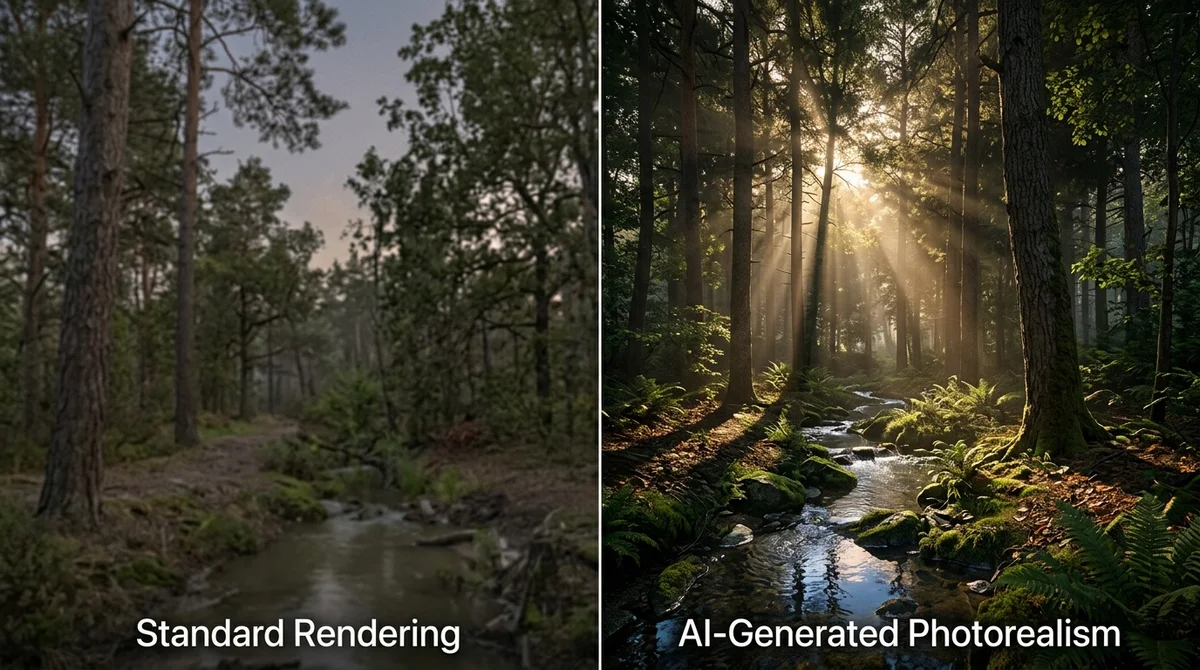
DLSS 5 from Nvidia — this is not just another update to the upscaling algorithm. The company applies generative artificial intelligence together with structured graphics data to make video games look fundamentally different — not improved, but truly photorealistic. Nvidia CEO Jensen Huang is already talking about the technology extending beyond gaming and transforming other industries.
This is a step that changes the architecture of rendering itself. Deep Learning Super Sampling — DLSS — first appeared in 2018 as an upscaling tool: the GPU rendered the picture at reduced resolution, and a neural network restored details to the required size. DLSS 4 added Multi Frame Generation — the generation of several intermediate frames between actually calculated ones, which significantly increased the frame refresh rate in games.
The fifth version takes a more radical step: instead of improving existing pixels, it creates an image from scratch, relying on structured scene data — depth maps, normal buffers, and object motion vectors. The key innovation is the use of G-buffer data, that is, geometric buffers. This is a set of structured data about a three-dimensional scene: surface materials, their spatial position, lighting, camera direction.
The generative model receives not just a pixel stream, but semantically rich context about scene content. This fundamentally distinguishes DLSS 5 from ordinary neural upscaling: the system understands the scene rather than simply guessing pixels. According to Nvidia, in tests the technology produces results that external observers cannot distinguish from full path tracing rendering — with significantly lower computational costs.
Huang positions DLSS 5 as a platform, not as a gaming feature. According to him, the same approach — generative AI plus structured data — is applicable in medical visualization, architectural design, industrial design, and cinema. In these fields the cost of photorealistic rendering remains high: architects pay thousands of dollars for a single presentation frame render, film studios spend hours on a single visual effect with ray tracing.
If Nvidia transfers the DLSS logic to professional tools, the market for the technology will be incomparably larger than the gaming segment. The potential is assessed highly. The combined market for computer graphics in medicine, architecture, and cinema exceeds the gaming segment.
Nvidia is already moving in this direction through the Omniverse platform, designed for digital twins and industrial simulations. DLSS 5 could become a technological bridge between game rendering and these professional scenarios. Nvidia holds about 85% of the discrete GPU market.
DLSS has long been a key argument for buying RTX cards: the technology is embedded in hundreds of games and supported by the largest engines — Unreal Engine, Unity, and Godot. DLSS 5 continues this strategy: each generation makes existing hardware more attractive even when the physical performance difference between GPU generations slows. Competitors — AMD with FSR and Intel with XeSS — offer solutions that work on any hardware, but without Tensor Cores hardware blocks they cannot reproduce the same algorithms with the same efficiency.
DLSS 5 — a signal that the boundary between rendering and image generation is ultimately erased. When a GPU creates a frame not through calculating light physics, but using a trained generative model — this is a fundamentally different architecture. If Nvidia realizes its promises and transfers the technology beyond games, DLSS 5 may turn out to be not an update for gamers, but the foundation of the next generation of visual computing.
Want to stop reading about AI and start using it?
AI News is a curated feed of AI/tech news. Hamidun Academy teaches you to use AI systematically in your work.