Memories.ai is developing a visual memory layer for wearables and robots
Startup Memories.ai is building a large visual memory model — an infrastructure layer for physical AI. The system can index and retrieve real-world video…
AI-processed from TechCrunch; edited by Hamidun News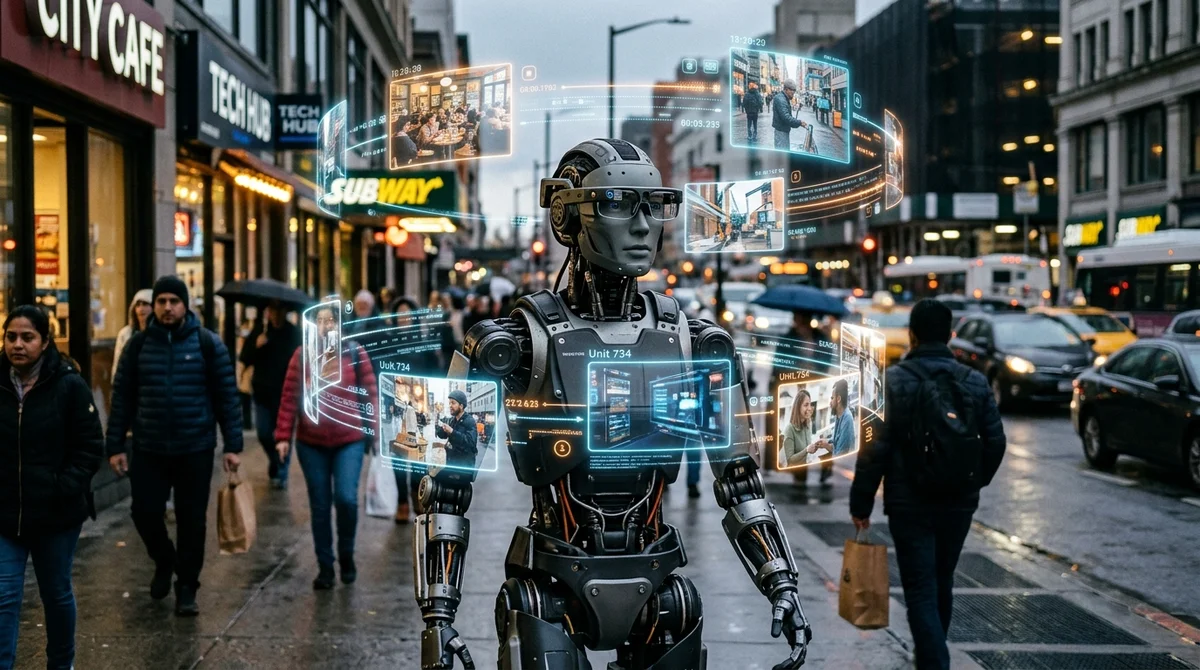
Startup Memories.ai announced the development of a large-scale visual memory model — a system that will allow physical AI to index and retrieve video-recorded memories of the real world. Essentially, the team is building what has been missing from wearable devices and robots: the ability not just to see, but to remember.
The idea sounds simple, but the technical complexity is enormous. Ordinary language models work with text — they know how to memorize and reproduce information in the form of words and symbols. Video is fundamentally different: each second contains thousands of frames, spatial relationships, object movement, temporal sequence of events.
For a robot or smart glasses to remember where the keys are, or what happened in the kitchen three hours ago, you need a specialized architecture optimized for visual data. Memories.ai positions its development as an infrastructure layer for physical AI — a new class of systems operating in the physical world, not the digital one.
Physical AI is behind wearable devices like Ray-Ban Meta and Humane AI Pin, as well as humanoid robots actively entering the market: Boston Dynamics, Figure, Agility Robotics. They all suffer from the same problem — the lack of long-term contextual memory about what's happening around them. For wearable gadgets, visual memory means the ability to answer the question "where have I seen this person?"
or "when was I last in this cafe?" For robots — to understand changes in the environment, track object movement, avoid mistakes that were made before. Without such a layer, physical AI functions like an amnesiac patient: each new launch from a blank slate, without accumulated experience.
The team does not disclose technical details of the architecture or the volume of training data. It is unknown at what stage the development is and whether there are already partners among hardware manufacturers. Nevertheless, the very fact that specialized startups focused specifically on visual memory for physical devices are emerging shows that the industry has reached the next scaling barrier.
Until now, most AI startups have focused on language or multimodal models working primarily with text and static images. Video memory is a much more resource-intensive task, requiring new approaches to compression, storage, and retrieval. Major players like Google DeepMind and OpenAI are working on video understanding, but their products are oriented toward cloud processing, not embedded solutions.
Memories.ai, judging by its positioning, aims at a different segment: edge solutions working directly on the device. This is critical for robots and wearable gadgets, which cannot afford the latency of a cloud request each time they need to access past experience.
If the startup succeeds in delivering what it promises, its model could become one of the key components of the physical AI stack — comparable in importance to the emergence of large language models for text assistants. The race for visual memory is just beginning.
Want to stop reading about AI and start using it?
AI News is a curated feed of AI/tech news. Hamidun Academy teaches you to use AI systematically in your work.