Nvidia released DLSS 5, but the new technology distorts characters' faces in games
Nvidia unveiled DLSS 5, a next-generation upscaling technology that the company calls the biggest breakthrough in computer graphics since 2018. Generative AI…
AI-processed from The Verge; edited by Hamidun News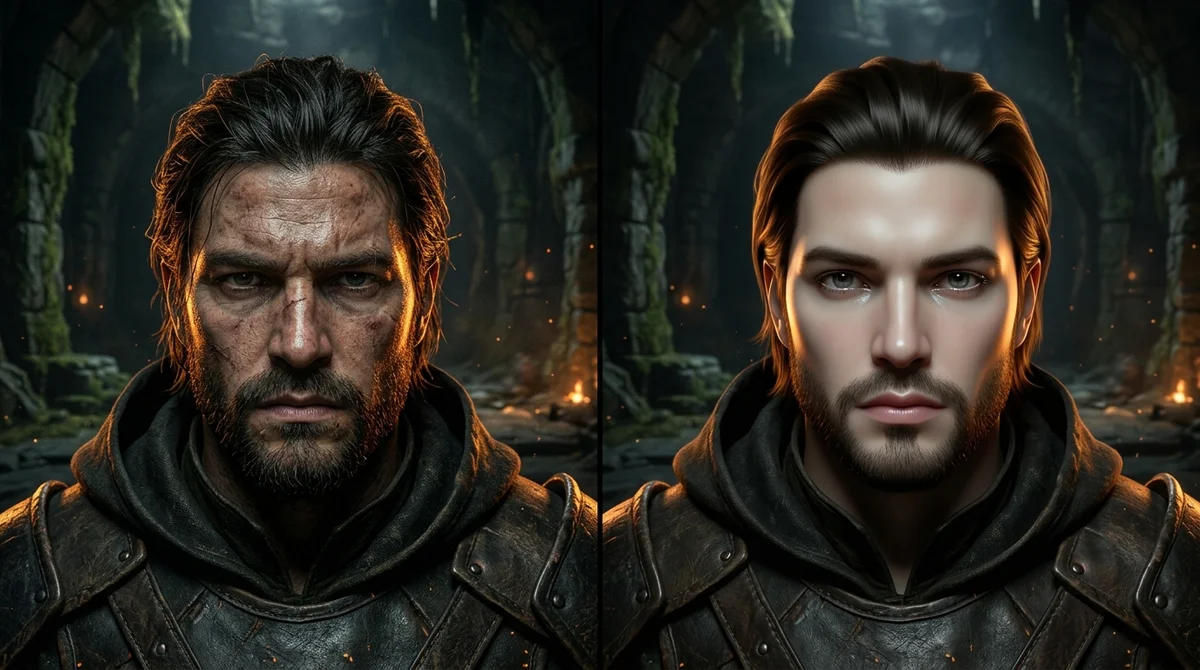
Nvidia announced the release of DLSS 5 — the new version of its proprietary image upscaling technology for games. The company presented it as "the largest breakthrough in computer graphics since the advent of real-time ray tracing in 2018." The promises are grand.
Reality turned out to be much more mundane — and much more unpleasant for the first viewers. DLSS (Deep Learning Super Sampling) is Nvidia's technology that uses neural networks to increase image resolution in real time. The principle is simple: the game is rendered at a lower resolution, and DLSS infers the missing pixels using a trained neural network.
This allows achieving higher frame rates without significant loss of image quality. Previous versions — DLSS 2, 3, and 4 — gained wide recognition among gamers and developers. The fourth generation, presented in early 2025, was especially praised for the Multi Frame Generation technology: it generates several intermediate frames between real ones, which significantly increases image smoothness.
DLSS 5, according to Nvidia, takes the next step: the technology fills pixels with photorealistic lighting and materials using generative AI. It sounds technological and promising. But when gamers and tech journalists saw the first demonstrations, the community's reaction was unambiguous: something went wrong with the characters' faces.
The main character of Resident Evil Requiem named Grace in DLSS 5 mode looks as if she passed through an aggressive AI filter — facial features are smoothed, details are blurred, and the expression acquired that characteristic plasticity that the internet calls AI-slop. Hogwarts Legacy characters look as if they were processed with a blurred Instagram skin-smoothing filter. The neural network infers details too aggressively exactly where they are particularly noticeable to humans — and we read faces more accurately and quickly than anything else in the field of vision.
Here the uncanny valley effect works at full strength: the closer the image is to a real face, the more acutely the brain notices the slightest discrepancy. This is a fundamentally important difference of DLSS 5 from previous versions. Earlier generations of the technology reconstructed pixels based on accumulated motion data and information from previous frames — this was smart interpolation based on real data.
The fifth generation tries to actively recreate details that were not originally in the source geometry, using the generative capabilities of the neural network. This is precisely what creates the problem: the algorithm hallucinates where any error instantly stands out. Upscaling is no longer a niche technology.
AMD offers its own FSR analogue, Intel develops XeSS, and all graphics card manufacturers actively compete for the title of best solution. Nvidia has maintained its leadership largely due to DLSS quality — the technology consistently delivered the best image with lower rendering costs. If DLSS 5 establishes itself as a technology that degrades faces, this could affect developers' willingness to implement it in their projects.
The situation is partly reminiscent of motion smoothing on modern televisions. This mode, which manufacturers have been enabling by default for years, technically makes the image smoother, but filmmakers and critics advised disabling it: as a result, films looked like cheap soap operas rather than cinematic works. DLSS 5 has the same dynamic — the technical metric grows, but the perceived quality falls.
It is still unknown whether Nvidia will refine the algorithm before a broad commercial release. Public reaction could push the company to correct the aggressiveness of generation in the facial region. Nvidia itself compares the breakthrough to the advent of ray tracing and positions the technology as maximally positive.
But the community's first reaction is unambiguous: the path from the largest breakthrough to actually better picture quality in games for DLSS 5 is only just beginning.
Want to stop reading about AI and start using it?
AI News is a curated feed of AI/tech news. Hamidun Academy teaches you to use AI systematically in your work.