Bezos Aims to Raise $100 Billion to Acquire and AI-Transform Industrial Companies
Jeff Bezos wants to raise $100 billion for a new project: to acquire aging industrial companies and restructure them with AI. Amazon's founder is betting on…
AI-processed from TechCrunch; edited by Hamidun News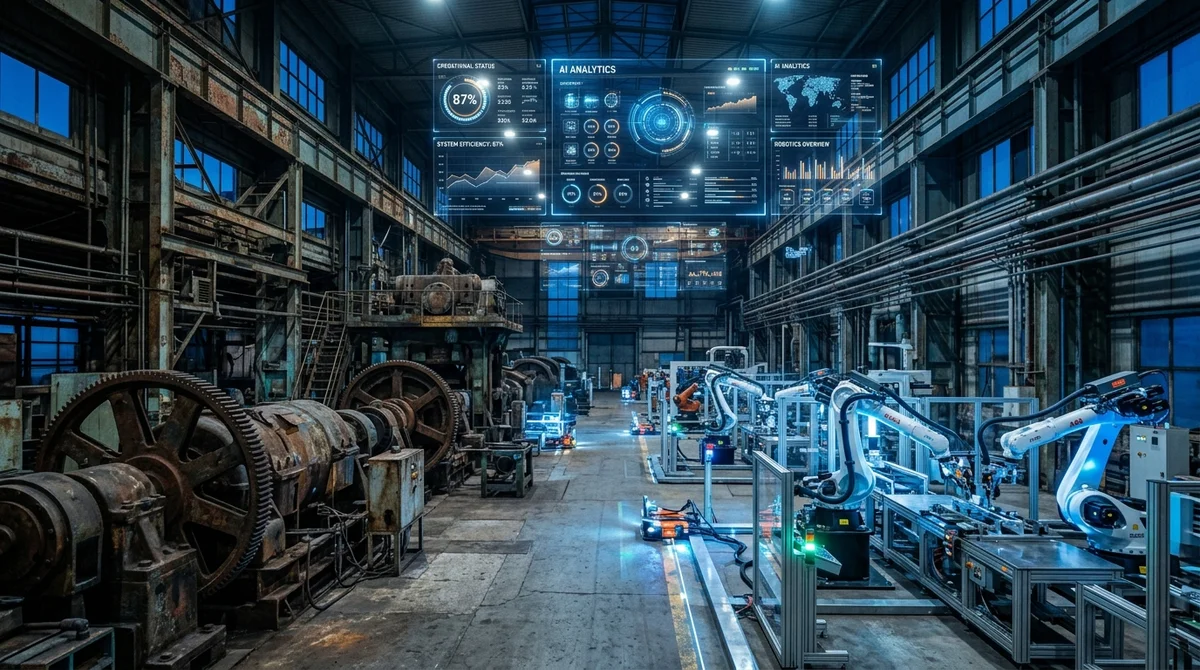
Jeff Bezos is preparing one of the most ambitious venture projects of the past decade: the Amazon founder intends to raise up to $100 billion for large-scale acquisitions of outdated industrial companies followed by their transformation through artificial intelligence. If the plan is realized, it will become the largest private bet on industrial AI in history. According to available information, Bezos is in negotiations with potential investors about creating a new holding company or fund that will specialize in purchasing industrial enterprises — primarily in the United States. These are companies from traditional sectors: mechanical engineering, metallurgy, materials production, logistics. They have one thing in common — mature businesses with stable cash flows, but extremely low technological maturity.
The idea is built on simple but powerful logic. In the United States and other developed economies, there are thousands of manufacturing enterprises technologically stuck in the 1990s. They operate on outdated equipment, with archaic processes and practically without digital infrastructure. Yet they have real assets, well-established supply chains, customer bases, and years of industry-specific expertise — something that cannot be recreated from scratch.
The strategy's essence is not to build production from scratch, but to buy existing companies and systematically implement AI tools in them: line automation, predictive equipment maintenance through sensors and machine learning, neural network supply chain optimization, and autonomous quality control systems.
The figure of $100 billion is impressive even by technology industry standards. For comparison: Bezos's entire fortune is estimated at approximately $200 billion. This means attracting large-scale external capital — from institutional investors, sovereign funds, or strategic partners. Essentially, this is not a personal investment, but rather the creation of a structure managed by Bezos, where he acts as both the strategy architect and the main capital attractor.
It is indicative that Bezos consistently bets specifically on heavy industries far from Silicon Valley. Blue Origin — aerospace. Amazon — initially logistics and physical distribution, not just e-commerce. Now — industrial manufacturing. The pattern is one: take markets with enormous volumes, low technological maturity, and high barriers to entry — and crack them through scale and technology.
The timing is not coincidental. 2025–2026 are years when AI truly begins to penetrate the real sector. Industrial agents, autonomous robotics for production lines, predictive factory management systems — all of this is transitioning from the stage of expensive pilots to the stage of scalable products. Early entry into this market with massive capital creates sustainable competitive advantage.
If the ambition is confirmed, it will significantly change the balance of power in the race for industrial AI. Competition already exists here: next-generation manufacturers with showcase factories, German and Japanese industrial conglomerates actively investing in digitalization, and Chinese players with state support. But such a level of concentrated private capital under the management of one visionary is a rare phenomenon.
The coming months will show how realistic this plan is and who is willing to bet on Bezos's version of industrial renaissance.
Want to stop reading about AI and start using it?
AI News is a curated feed of AI/tech news. Hamidun Academy teaches you to use AI systematically in your work.