Nvidia DLSS 5 disappoints gamers and developers alike, but could become the industry standard
Nvidia DLSS 5, the fifth generation of AI upscaling, has sparked a wave of criticism. Gamers report an "uncanny valley effect": the image looks unnatural…
AI-processed from Wired; edited by Hamidun News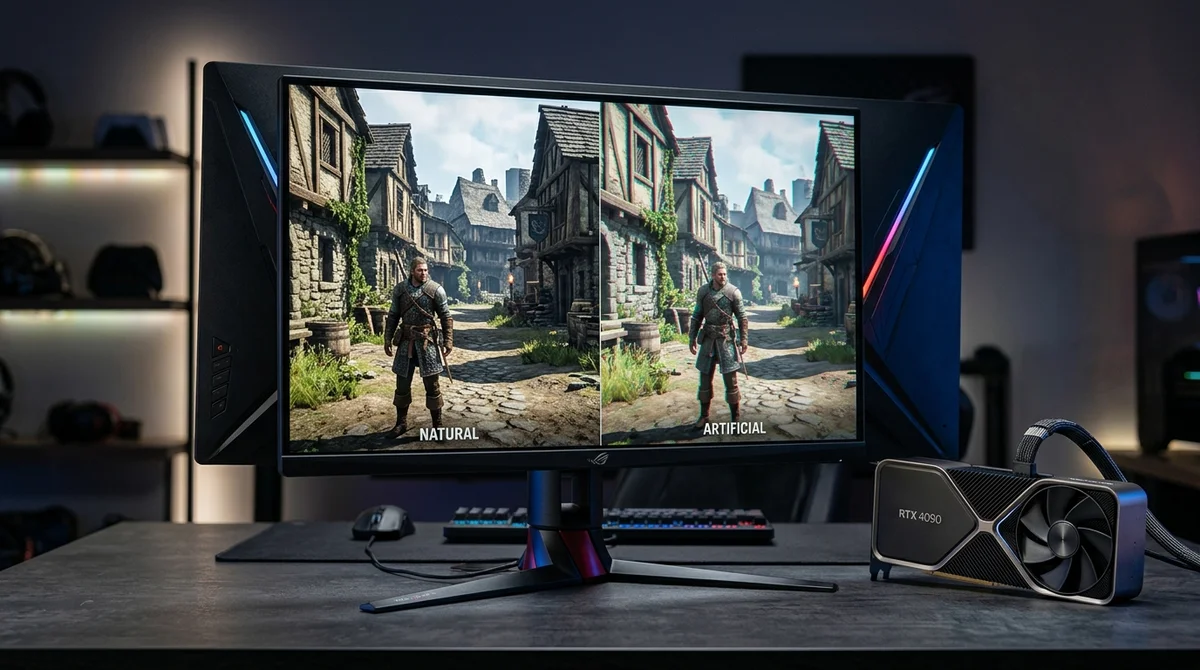
Nvidia DLSS 5 — the new generation of AI upscaling technology — met a cold reception from both sides. Gamers call the image eerie and unnatural. Game developers share the skepticism, although Nvidia insists: in a few years this will become the default mode for all graphics cards.
DLSS stands for Deep Learning Super Sampling. Nvidia has been developing the technology since 2018 — the idea is to render the scene at a lower resolution, and the neural network fills in the details and upscales the picture to 4K or higher. Early versions worked well enough: many players didn't notice the difference from native rendering, but got a significant FPS boost.
DLSS 3, released with the RTX 40-series graphics cards, added intermediate frame generation — Frame Generation. The technology inserted synthesized frames between real ones, allowing you to double the FPS counter without GPU load. DLSS 5 goes even further.
The fifth generation uses multi-frame generation: AI creates multiple intermediate frames in a row, potentially multiplying visible FPS by several times. The problem is that the more frames the neural network generates — the more artifacts it introduces. Gamers are noting the uncanny valley effect: the image looks almost right, but the eye catches something unnatural.
Blurred edges of moving objects, ghostly traces, texture jittering — all of this breaks the immersion that players buy top-tier graphics cards for. The community's reaction was predictably harsh. Forums and Reddit filled with comparative screenshots and videos where DLSS 5 loses to native rendering in visual quality.
This is especially painful in the context of price: graphics cards supporting the latest DLSS features are expensive, and no one wants to pay for picture degradation. But more telling is the position of game developers. Studios are generally not thrilled with DLSS 5.
Integrating the technology requires additional effort during development: you need to tune parameters for each specific game, test on different scenes and resolutions, manage artifacts. AI frame generation changes the usual pipeline for working with a graphics engine, complicates optimization, and adds unpredictability to the QA process. Meanwhile, the end result is unstable: in some games DLSS 5 works acceptably, in others — clearly worse than native rendering.
Nvidia, however, is not changing its rhetoric. The company positions DLSS 5 as the future of game graphics and predicts that in a few years the technology will become the default mode. Nvidia has arguments: screen resolutions are growing, game scenes are becoming more complex, and traditional rendering is increasingly difficult to scale.
AI upscaling is a logical answer to this challenge, the question is only how quickly the technology will mature to acceptable quality. Competitors are not sleeping. AMD promotes FSR (FidelityFX Super Resolution), Intel — XeSS.
Both technologies work on graphics cards from any manufacturer, giving them an advantage in coverage. If the quality of DLSS 5 doesn't improve in the next updates, some developers may prefer solutions that are simpler to integrate — and this will hurt Nvidia's position in a key segment for it. The DLSS 5 story is a story about speed versus quality.
Nvidia is rushing to implement technology that hasn't yet matured to the expected level. Gamers feel this intuitively, developers — practically. Until the company eliminates artifacts and reduces the burden on studios, the future standard will remain a controversial setting for those willing to overlook the side effects.
Want to stop reading about AI and start using it?
AI News is a curated feed of AI/tech news. Hamidun Academy teaches you to use AI systematically in your work.