Jensen Huang at GTC: What Nvidia CEO's Keynote Means for the Company's Future
At the annual GTC conference, Nvidia CEO Jensen Huang delivered a keynote address that traditionally sets the tone for the entire AI industry. The Equity…
AI-processed from TechCrunch; edited by Hamidun News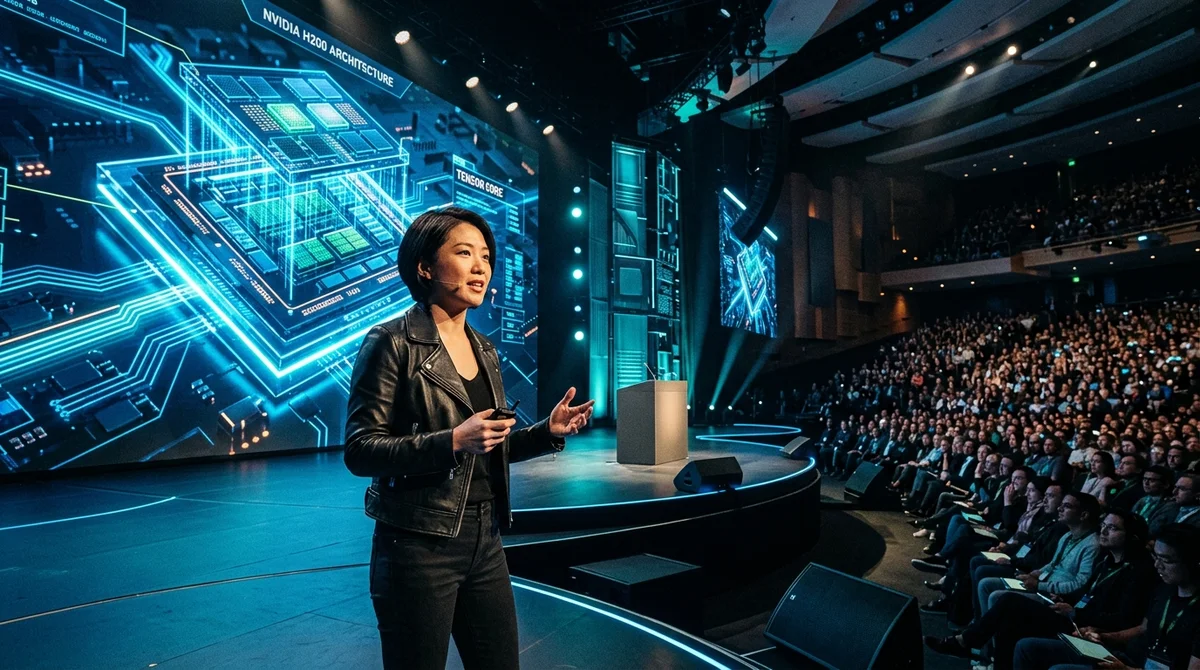
GTC is not just a conference for developers. It is an annual ritual in which Jensen Huang, CEO of Nvidia, acts as the chief prophet of a new technological era. In 2026, the keynote once again assembled tens of thousands of participants and set the agenda for the entire AI industry for the next 12 months.
The team from the Equity podcast broke down the presentation piece by piece—and came to mixed conclusions. TechCrunch hosts discussed which of Huang's theses are backed by real data and which look more like strategic signals to the market. The gap between the ambitious presentation and the actual competitive situation turned out to be significant—and it is precisely this that forms the center of the episode.
Nvidia today is not just a graphics card manufacturer. Over the last three years, the company has transformed itself into the infrastructure backbone of the entire global AI industry. Quarterly revenue exceeded 30 billion dollars, and market capitalization allows it to compete with Apple and Microsoft for the status of the world's most valuable corporation.
The H100 series chips and then the Blackwell architecture set the industry standard for training large language models. The largest technology companies—Microsoft, Google, Meta, Amazon—continue to increase their purchases despite prices that make GPUs one of the planet's most scarce resources. GTC-2026 continued this trend, but the focus shifted toward a new frontier.
Huang bet on physical AI—systems capable of acting in the real world: industrial robots, autonomous vehicles, intelligent simulators. The Omniverse platform, which Nvidia has been developing for several years, is positioned as the central tool for creating digital twins—virtual copies of factories, cities, and logistics networks. According to Huang, the next frontier of AI is not another language model, but systems that can interact with physical reality and make decisions in real time.
Nevertheless, the Equity editorial team questioned several key narratives. The first is competitive. AMD is actively promoting MI300X as a lower-cost alternative to Nvidia, and cloud providers are increasingly developing their own solutions: TPU from Google, Trainium from AWS, Maia from Microsoft.
Startups like Groq and Cerebras are aiming at the fast inference niche. Nvidia still maintains its dominant position, but margins may begin to compress—and this is already reflected in analysts' price expectations. The second issue is geopolitical.
U.S. export restrictions on the supply of advanced chips to China continue to be in effect and are periodically tightened.
Nvidia is forced to release special versions of its products for the Chinese market, but they too regularly fall under new sanctions. A potentially enormous market remains partially closed, forcing the company to redirect its growth toward Europe, India, and the Middle East. The third is valuation.
Nvidia's stock trades at levels that factor in growth that should continue for several years in a row without significant disruptions. Investors are factoring into the valuation not only current leadership but also success in new segments—robotics, physical AI, telecommunications. Any slowdown—a reduction in hyperscaler capital expenditures, the emergence of real competitive alternatives, or regulatory restrictions—could sharply adjust market capitalization and call into question current multiples.
GTC-2026 showed Huang in his familiar form: confident, visionary, able to sell ideas as well as hardware. But the Equity podcast has clearly captured the gap between the brilliant presentation and the real challenges that Nvidia will face in the coming 12–18 months. The company's dominance in the era of language model training is unquestionable.
But the next era—inference and physical AI—has yet to be written. It is here that competitors will seek entry points capable of shifting the balance of power.
Want to stop reading about AI and start using it?
AI News is a curated feed of AI/tech news. Hamidun Academy teaches you to use AI systematically in your work.